Security Affairs
Attackers Exploit Critical ServiceNow RCE Flaw CVE-2026-6875|Dutch Intelligence Warns Russia Uses Hacked IP Cameras for Military Espionage|Critical 7-Zip Flaw Allows Code Execution by Opening Crafted XZ-Compressed Files. Update it now!|CVE-2026-42533: Critical NGINX Bug Could Turn HTTP Requests Into Server Takeovers|AI Agents Turned Into Attackers: Hugging Face Reveals Autonomous Intrusion Campaign|Volexity Uncovers Zero-Day Campaign Targeting SonicWall VPN Appliances|SECURITY AFFAIRS MALWARE NEWSLETTER ROUND 106|Security Affairs newsletter Round 586 by Pierluigi Paganini – INTERNATIONAL EDITION|Attackers Can Take Over WordPress Sites Using Newly Released wp2shell Exploits|OpenSSL Fixes HollowByte Memory Exhaustion Bug|Daxin: 13-Year-Old China-Linked Malware Found Still Active on Manufacturer’s Network|U.S. CISA adds Fortinet FortiSandbox and Microsoft SharePoint flaws to its Known Exploited Vulnerabilities catalog|Attackers Exploit Critical ServiceNow RCE Flaw CVE-2026-6875|Dutch Intelligence Warns Russia Uses Hacked IP Cameras for Military Espionage|Critical 7-Zip Flaw Allows Code Execution by Opening Crafted XZ-Compressed Files. Update it now!|CVE-2026-42533: Critical NGINX Bug Could Turn HTTP Requests Into Server Takeovers|AI Agents Turned Into Attackers: Hugging Face Reveals Autonomous Intrusion Campaign|Volexity Uncovers Zero-Day Campaign Targeting SonicWall VPN Appliances|SECURITY AFFAIRS MALWARE NEWSLETTER ROUND 106|Security Affairs newsletter Round 586 by Pierluigi Paganini – INTERNATIONAL EDITION|Attackers Can Take Over WordPress Sites Using Newly Released wp2shell Exploits|OpenSSL Fixes HollowByte Memory Exhaustion Bug|Daxin: 13-Year-Old China-Linked Malware Found Still Active on Manufacturer’s Network|U.S. CISA adds Fortinet FortiSandbox and Microsoft SharePoint flaws to its Known Exploited Vulnerabilities catalog|
Advertisement

Ad Placeholder

Full Width × 90

Breaking News

2017 OWASP Top 10 is out, you can submit your comment until June

The Open Web Application Security Project (OWASP) presented the first release candidate for the 2017 OWASP Top 10, it includes 2 new categories. This week the Open Web Application Security Project (OWASP) presented the first release candidate for the 2017 OWASP Top 10, the principal novelty is the presence of two new vulnerability categories. The […]

2017 OWASP Top 10 is out, you can submit your comment until June

The Open Web Application Security Project (OWASP) presented the first release candidate for the 2017 OWASP Top 10, it includes 2 new categories.

This week the Open Web Application Security Project (OWASP) presented the first release candidate for the 2017 OWASP Top 10, the principal novelty is the presence of two new vulnerability categories.

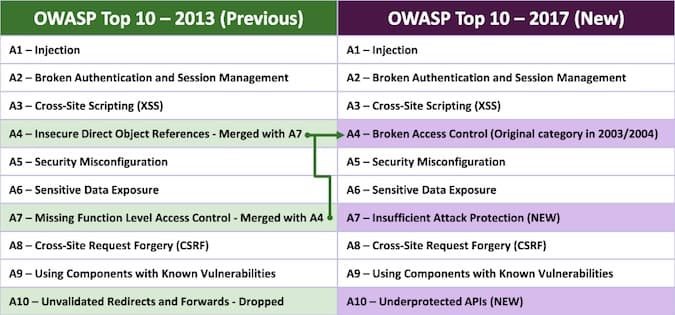
The new categories introduced for OWASP Top 10 – 2017:

  • “insufficient attack detection and prevention”
  • “unprotected APIs.”

The 2017 OWASP Top 10 misses the “unvalidated redirects and forwards,” that was the 10th item on the current list dated back 2013.

The “insufficient attack detection and prevention” results from the merger of the current 4th and 7th items, “Insecure direct object references” and the “Missing Function Level Access Control.”

The categories have been merged into the item “Broken access control” that was dated back in 2004.

2017 OWASP Top 10

Below the description provided by OWASP for the new categories:

Insufficient attack protection“: “The majority of applications and APIs lack the basic ability to detect, prevent, and respond to both manual and automated attacks. Attack protection goes far beyond basic input validation and involves automatically detecting, logging, responding, and even blocking exploit attempts. Application owners also need to be able to deploy patches quickly to protect against attacks.”

“Unprotected APIs”: “Modern applications often involve rich client applications and APIs, such as JavaScript in the browser and mobile apps, that connect to an API of some kind (SOAP/XML, REST/JSON, RPC, GWT, etc.). These APIs are often unprotected and contain numerous vulnerabilities.”

Security experts, developers, and users can submit comments on the 2017 OWASP Top 10 proposal via email until June 30 to OWASP-TopTen(at)lists.owasp.org, or dave.wichers(at)owasp.org (for private comments).

The final version of the 2017 OWASP Top 10 is expected to be released next summer.

[adrotate banner=”9″]

Pierluigi Paganini

(Security Affairs – 2017 OWASP Top 10, Application Security)

[adrotate banner=”13″]