Security Affairs
Ubiquiti Patches Critical UniFi OS Flaws Allowing Command Injection and Privilege Escalation|A Hacker Claims 35 GB of Accenture Source Code. The Company discloses the data breach|Telegram-Hosted RedWing Malware Lets Anyone Rent Android Spyware Tools|U.S. CISA adds Adobe ColdFusion, Joomlack Page Builder, Langflow, and JoomShaper SP Page Builder flaws to its Known Exploited Vulnerabilities catalog|CISA Deploys Anthropic’s Mythos AI to Hunt Vulnerabilities in U.S. Government Code|Critical Gitea Docker Bug Under Active Exploitation Exposes Repositories and Secrets|Spanish Police Arrest Man Linked to CARR, Z-Pentest, and NoName057(16)|Hidden Tenda Router Backdoor Grants Admin Access, No Patch Available|AI-Generated Malware Powers New Armored Likho APT Campaign|Januscape: 16-Year-Old Linux KVM Bug Enables Cloud VM Escape Attacks|Adobe ColdFusion flaw CVE-2026-48282 now exploited in the wild|Hidden Web Prompts Trick AI Agents Into Sending Money|Ubiquiti Patches Critical UniFi OS Flaws Allowing Command Injection and Privilege Escalation|A Hacker Claims 35 GB of Accenture Source Code. The Company discloses the data breach|Telegram-Hosted RedWing Malware Lets Anyone Rent Android Spyware Tools|U.S. CISA adds Adobe ColdFusion, Joomlack Page Builder, Langflow, and JoomShaper SP Page Builder flaws to its Known Exploited Vulnerabilities catalog|CISA Deploys Anthropic’s Mythos AI to Hunt Vulnerabilities in U.S. Government Code|Critical Gitea Docker Bug Under Active Exploitation Exposes Repositories and Secrets|Spanish Police Arrest Man Linked to CARR, Z-Pentest, and NoName057(16)|Hidden Tenda Router Backdoor Grants Admin Access, No Patch Available|AI-Generated Malware Powers New Armored Likho APT Campaign|Januscape: 16-Year-Old Linux KVM Bug Enables Cloud VM Escape Attacks|Adobe ColdFusion flaw CVE-2026-48282 now exploited in the wild|Hidden Web Prompts Trick AI Agents Into Sending Money|
Advertisement

Ad Placeholder

Full Width × 90

Breaking News

Attackers actively exploit a critical zero-day in Zyxel CPE Series devices

Experts warn that threat actors are actively exploiting critical zero-day vulnerability, tracked as CVE-2024-40891, in Zyxel CPE Series devices. GreyNoise researchers are observing active exploitation attempts targeting a zero-day, tracked as CVE-2024-40891, in Zyxel CPE Series devices. The vulnerability is a command injection issue that remains unpatched and has not yet been publicly disclosed. Attackers can exploit […]

CVE-2024-40891 Zyxel CPE Series devices.

Experts warn that threat actors are actively exploiting critical zero-day vulnerability, tracked as CVE-2024-40891, in Zyxel CPE Series devices.

GreyNoise researchers are observing active exploitation attempts targeting a zero-day, tracked as CVE-2024-40891, in Zyxel CPE Series devices.

The vulnerability is a command injection issue that remains unpatched and has not yet been publicly disclosed. Attackers can exploit this flaw to execute arbitrary commands on affected devices, potentially resulting in device takeover, data exfiltration, or network infiltration.

“CVE-2024-40891 is very similar to CVE-2024-40890 (observed authentication attemptsobserved command injection attempts), with the main difference being that the former is telnet-based while the latter is HTTP-based.” reads the advisory published by GreyNoise. “Both vulnerabilities allow unauthenticated attackers to execute arbitrary commands using service accounts (supervisor and/or zyuser).”

VulnCheck disclosed the Zyxel CPE Telnet command injection flaw CVE-2024-40891 on August 1, 2024, but the vendor has yet to publish an advisory. GreyNoise researchers collaborated with VulnCheck to verify the detection and created a tag for the issue on January 21, 2025. Due to widespread attacks, the disclosure was made immediately without vendor coordination.

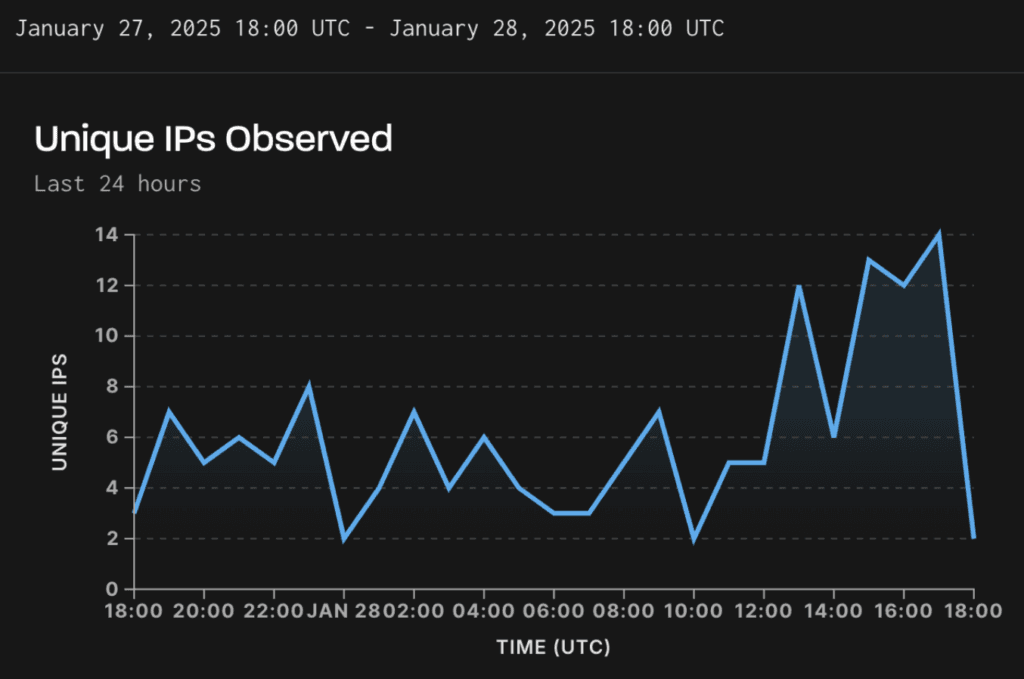
GreyNoise observed thousands of attack attempts originated from multiple IP addresses, most of them located in Taiwan. Cybersecurity firm Censys reported that more than 1,500 online devices are affected by the vulnerability.

Follow me on Twitter: @securityaffairs and Facebook and Mastodon

Pierluigi Paganini

(SecurityAffairs – hacking, CVE-2024-40891)