
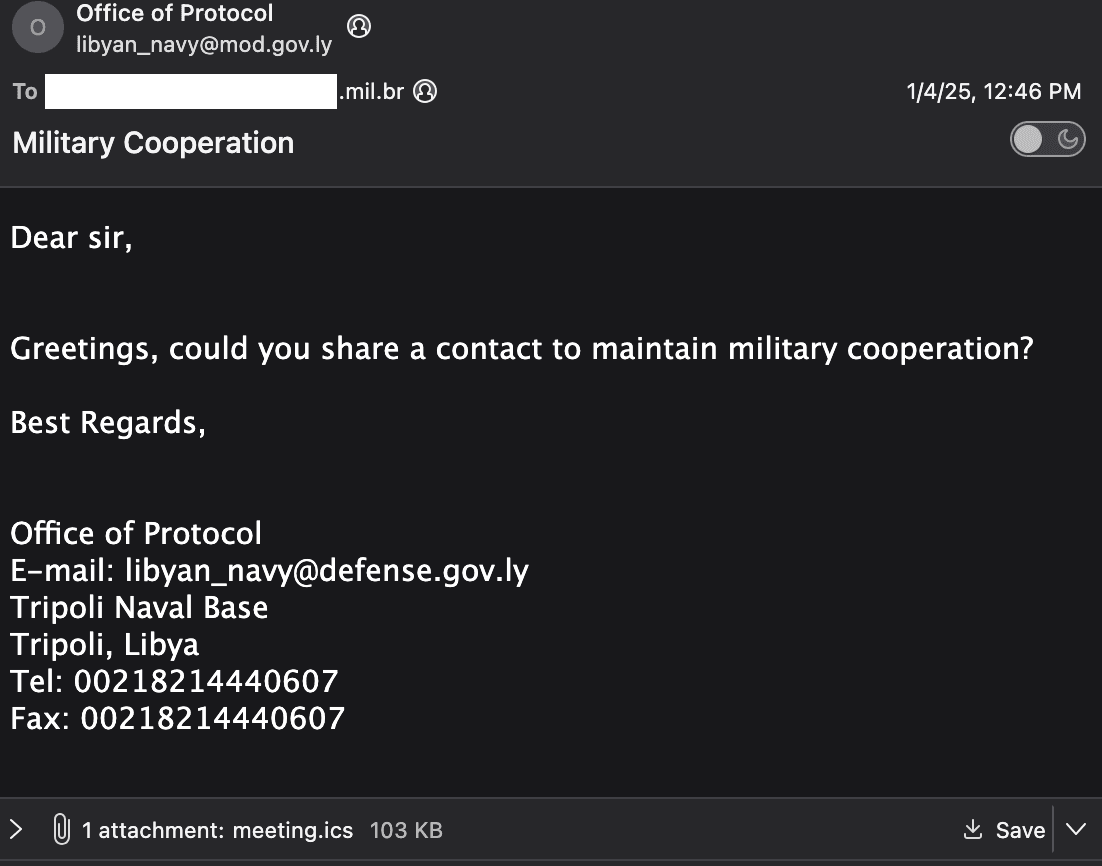
Threat actors exploited a Zimbra zero-day via malicious iCalendar (.ICS) files used to deliver attacks through calendar attachments.
StrikeReady researchers discovered that threat actors exploited the vulnerability CVE-2025-27915 in Zimbra Collaboration Suite in zero-day attacks using malicious iCalendar (.ICS) files. These files, used to share calendar data, were weaponized to deliver JavaScript payloads to targeted systems earlier this year.
CVE-2025-27915 is a stored XSS flaw in Zimbra Collaboration Suite (versions 9.0–10.1) caused by improper HTML sanitization in ICS files. When victims open an email with a malicious ICS entry, JavaScript executes via an <ontoggle> event, allowing attackers to hijack sessions, set email redirects, and exfiltrate data.
“Earlier in 2025, an apparent sender from 193.29.58.37 spoofed the Libyan Navy’s Office of Protocol to send a then-zero-day exploit in Zimbra’s Collaboration Suite, CVE-2025-27915, targeting Brazil’s military. This leveraged a malicious .ICS file, a popular calendar format.” reads the report published by StrikeReady.

The researchers discovered the attacks while analyzing ICS files larger than 10 KB that contained embedded obfuscated JavaScript.
The malicious script targets Zimbra Webmail, stealing credentials, emails, contacts, and shared folders. It exfiltrates data to ffrk.net and uses multiple evasion techniques; the malicious code delays its execution by 60 seconds, limits activity to three days, hides UI clues, and logs out inactive users to steal data. The researchers also discovered that the script runs asynchronously using multiple Invoked Function Expressions (IIFEs) functions.
Below are the functions supported by the malware:
- Injects concealed form fields to capture usernames and passwords without visible UI indicators.
- Exfiltrates credentials entered into authentication forms.
- Tracks input activity (mouse/keyboard) and, if the user goes idle, terminates the session to enable data theft.
- Queries the Zimbra SOAP API to enumerate folders and pull email messages.
- Periodically (every ~4 hours) uploads captured email content to the attacker’s server.
- Installs a mail-forwarding rule titled “Correo” that redirects messages to a ProtonMail address.
- Gathers authentication artifacts and backup tokens and sends them to the attacker.
- Extracts address books, distribution lists and items from shared folders.
- Delays its payload by 60 seconds after injection to evade quick detection.
- Restricts full activity to a three-day operational window before requiring a cooldown period.
- Obscures or removes interface elements to minimize visual signs of compromise.
- Operates asynchronously in multiple self-contained code blocks to fragment execution and complicate analysis.
StrikeReady couldn’t attribute the attack to a specific group, but pointed out that only a few well-resourced actors have the capabilities to carry out zero-day attacks. The researchers observed TTPs similar to those tied to the Belarusian APT group UNC1151.
Follow me on Twitter: @securityaffairs and Facebook and Mastodon
(SecurityAffairs – hacking, Zimbra zero-day)


