
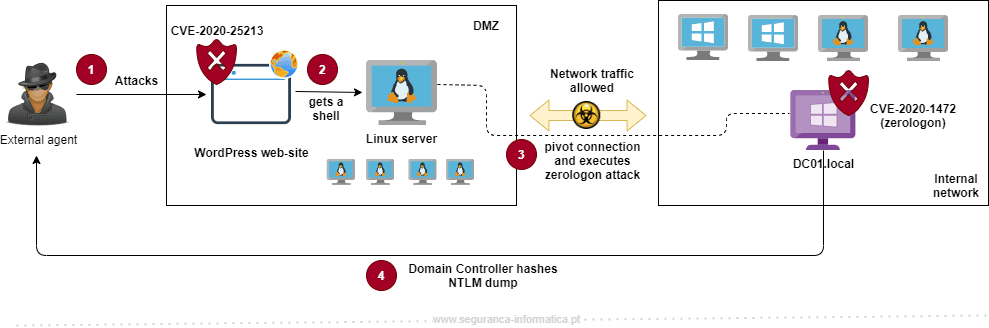
Microsoft researchers are warning that threat actors are continuing to actively exploit the ZeroLogon vulnerability in attacks in the wild.
Microsoft is warning that threat actors are actively exploiting the ZeroLogon vulnerability in the Netlogon Remote Protocol.
The CVE-2020-1472 flaw is an elevation of privilege that resides in the Netlogon. The Netlogon service is an Authentication Mechanism used in the Windows Client Authentication Architecture which verifies logon requests, and it registers, authenticates, and locates Domain Controllers.
An attacker could exploit the vulnerability to impersonate any computer, including the domain controller itself, and execute remote procedure calls on their behalf.
An attacker could also exploit the flaw to disable security features in the Netlogon authentication process and change a computer’s password on the domain controller’s Active Directory.
“Microsoft has received a small number of reports from customers and others about continued activity exploiting a vulnerability affecting the Netlogon protocol (CVE-2020-1472) which was previously addressed in security updates starting on August 11, 2020.” reads a post published by MSRC VP of Engineering Aanchal Gupta. “If the original guidance is not applied, the vulnerability could allow an attacker to spoof a domain controller account that could be used to steal domain credentials and take over the domain.”
Microsoft strongly encourages administrators of enterprise Windows Servers to install the August 2020 Patch Tuesday as soon as possible to protect their systems from Zerologon attack that exploits the CVE-2020-1472.
Because the initial documentation regarding Zerologon patching process was not clear enough, Microsoft provided the following updates:
- UPDATE your Domain Controllers with an update released August 11, 2020 or later.
- FIND which devices are making vulnerable connections by monitoring event logs.
- ADDRESS non-compliant devices making vulnerable connections.
- ENABLE enforcement mode to address CVE-2020-1472 in your environment.
At the end of September, Microsoft issued a similar warning. The IT giant published a series of Tweets to warn of attackers that are actively exploiting the Windows Server Zerologon in attacks in the wild. The IT giant urged Windows administrators to install the released security updates as soon as possible.
In early October, Microsoft spotted a series of Zerologon attacks allegedly launched by the Russian cybercrime group tracked as TA505, CHIMBORAZO and Evil Corp.
Microsoft experts spotted the Zerologon attacks involving fake software updates, the researchers noticed that the malicious code connected to command and control (C&C) infrastructure known to be associated with TA505.
In the same period, Microsoft published a post and a series of tweets to warn of cyber attacks exploiting the Zerologon vulnerability carried out by the Iran-linked APT group known as MuddyWater, aka Mercury.
On September 18, The Department of Homeland Security’s CISA issued an emergency directive to order government agencies to address the Zerologon vulnerability (CVE-2020-1472) by September 21.
| [adrotate banner=”9″] | [adrotate banner=”12″] |
(SecurityAffairs – hacking, Windows)
[adrotate banner=”5″]
[adrotate banner=”13″]


