
Mysterious hackers ingenuously reveal two zero-days to the security community, experts collaborated to promptly fix them.
Anton Cherepanov, security expert form ESET researcher, discovered two zero-days while analyzing a malicious PDF, according to the researcher the mysterious hacker(s) were still working on the exploits.
The malicious PDF was discovered late in March 2018 (Two suspicious PDF samples zero-day 1, zero-day 2), the analysis of the document revealed it was exploiting two previously unknown vulnerabilities, a remote-code execution vulnerability in Adobe Reader and a Windows privilege escalation flaw.
“The use of the combined vulnerabilities is extremely powerful, as it allows an attacker to execute arbitrary code with the highest possible privileges on the vulnerable target, and with only the most minimal of user interaction. APT groups regularly use such combinations to perform their attacks, such as in the Sednit campaign from last year.” reads the analysis published by ESET.
“The sample does not contain a final payload, which may suggest that it was caught during its early development stages,” Cherepanov said.
ESET shared its discovery with the Microsoft Security Response Center, Windows Defender ATP research team, and Adobe Product Security Incident Response Team as they fixed these bugs.
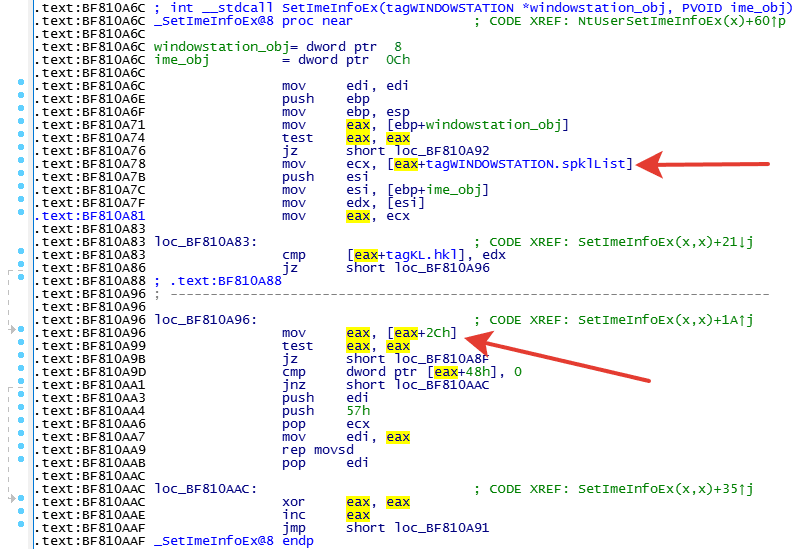
The two zero-days were tracked as CVE-2018-4990, that affected Adobe Acrobat/Reader PDF viewer, and as CVE-2018-8120 that affected the Win32k component of Windows.
By chaining the two vulnerabilities it was possible to escape the Adobe’s sandbox protection and execute arbitrary code inside Adobe Acrobat/Reader.
“The malicious PDF sample embeds JavaScript code that controls the whole exploitation process. Once the PDF file is opened, the JavaScript code is executed,” states the report published by ESET.
Below the steps composing the attack chain:
- The victim receives and opens a weaponized PDF file
- Once the user opened the PDF, a malicious JavaScript code will execute.
- JavaScript code manipulates a button object
- The Button object contains a specially-crafted JPEG2000 image, triggers a double-free vulnerability in Adobe Acrobat/Reader.
- JavaScript code uses heap-spray techniques to obtain read and write memory access
- JavaScript code then interacts with Adobe Reader’s JavaScript engine
- The attacker uses the engine’s native assembly instructions (ROP gadgets) to execute its own native shellcode.
- Shellcode initializes a PE file embedded in the PDF
- Once the attacker has exploited the Adobe Reader vulnerability, he will leverage the Window zero-day flaw to escape the sandbox. The Microsoft Win32k zero-day allows the attacker to elevate the privilege of the PE file to run, which is run in kernel mode, escaping the Adobe Acrobat/Reader sandbox and gaining system-level access.
Even if the chain of the zero-days could be very dangerous, the developers allowed the security community to detect them by uploading it to a known virus scanning engine aiming to test its evasion capability.

| [adrotate banner=”9″] | [adrotate banner=”12″] |
(Security Affairs – zero-days, hacking)
[adrotate banner=”5″]
[adrotate banner=”13″]


