
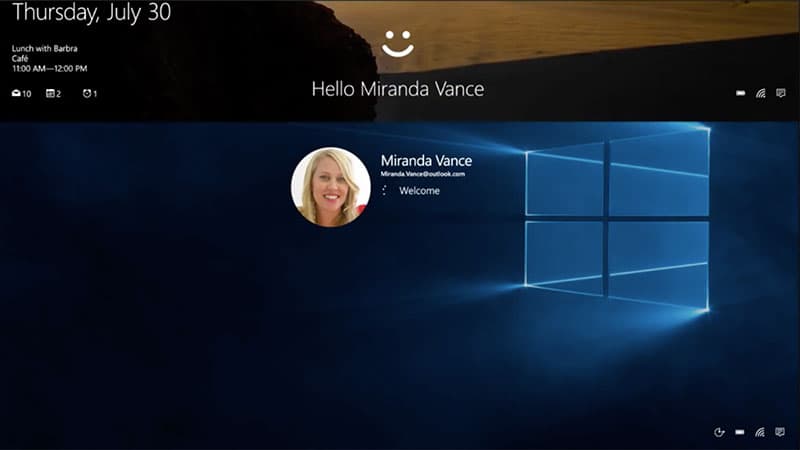
Experts discovered that the Windows 10 facial recognition security feature Hello can be spoofed using a photo of an authorized user.
Security experts at pen-test firm Syss have discovered that the Windows 10 facial recognition security feature dubbed Hello can be spoofed in the simplest way, using a photo of an authorized user.
“Microsoft face authentication in Windows 10 is an enterprise-grade identity verification mechanism that’s integrated into the Windows Biometric Framework (WBF) as a core Microsoft Windows component called Windows Hello. Windows Hello face authentication utilizes a camera specially configured for near infrared (IR) imaging to authenticate and unlock Windows devices as well as unlock your Microsoft Passport.”
The bad news for the users is that even if they have installed the fixed versions shipped in October (builds 1703 or 1709) the technique is effective. In this scenario, users need to set up the facial recognition from scratch to make it resistant to the attack.
“Due to an insecure implementation of the biometric face recognition in some Windows 10 versions, it is possible to bypass the Windows Hello face authentication via a simple spoofing attack using a modified printed photo of an authorized person.” states the security advisory published on Full Disclosure.
The attack devised by the researchers works on both the default config, and Windows Hello with its “enhanced anti-spoofing” feature enabled.
“Thus, by having access to a suitable photo of an authorized person (frontal face photo), Windows Hello face authentication can easily be bypassed with little effort, enabling unauthorized access to the Windows system.” reads the
“Both, the default Windows Hello configuration and Windows Hello with the enabled “enhanced anti-spoofing” feature on different Windows 10 versions are vulnerable to the described spoofing attack and can be bypassed. If “enhanced anti-spoofing” is enabled, depending on the targeted Windows 10 version, a slightly different modified photo with other attributes has to be used, but the additional effort for an attacker is negligible. In general, the simple spoofing attack is less reliable when the “enhanced anti-spoofing” feature is enabled.”

The Proof of Concept (PoC) detailed by the researchers worked against a Dell Latitude running Windows 10 Pro, build 1703; and a Microsoft Surface Pro running 4 build 1607.
The experts tried to use the “enhanced anti-spoofing” feature on Surface Pro’s , but claimed its “LilBit USB IR camera only supported the default configuration and could not be used with the more secure face recognition settings.”
They successfully bypassed the default Windows Hello configuration on both test devices running all tested Windows 10 versions.
Below the proof-of-concept videos published by the researchers.:
| [adrotate banner=”9″] | [adrotate banner=”12″] |
(Security Affairs – Windows 10 Hello, facial recognition)
[adrotate banner=”5″]
[adrotate banner=”13″]


