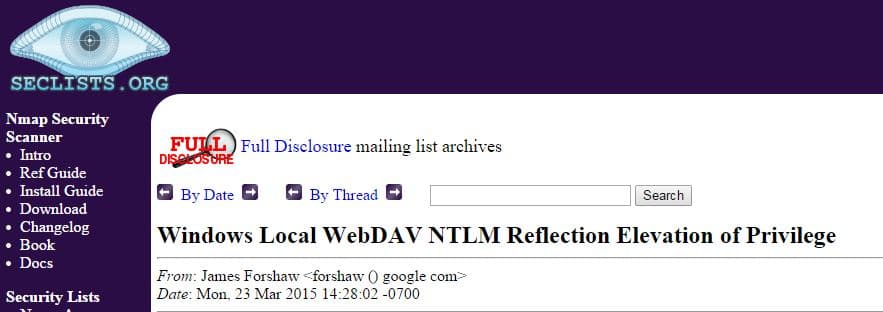
Experts of the Project Zero have disclosed a proof-of-concept for the exploitation of a default setting in Windows 7, 8.1 that allow privilege escalation.
A new security issue threatens users of Windows 7 and 8.1, this time experts are warning about a default setting in both OSs that could allow local users to elevate privileges and in some situations, escape application sandboxes.
The security issue has been discovered by James Forshaw, a researcher at Google Project Zero, which explained that the problem resides in the way the Windows operating system handles authentication. All Windows client installations are potentially vulnerable, the expert explained that it could be possible for a user to run a reflection attack in NT LAN Manager and execute the attack.
The NTLM reflection is a security issue well known to the community of Windows experts, attackers typically abuse in networked scenarios to reflect credentials from one machine to another. Microsoft has already mitigated the issue in MS08-068.

The fix disallowed NTLM sessions in flight, but doesn’t solve cross-protocol attacks like the one conducted by the experts of the Project Zero team.
The security issue was discovered last year, Forshaw reported it to Microsoft on Dec. 18 and according its disclosure policy (90 days), Google security team also published a proof of concept for the exploitation of the flaw.
“It’s possible to abuse cross-protocol NTLM reflection to attack the local SMB server by forcing a local system process to access a WebDAV UNC path. The NTLM authentication can then be reflected locally authenticating to the Server service as NT AUTHORITY\SYSTEM. From this it’s possible to elevate privileges by writing files to the admin shares or connecting to the service manager named pipe. ” wrote James Forshaw in a security advisory.
The real problem is that Microsoft doesn’t recognize the privilege escalation issue as a security flaw because is already offers mitigations for it, like Extended Protection for Authentication. Microsoft informed Forshaw that that it is necessary to apply the mitigations to avoid “application compatibility concerns.”
Forshaw explained that users can disable their Webclient service, but that this wouldn’t prevent attacks like sandbox escapes.
Users must apply a set of precautions in order to secure their systems as explained in the advisory:
“By default all Windows client installations are vulnerable. Even though the WebClient service is not started by default it’s possible to start it using service triggers. The recommended fixes for this issue are: * Enable SMB signing, or, * Enable SMB Server SPN verification Please see the following references for more information on the issue and how to configure the mitigations. Security Advisory: https://technet.microsoft.com/library/security/973811.” states the Full Disclosure advisory.
(Security Affairs – Windows, privilege escalation)