
U.S. CISA adds a Microsoft SharePoint Server flaw to its Known Exploited Vulnerabilities catalog|430,000 FortiGate Devices Exposed in FortiBleed Ransomware Link|Adobe fixed multiple maximum-severity flaws in ColdFusion and Campaign Classic|Alleged Scattered Spider Hacker Extradited to U.S. to Face Cybercrime Charges|Oracle E-Business Suite Flaw Under Active Attack, 950 Systems Exposed|Azure CLI Targeted in LSHIY Password Spray Campaign Across 64 Orgs|CISA Warns BlueHammer Flaw Is Now Exploited in Ransomware Attacks|RustDuck: The Botnet That’s Still Small but Engineering Like It Plans to Grow|GuardFall Flaw Hits 10 of 11 Popular Open-Source AI Agents|XSS.is, The Forum That Ran the Ransomware Supply Chain Is Down. The Market Isn’t|U.S. CISA adds SimpleHelp flaw to its Known Exploited Vulnerabilities catalog|Hackers Steal Data of 4.38 Million Aflac Japan Customers|U.S. CISA adds a Microsoft SharePoint Server flaw to its Known Exploited Vulnerabilities catalog|430,000 FortiGate Devices Exposed in FortiBleed Ransomware Link|Adobe fixed multiple maximum-severity flaws in ColdFusion and Campaign Classic|Alleged Scattered Spider Hacker Extradited to U.S. to Face Cybercrime Charges|Oracle E-Business Suite Flaw Under Active Attack, 950 Systems Exposed|Azure CLI Targeted in LSHIY Password Spray Campaign Across 64 Orgs|CISA Warns BlueHammer Flaw Is Now Exploited in Ransomware Attacks|RustDuck: The Botnet That’s Still Small but Engineering Like It Plans to Grow|GuardFall Flaw Hits 10 of 11 Popular Open-Source AI Agents|XSS.is, The Forum That Ran the Ransomware Supply Chain Is Down. The Market Isn’t|U.S. CISA adds SimpleHelp flaw to its Known Exploited Vulnerabilities catalog|Hackers Steal Data of 4.38 Million Aflac Japan Customers|
Advertisement

Ad Placeholder

Full Width × 90

Breaking News

Emails among dumps published by Wikileaks includes 300+ malware

A malware researcher has analyzed the attachments of in the WikiLeaks email dumps and discovered more than 300 pieces of malware. WikiLeaks has published more than 300 pieces of malicious code among its caches of dumped emails. Dr Vesselin Bontchev (@bontchev), a top Bulgarian malware researcher, has analyzed documents published by the organization and detected […]

Emails among dumps published by Wikileaks includes 300+ malware

A malware researcher has analyzed the attachments of in the WikiLeaks email dumps and discovered more than 300 pieces of malware.

WikiLeaks has published more than 300 pieces of malicious code among its caches of dumped emails. Dr Vesselin Bontchev (@bontchev), a top Bulgarian malware researcher, has analyzed documents published by the organization and detected 324 instances of malware in its archive of dumped emails.

A check to the instance of malware allowed the malware expert to discover that the almost any instance appears to be an attachment of the dumped email.

The malicious codes are recognized by the Virus Total malware and URL online scanning service, they were likely sent by attackers to the recipients in the attempt to hack them.

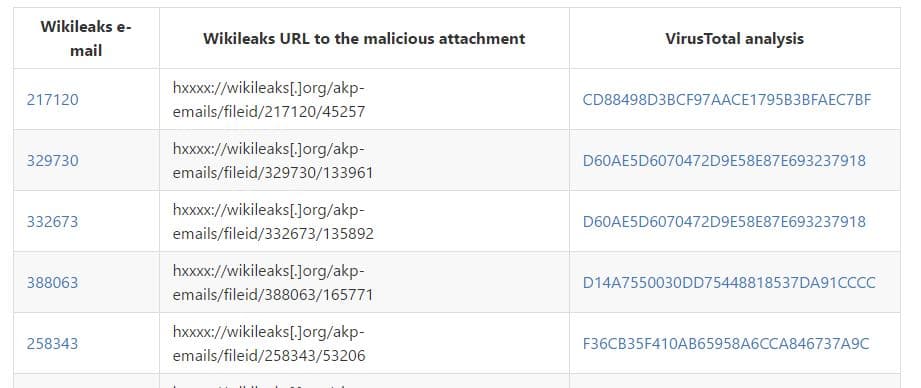
“The following table contains the confirmed malware residing on the Wikileaks site. The list is by no means exhaustive; I am just starting with the analysis. But what is listed below is definitely malware; no doubts about it.” wrote Dr Bontchev on GitHub.

“The first column contains a link to the e-mail on the Wikileaks site that contains the malicious attachment. The e-mail itself is safe to view (although the text is usually spam/scam/phish/whatever).”

wikileaks email malware

The situation may be worse because the piece of malware found by the Bulgarian researchers were identified in an initial search effort.

If you want to test the malware adopt all the necessary countermeasures to avoid infecting your machine.

Fortunately, the piece of malware are well known to the principal antivirus solutions, according to the malware researcher, the majority of the malicious codes have a Virus Total detection rate from 80 to 100 percent.

Anyway … be careful managing email attachments from Wikileaks archives.

[adrotate banner=”9″]

Pierluigi Paganini

(Security Affairs –  Wikileaks, malware)


