
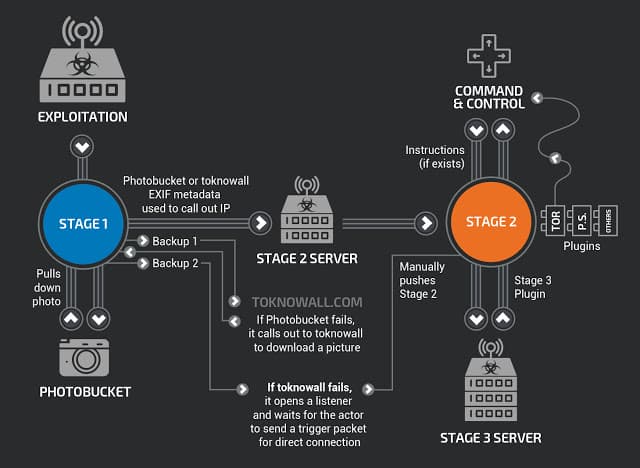
Security firm Talos along with other cybersecurity firms and law enforcement agencies have uncovered a huge botnet dubbed VPNFilter, composed of more than 500,000 compromised routers and network-attached storage (NAS) devices.
The experts believe the VPNFilter was developed by Russia and the associated malware appears to be very sophisticated, at the time they discovered more than 500,000 compromised devices across 54 countries.
“For several months, Talos has been working with public- and private-sector threat intelligence partners and law enforcement in researching an advanced, likely state-sponsored or state-affiliated actor’s widespread use of a sophisticated modular malware system we call ‘VPNFilter.'” reads the blog post published by Talos.
“We have not completed our research, but recent events have convinced us that the correct way forward is to now share our findings so that affected parties can take the appropriate action to defend themselves.”
Even if the experts are still investigating the botnet, they decided to publish an initial report fearing an imminent massive attack powered by VPNFilter.
Researchers believe the nation-state malware was developed by the same author of the BlackEnergy malware.
Many infected devices have been discovered in Ukraine and their number in the country continues to increase. On May 8, Talos researchers observed a spike in VPNFilter infection activity, most infections in Ukraine and the majority of compromised devices contacted a separate stage 2 C2 infrastructure at the IP 46.151.209[.]33.
The experts discovered the VPNFilter malware has infected devices manufactured by Linksys, MikroTik, Netgear, QNAP, and TP-Link.
At the time of writing, the experts haven’t yet identified the attack vector.
VPNFilter is a multi-stage, modular strain of malware that has a wide range of capabilities for both cyber espionage and sabotage purpose.
“As of this writing, we are aware of two plugin modules: a packet sniffer for collecting traffic that passes through the device, including theft of website credentials and monitoring of Modbus SCADA protocols, and a communications module that allows stage 2 to communicate over Tor.” continues the report.
“We assess with high confidence that several other plugin modules exist, but we have yet to discover them.”

Experts are particularly concerned by the destructive features implemented by the malware that could allow attackers to burn users’ devices to cover up their tracks.
Experts believe that the attack could be launched by threat actors during the Ukrainian celebration of the Constitution Day, last year the NotPetya wiper attack was launched on the same period.
“VPNFilter is an expansive, robust, highly capable, and dangerous threat that targets devices that are challenging to defend. Its highly modular framework allows for rapid changes to the actor’s operational infrastructure, serving their goals of misattribution, intelligence collection, and finding a platform to conduct attacks,” Talos concluded.
| [adrotate banner=”9″] | [adrotate banner=”12″] |
(Security Affairs – VPNFilter malware, state-sponsered hacking)
[adrotate banner=”5″]
[adrotate banner=”13″]


