
A team of researchers from the University of Michigan and Zhejiang University has devised a method to cause physical damage to hard drives by using sonic and ultrasonic signals.
An attacker just needs to play ultrasonic sounds through a built-in speaker of a target computer or by using a speaker in its proximity.
The principle is simple, the technique leverages specially crafted acoustic signals to cause significant vibrations in the HDDs components that could cause severe damage.
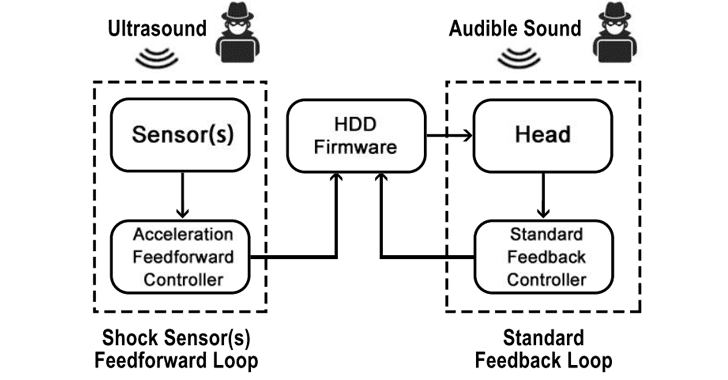
Modern HDDs use shock sensors to prevent the head crash, but the team of researchers has demonstrated that sonic and ultrasonic sounds could cause false positives in the shock sensor, causing a drive to park the head in a wrong position.
“We created and modeled a new feedback controller that could be deployed as a firmware update to attenuate the intentional acoustic interference. Our sensor fusion method prevents unnecessary head parking by detecting ultrasonic triggering
of the shock sensor” reads the paper published by the experts.

The experts have demonstrated how to use the technique in a real-world attacks targeting HDDs in desktop computers and CCTV (Closed-Circuit Television) systems.
These attackers just need to trick victims into playing a malicious sound attached to an email or triggered visiting a specially crafted web page.
“Our case studies show that an attacker can use the effects from hard disk drive vulnerabilities to launch system level consequences such as crashing Windows on a laptop using the built-in speaker and preventing surveillance systems from recording video. We delve into the details of the Windows and Linux operating systems to uncover the root causes of the crash in the I/O request stack” continues the experts.
The experts tested the technique against various HDD from several vendors, including Seagate, Toshiba, and Western Digital. The discovery was interesting, the ultrasonic waves took just 5-8 seconds to cause severe interferences.

Sound interferences with a duration greater than 105 seconds caused the Western Digital HDD in the video-surveillance device to stop recording from the beginning of the vibration until the device was restarted.
“Recordings from periods of interference less than 105 seconds exhibited video loss from about 12 seconds after being subjected to acoustic induced vibration until the
vibration subsided. In contrast, (2) interference for periods of 105 seconds or longer resulted in video loss from the beginning of the vibration until the device was restarted.” continues the paper.
“In the case that a victim user is not physically near the system being attacked, an adversary can use any frequency to attack the system. The system’s live camera stream never displays an indication of an attack. Also, the system does not provide any method to learn of audio in the environment. Thus, if a victim user were not physically near the system, an adversary can use audible signals while remaining undetected.”
The tests demonstrated that an attacker can disrupt HDDs in desktops and laptops running both Windows and Linux operating system.
The experts were able to cause a Dell XPS 15 9550 laptops to freeze in 45 seconds and crash when the laptop was tricked to play malicious audio over its built-in speaker in 125 seconds.
The paper also includes recommendations to detect or prevent such type of attacks, including a new feedback controller to attenuate the acoustic interference that could be deployed as a firmware update.
Another countermeasure against attacks leveraging sonic and ultrasonic signals could be a sensor fusion method to prevent unnecessary head parking by detecting ultrasonic triggering of the shock sensor.
The last solution is represented by noise dampening materials to attenuate the signal.
| [adrotate banner=”9″] | [adrotate banner=”12″] |
(Security Affairs – ultrasonic signals, hacking)
[adrotate banner=”5″]
[adrotate banner=”13″]


