
U.S. CISA adds a Microsoft SharePoint Server flaw to its Known Exploited Vulnerabilities catalog|430,000 FortiGate Devices Exposed in FortiBleed Ransomware Link|Adobe fixed multiple maximum-severity flaws in ColdFusion and Campaign Classic|Alleged Scattered Spider Hacker Extradited to U.S. to Face Cybercrime Charges|Oracle E-Business Suite Flaw Under Active Attack, 950 Systems Exposed|Azure CLI Targeted in LSHIY Password Spray Campaign Across 64 Orgs|CISA Warns BlueHammer Flaw Is Now Exploited in Ransomware Attacks|RustDuck: The Botnet That’s Still Small but Engineering Like It Plans to Grow|GuardFall Flaw Hits 10 of 11 Popular Open-Source AI Agents|XSS.is, The Forum That Ran the Ransomware Supply Chain Is Down. The Market Isn’t|U.S. CISA adds SimpleHelp flaw to its Known Exploited Vulnerabilities catalog|Hackers Steal Data of 4.38 Million Aflac Japan Customers|U.S. CISA adds a Microsoft SharePoint Server flaw to its Known Exploited Vulnerabilities catalog|430,000 FortiGate Devices Exposed in FortiBleed Ransomware Link|Adobe fixed multiple maximum-severity flaws in ColdFusion and Campaign Classic|Alleged Scattered Spider Hacker Extradited to U.S. to Face Cybercrime Charges|Oracle E-Business Suite Flaw Under Active Attack, 950 Systems Exposed|Azure CLI Targeted in LSHIY Password Spray Campaign Across 64 Orgs|CISA Warns BlueHammer Flaw Is Now Exploited in Ransomware Attacks|RustDuck: The Botnet That’s Still Small but Engineering Like It Plans to Grow|GuardFall Flaw Hits 10 of 11 Popular Open-Source AI Agents|XSS.is, The Forum That Ran the Ransomware Supply Chain Is Down. The Market Isn’t|U.S. CISA adds SimpleHelp flaw to its Known Exploited Vulnerabilities catalog|Hackers Steal Data of 4.38 Million Aflac Japan Customers|
Advertisement

Ad Placeholder

Full Width × 90

Breaking News

Expert warns of Turtle macOS ransomware

The popular cybersecurity researcher Patrick Wardle dissected the new macOS ransomware Turtle used to target Apple devices. The popular cyber security researcher Patrick Wardle published a detailed analysis of the new macOS ransomware Turtle. Wardle pointed out that since Turtle was uploaded on Virus Total, it was labeled as malicious by 24 anti-malware solutions, suggesting […]

TurtleRansom

The popular cybersecurity researcher Patrick Wardle dissected the new macOS ransomware Turtle used to target Apple devices.

The popular cyber security researcher Patrick Wardle published a detailed analysis of the new macOS ransomware Turtle.

Wardle pointed out that since Turtle was uploaded on Virus Total, it was labeled as malicious by 24 anti-malware solutions, suggesting it is not a sophisticated threat. However, the malicious code was generally detected as “Other:Malware-gen”, “Trojan.Generic”, or “Possible Threat”. In some cases, the anti-virus solution flagged the binary as Windows malware (“Win32.Troj.Undef”).

The experts speculate the malware was first developed for Windows, then ported to macOS.

Only one AV engine detects the malicious code as “Ransom.Turtle” due to the internal name of the malware.

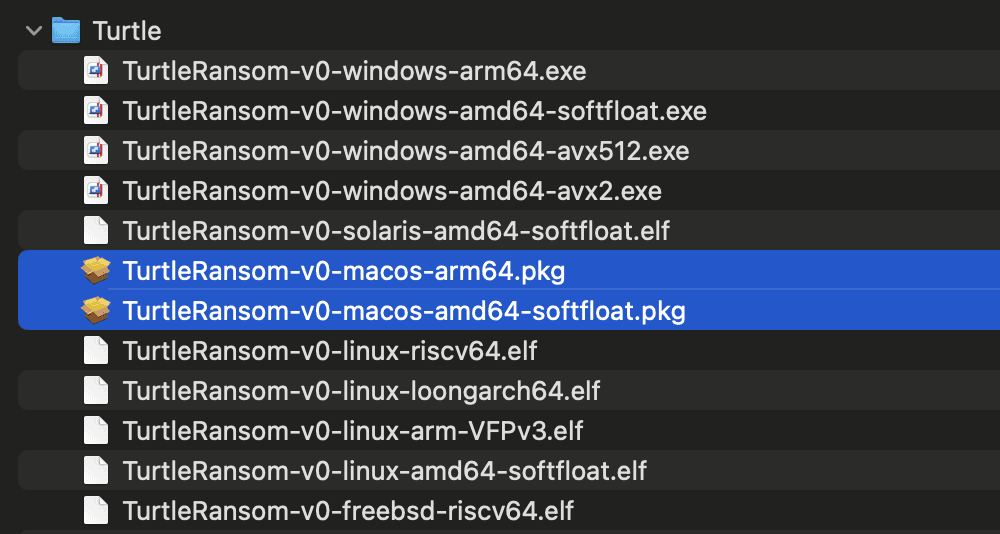
“If we download the archive and unzip it, we find it contains files (prefixed with “TurtleRansom”) that appear to be compiled for common platforms, including, Windows, Linux, and yes, macOS” reads the analysis published by Wardle.

The malicious code is only signed adhoc and Gatekeeper should block it, explains Wardle. The binary also lacks of obfuscation.

The Turtle ransomware reads files into memory, encrypt them with AES (in CTR mode), rename the files, then overwrites the original contents of the files with the encrypted data. The malware adds the extension “TURTLERANSv0” to the filenames of encrypted files.

The malware is not sophisticated, however the discovery of a macOS version for the Turtle ransomware suggests it is becoming popular in the cybercrime underground.

Wardle discovered various strings in Chinese, some of these strings are related to ransomware operations, such as “加密文件” which translate to “Encrypt files”. However the presence of these strings is not enough to attribute the malware to a specific threat actor.

“Today we dove into a new ransomware sample, internally dubbed “Turtle”. And while in its current state it does not post much of a threat to macOS users, it yet again, shows that ransomware authors continue to set their sites on macOS.” concludes the analysis.

Follow me on Twitter: @securityaffairs and Facebook and Mastodon

Pierluigi Paganini

(SecurityAffairs – hacking, TurtleRansom)


