
Security experts devised a new attack technique dubbed Throwhammer that could be exploited by attackers to launch Rowhammer attack on a system in a LAN.
A few days ago we discussed the GLitch attack that leverages graphics processing units (GPUs) to launch a remote Rowhammer attack against Android smartphones.
Now security experts devised a new attack technique dubbed Throwhammer that could be exploited by attackers to launch Rowhammer attack on a system just by sending specially crafted packets to the vulnerable network cards over the local area network.
Rowhammer is classified as a problem affecting some recent DRAM devices in which repeatedly accessing a row of memory can cause bit flips in adjacent rows, this means that theoretically, an attacker can change any value of the bit in the memory.
The issue has been known at least since 2012, the first attack was demonstrated in 2015 by white hat hackers at Google Project Zero team.
In October 2016, a team of researchers in the VUSec Lab at Vrije Universiteit Amsterdam devised a new method of attack based on Rowhammer, dubbed DRAMMER attack, that could be exploited to gain ‘root’ access to millions of Android smartphones and take control of affected devices.
The new technique was devised by the same team of researchers that proposed the previous ones, a group of experts from the Vrije Universiteit Amsterdam and the University of Cyprus.
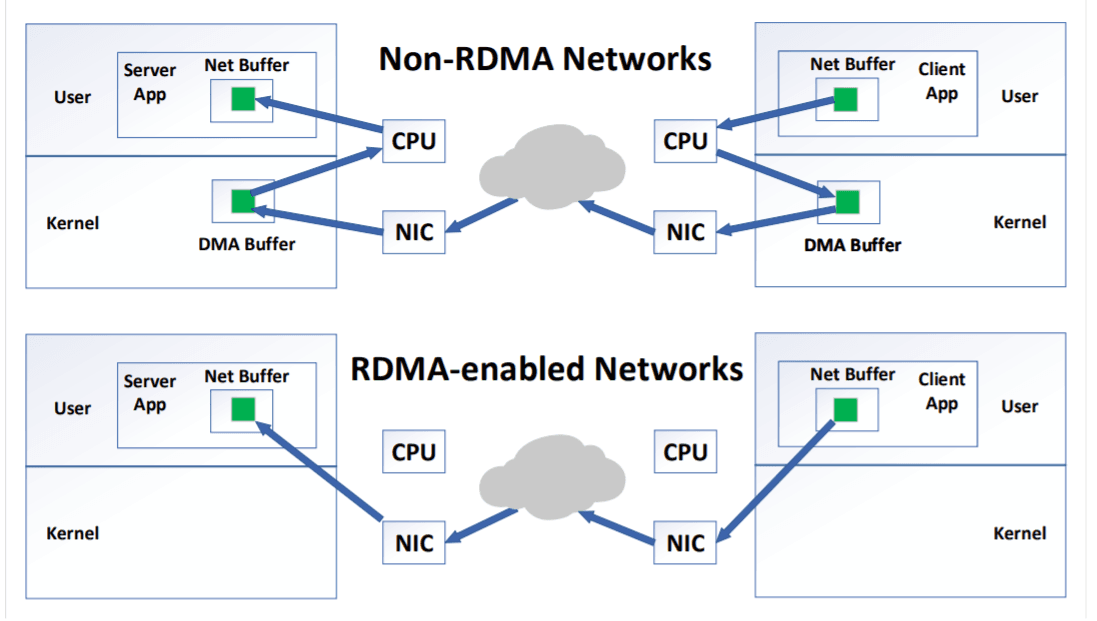
This time the researchers demonstrated that sending malicious packets over LAN it is possible to implement a Rowhammer attack on systems running Ethernet network cards equipped with Remote Direct Memory Access (RDMA). Such kind of configuration is widely adopted in cloud infrastructure and data centers.

The RDMA feature is used by network cards to allow computers in a network to exchange data (with read and write privileges) directly to the main memory. The researchers demonstrated that it is possible to abuse this feature to perform access to the target memory in rapid succession triggering bit flips on DRAM.
Researchers explained that the Throwhammer attack requires a high-speed network of at least 10Gbps to trigger a bit flip through hundreds of thousands of memory accesses to specific DRAM locations within tens of milliseconds.
“Specifically, we managed to flip bits remotely using a commodity 10 Gbps network. We rely on the commonly-deployed RDMA technology in clouds and data centers for reading from remote DMA buffers quickly to cause Rowhammer corruptions outside these untrusted buffers.” reads the research paper published by the experts.
“These corruptions allow us to compromise a remote memcached server without relying on any software bug”
According to the paper, the experts were able to observe bit flips accessing memory 560,000 times in 64 ms (roughly 9 million accesses per second) over LAN to its RDMA-enabled network card.
“Even regular 10 Gbps Ethernet cards can easily send 9 million packets per second to a remote host that end up being stored on the host’s memory.” continues the paper.
“Might this be enough for an attacker to effect a Rowhammer attack from across the network? In the remainder of this paper, we demonstrate that this is the case and attackers can use these bit flips induced by network traffic to compromise a remote server application.”
Let me remind you that the Rowhammer technique exploits a computer hardware weakness, this means that it is not possible to use software patch to mitigate it.
Experts explained that disable RDMA to mitigate the attack is effective but nor not realistic, therefore, they presented some solutions such as ALIS, a custom allocator that isolates a vulnerable RDMA buffer.
Technical details for the Throwhammer attack are available in the paper published by the experts and titled “Throwhammer: Rowhammer Attacks over the Network and Defenses.”
| [adrotate banner=”9″] | [adrotate banner=”12″] |
(Security Affairs – ski lift, hacking)
[adrotate banner=”5″]
[adrotate banner=”13″]


