A huge botnet dubbed Stantinko was undetected for at least 5 years, the disconcerting discovery was made by researchers from security firm ESET.
According to ESET, the Stantinko botnet has infected around half a million computers worldwide. Operators behind the botnet powered a massive adware campaign active since 2012, crooks mainly targeted users in Russia and Ukraine searching for pirated software.
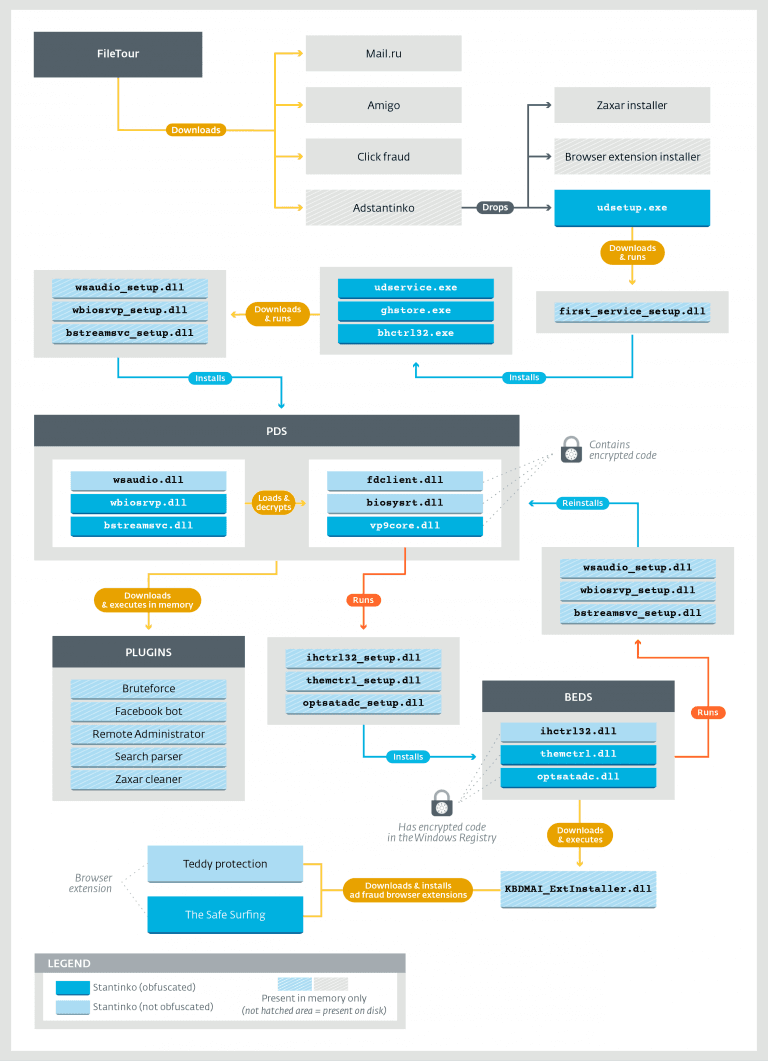
The researchers discovered that the attack vector used by the cyber criminals is an app called FileTour, it is used to install a variety of programs on the victim’s machine, while also launching Stantinko in the background.
“Making heavy use of code encryption and rapidly adapting so as to avoid detection by anti-malware, Stantinko’s operators managed to stay under the radar for at least the last five years, attracting very little attention to their operations.” states the analysis published by ESET.
The botnet is mainly used to install on the infected systems browser extensions that are used to inject ad and perform click fraud.
The malicious browser extensions installed by the Stantinko malware are called The Safe Surfing and Teddy Protection. Both extensions distributed through the Chrome Web Store are used to block unwanted URLs. The botnet installs its versions of both browser extensions that are able to receive a configuration to perform click fraud and ad injection.
The researchers also noticed that the Stantinko malware could be used take full control of the target systems, it leverages on services that allow attackers conduct several malicious activities (i.e. performing massive searches on Google, performing brute-force attacks on Joomla and WordPress installs).
The malware installs two specific Windows services after compromise, each of them is able to reinstall the other if deleted. This means that in order to sanitize the system it is necessary to remove both services at the same time.

The Stantinko malware is a modular backdoor, its components embed a loader allowing them to execute any Windows executable sent by the C&C server directly in memory.
“This feature is used as a very flexible plugin system allowing the operators to execute anything on an infected system. Table 1 is a description of known Stantinko plugins.
| Module Name | Analysis |
|---|---|
| Brute-force | Distributed dictionary-based attack on Joomla and WordPress administrative panels. |
| Search Parser | Performs massive distributed and anonymous searches on Google to find Joomla and WordPress websites. It uses compromised Joomla websites as C&C servers. |
| Remote Administrator | Backdoor that implements a full-range of actions from reconnaissance to data exfiltration. |
| Facebook Bot | Bot performing fraud on Facebook. Its capabilities include creating accounts, liking picture or pages, and adding friends. |
Experts speculate that crooks work close to the advertisers that pay for the traffic they receive from the botnet.
“On the other hand, traditional click-fraud malware relies on a series of redirections between several ad networks to launder their malicious traffic. This shows that not only are the Stantinko operators able to develop highly stealthy malware, but they are also able to abuse the traditional ad-serving economy without getting caught,” ESET points out.
[adrotate banner=”9″]
(Security Affairs – Stantinko botnet, cybercrime)
[adrotate banner=”13″]