

U.S. CISA adds a Microsoft SharePoint Server flaw to its Known Exploited Vulnerabilities catalog|430,000 FortiGate Devices Exposed in FortiBleed Ransomware Link|Adobe fixed multiple maximum-severity flaws in ColdFusion and Campaign Classic|Alleged Scattered Spider Hacker Extradited to U.S. to Face Cybercrime Charges|Oracle E-Business Suite Flaw Under Active Attack, 950 Systems Exposed|Azure CLI Targeted in LSHIY Password Spray Campaign Across 64 Orgs|CISA Warns BlueHammer Flaw Is Now Exploited in Ransomware Attacks|RustDuck: The Botnet That’s Still Small but Engineering Like It Plans to Grow|GuardFall Flaw Hits 10 of 11 Popular Open-Source AI Agents|XSS.is, The Forum That Ran the Ransomware Supply Chain Is Down. The Market Isn’t|U.S. CISA adds SimpleHelp flaw to its Known Exploited Vulnerabilities catalog|Hackers Steal Data of 4.38 Million Aflac Japan Customers|U.S. CISA adds a Microsoft SharePoint Server flaw to its Known Exploited Vulnerabilities catalog|430,000 FortiGate Devices Exposed in FortiBleed Ransomware Link|Adobe fixed multiple maximum-severity flaws in ColdFusion and Campaign Classic|Alleged Scattered Spider Hacker Extradited to U.S. to Face Cybercrime Charges|Oracle E-Business Suite Flaw Under Active Attack, 950 Systems Exposed|Azure CLI Targeted in LSHIY Password Spray Campaign Across 64 Orgs|CISA Warns BlueHammer Flaw Is Now Exploited in Ransomware Attacks|RustDuck: The Botnet That’s Still Small but Engineering Like It Plans to Grow|GuardFall Flaw Hits 10 of 11 Popular Open-Source AI Agents|XSS.is, The Forum That Ran the Ransomware Supply Chain Is Down. The Market Isn’t|U.S. CISA adds SimpleHelp flaw to its Known Exploited Vulnerabilities catalog|Hackers Steal Data of 4.38 Million Aflac Japan Customers|
Advertisement

Ad Placeholder

Full Width × 90

Breaking News

Snooping Samsung S6 calls with bogus base stations

A duo of security researchers, Daniel Komaromy of San Francisco and Nico Golde of Berlin, demonstrated how to intercept calls using bogus base stations. PacSec Modern Samsung devices, including the last generation Samsung S6, S6 Edge and Note 4, are vulnerable to phone eavesdropping. A duo of experts, Daniel Komaromy of San Francisco and Nico […]

Snooping Samsung S6 calls with bogus base stations

A duo of security researchers, Daniel Komaromy of San Francisco and Nico Golde of Berlin, demonstrated how to intercept calls using bogus base stations.

PacSec Modern Samsung devices, including the last generation Samsung S6, S6 Edge and Note 4, are vulnerable to phone eavesdropping. A duo of experts, Daniel Komaromy of San Francisco and Nico Golde of Berlin, demonstrated that is possible to intercept calls using malicious base stations.

The duo demonstrated the attacks on Samsung’s ‘Shannon’ line of baseband chips at the Mobile Pwn2Own competition at PacSec held in Toyko. Obviously the researchers haven’t publicly disclosed the details of their attack, they reported it to Samsung instead.
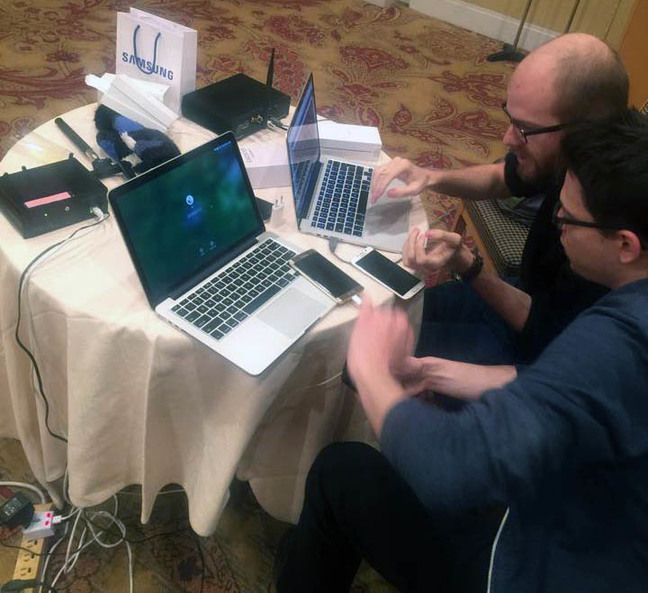
base stations MITM hack Samsung S6

Nico Golde and Daniel Komaromy at Pwn2Own today. (Drago Ruiu)

The experts targeted Samsung devices, including the Samsung S6, with a man-in-the-middle attack relying on an OpenBTS base station, tricking the handsets and forcing it to connect to the bogus station. Once connected to the bogus base station, the handset receives the baseband processor firmware, the module which is responsible handling voice calls.

“Our example of modifying the baseband to hijack calls is just an example,” Komaromy told Vulture South. “The idea with hijacking would be that you can redirect calls to a proxy (like a SIP proxy) and that way you can man-in-the-middle the call.” “So that means the caller sees her original call connected – but it can be recorded in the proxy [which is how] it’s like a wiretap implant.”

The attack works on Samsung S6 Edge running up updated software.

“I turned it on next to their radio and then dialled myself,” said PacSec organiser Dragos Ruiu. “And instead of ringing on my phone it rang on theirs.”

Stay tuned.

Pierluigi Paganini

Security Affairs –  (Samsung S6, hacking)


