
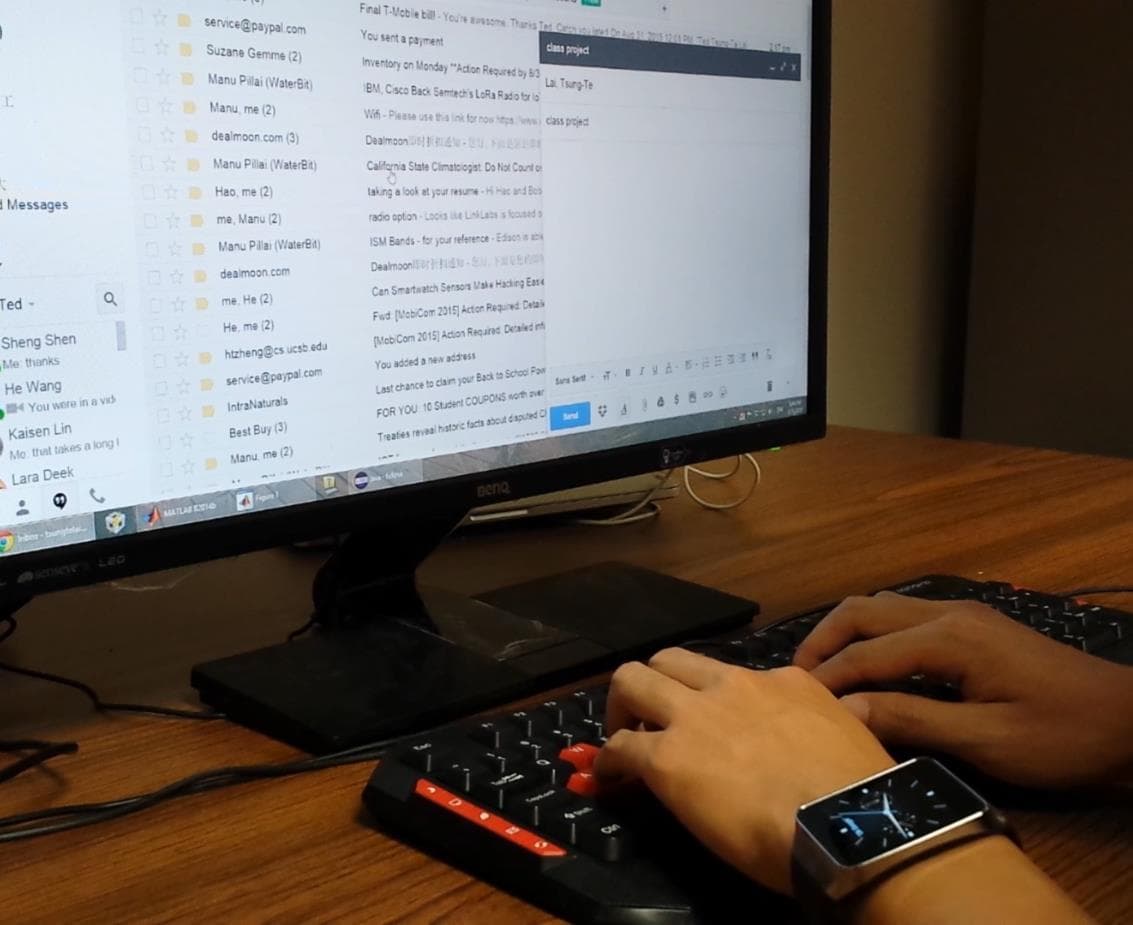
Researchers have created an app that follows the micro-movements of your smartwatch and are able to detect what keys you’re pressing with your left hand and thus guess what words you may be typing on a keyboard.
A group of students lead by Romit Roy Choudhury, Associate Professor at ECE Illinois developed a mobile app that is able to analyze the movements of a smartwatch to detect the keys pressed by the user. The researchers plan to present it this week at the MobiCon 2015 conference in Paris.
The project called Motion Leaks (MoLe) is funded by the National Science Foundation, the researchers have installed the homegrown app on a Samsung Gear Live smartwatch.
Using the watch’s built-in motion sensors, more specific data from the accelerometer and gyroscope, researchers were able to create a 3D map of the user’s hand movements while typing on a keyboard.
“The app uses an accelerometer and gyroscope to track the micro-motion of keystrokes as a wearer types on a keyboard. After collecting the sensor data, researchers ran it through a “Keystroke Detection” module, which analyzed the timing of each keystroke and the net 2-D displacement of the watch. For example, the left wrist moves farther to type a “T” than an “F.” You can see how it works in the researchers’ video.” states the blog post published by the researchers,
At this point, the group created two algorithms for detecting what keys were being pressed and for guessing the words typed by the user.
The two algorithms are used in conjunction, the first one allows the researchers to detect when the user starts to type on a keystroke and create of a heatmap of common spots where the user would press down.
The second algorithm receives in input the data elaborated by the first algorithm and analyzing the pauses between smartwatch (left hand) keystrokes, it is able to detect how many letters were pressed with the right hand.
The algorithm uses a simple dictionary lookup to discover the words typed on the keyboard.

The research team acknowledged that the MoLe project still has a long way to go, since there are some flaws in their system. Currently, MoLe can’t detect special characters (numbers, punctuation, and symbols), the space bar still poses some difficulties, and the project can acquire usable data from people with standard typing patterns.
The app developed for the MoLe project only works on a Samsung Gear Live smartwatch, but researchers say that, in theory, a similar app could be developed for other smartwatch models.
We have explained several times that every IoT device, especially wearable devices, could be exploited by attackers to spy on users.
“There are a lot of good things that smartwatches can bring to our lives, but there could be bad things,” said graduate student He Wang. “So if you think from that perspective — if there are any ‘bad’ things we could do — we can help other people protect their privacy, or at least make them realize there’s a potential problem.”
On May 2015, researchers at Context Information Security have demonstrated that it is very easy to monitor IoT devices that implement the Bluetooth Low Energy protocol.
Vendors have to carefully consider possible privacy violation and cyber threats in order to avoid putting users at risks of hack.
(Security Affairs – IoT, smartwatch)


