
The seven-year-old remote code execution vulnerability SambaCry was exploited by the SHELLBIND IoT malware to target NAS devices.
A new strain of malware dubbed SHELLBIND exploits the recently patched CVE-2017-7494 Samba vulnerability in attacks against Internet of Things devices.
SHELLBIND has infected most network-attached storage (NAS) appliances, it exploits the Samba vulnerability (also known as SambaCry and EternalRed) to upload a shared library to a writable share, and then cause the server to load that library.
This trick allows a remote attacker to execute arbitrary code on the targeted system.
The Samba vulnerability affects the products of several major vendors, including NAS appliances.
The Samba bug appears to be a network wormable issue that could be exploited by a malicious code to self-replicate from vulnerable machine to vulnerable machine without requiring user interaction.
When SambaCry was discovered, nearly 485,000 Samba-enabled computers were found to be exposed on the Internet.
In June, researchers at Kaspersky Lab set up honeypots to detect SambaCry attacks in the wild. The experts spotted a malware campaign that was exploiting the SambaCry vulnerability to infect Linux systems and install a cryptocurrency miner.
“On May 30th our honeypots captured the first attack to make use of this particular vulnerability, but the payload in this exploit had nothing in common with the Trojan-Crypt that was EternalBlue and WannaCry. Surprisingly, it was a cryptocurrency mining utility!” reported Kaspersky.
The independent security researcher Omri Ben Bassat also observed the same campaign that he dubbed “EternalMiner.” The expert confirmed threat actors started exploiting the SambaCry flaw just a week after its discovery to hijack Linux PCs and to install an upgraded version of “CPUminer,” a Monero miner.
In early July, experts at Trend Micro uncovered a new type of attack involving SambaCry. Crooks have been exploiting the flaw in attacks targeting NAS devices used by small and medium-size businesses. The malicious code was designed to compromise almost any IoT architecture, including MIPS, ARM, and PowerPC.
The attackers can easily find vulnerable devices using the Shodan Internet search engine then and write the malicious code to their public folders.
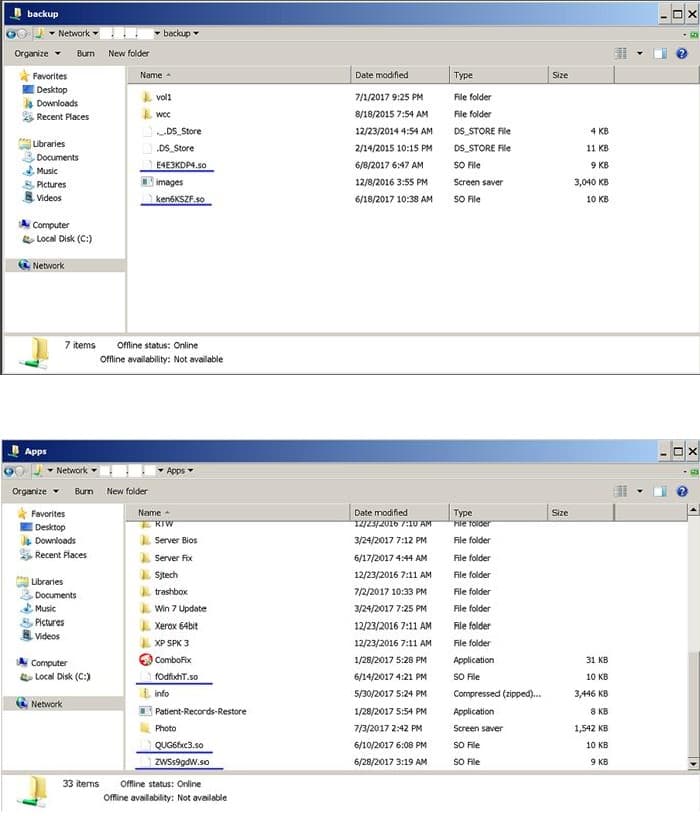
Experts at Trend Micro discovered that the ELF_SHELLBIND.A is delivered as a SO file to Samba public folders, then the attacker load and execute it by exploiting the SambaCry vulnerability.
“This more recent malware is detected as ELF_SHELLBIND.A and was found on July 3. Similar to the previous reports of SambaCry being used in the wild, it also opens a command shell on the target system. But ELF_SHELLBIND.A has marked differences that separate it from the earlier malware leveraging SambaCry. For one, it targets internet of things (IoT) devices—particularly the Network Attached Storage (NAS) devices favored by small to medium businesses.” reads the analysis published by Trend Micro. “ELF_SHELLBIND also targets different architectures, such as MIPS, ARM, and PowerPC. This is the first time we’ve seen SambaCry being exploited without the cryptocurrency miner as a payload.”

Once the malware is executed, it connects a C&C server located in East Africa “169[.]239[.]128[.]123” over TCP, port 80. , To establish a connection, the malicious code modifies firewall rules, then the attacker will open a command shell on the target system.
“Once the connection is successfully established and authentication is confirmed, then the attacker will have an open command shell in the infected systems where he can issue any number of system commands and essentially take control of the device,” continues Trend Micro.
nt pipe support = no
to the Samba configuration file and restarting the network’s SMB daemon.
The change will limit clients from accessing some network computers.
| [adrotate banner=”9″] | [adrotate banner=”12″] |
(Security Affairs – CVE-2017-7494, SHELLBIND)
[adrotate banner=”5″]
[adrotate banner=”13″]


