Security Affairs
Pegasus Used Against MEP Investigating Pegasus, Citizen Lab Finds|JADEPUFFER: First End-to-End AI-Driven Ransomware Operation|The Anatomy of a Shadow AI Supply-Chain Breach: Lessons from the 2026 Vercel Incident|Law enforcememt operation disrupted Malicious Residential Proxy Networks NetNut|Government and Healthcare Are the Weakest Links in Global Email Security|Europe Confirms Record €4.1B Penalty Against Google for Android Practices|U.S. CISA adds a Microsoft SharePoint Server flaw to its Known Exploited Vulnerabilities catalog|430,000 FortiGate Devices Exposed in FortiBleed Ransomware Link|Adobe fixed multiple maximum-severity flaws in ColdFusion and Campaign Classic|Alleged Scattered Spider Hacker Extradited to U.S. to Face Cybercrime Charges|Oracle E-Business Suite Flaw Under Active Attack, 950 Systems Exposed|Azure CLI Targeted in LSHIY Password Spray Campaign Across 64 Orgs|Pegasus Used Against MEP Investigating Pegasus, Citizen Lab Finds|JADEPUFFER: First End-to-End AI-Driven Ransomware Operation|The Anatomy of a Shadow AI Supply-Chain Breach: Lessons from the 2026 Vercel Incident|Law enforcememt operation disrupted Malicious Residential Proxy Networks NetNut|Government and Healthcare Are the Weakest Links in Global Email Security|Europe Confirms Record €4.1B Penalty Against Google for Android Practices|U.S. CISA adds a Microsoft SharePoint Server flaw to its Known Exploited Vulnerabilities catalog|430,000 FortiGate Devices Exposed in FortiBleed Ransomware Link|Adobe fixed multiple maximum-severity flaws in ColdFusion and Campaign Classic|Alleged Scattered Spider Hacker Extradited to U.S. to Face Cybercrime Charges|Oracle E-Business Suite Flaw Under Active Attack, 950 Systems Exposed|Azure CLI Targeted in LSHIY Password Spray Campaign Across 64 Orgs|
Advertisement

Ad Placeholder

Full Width × 90

Breaking News

Researchers spotted a new malware in the wild, the Saturn Ransomware

Researchers at the MalwareHunterTeam spotted a new strain of ransomware called Saturn Ransomware, the name derives from the .saturn extension it appends to the name of the encrypted files. Currently, the malware requests victims of $300 USD payment that doubles after 7 days. Once infected a system, the Saturn Ransomware checks if it is running in a […]

Researchers spotted a new malware in the wild, the Saturn Ransomware

Researchers at the MalwareHunterTeam spotted a new strain of ransomware called Saturn Ransomware, the name derives from the .saturn extension it appends to the name of the encrypted files.

Currently, the malware requests victims of $300 USD payment that doubles after 7 days.

Once infected a system, the Saturn Ransomware checks if it is running in a virtual environment and eventually it halts the execution to avoid being analyzed by researchers.

Then it performs a series of actions to make impossible for the victims restoring the encrypted files, it deletes shadow volume copies, disables Windows startup repair, and to clear the Windows backup catalog.

Below the command executed by the malicious code:


At this point, the Saturn ransomware is ready to encrypt files having certain file types.

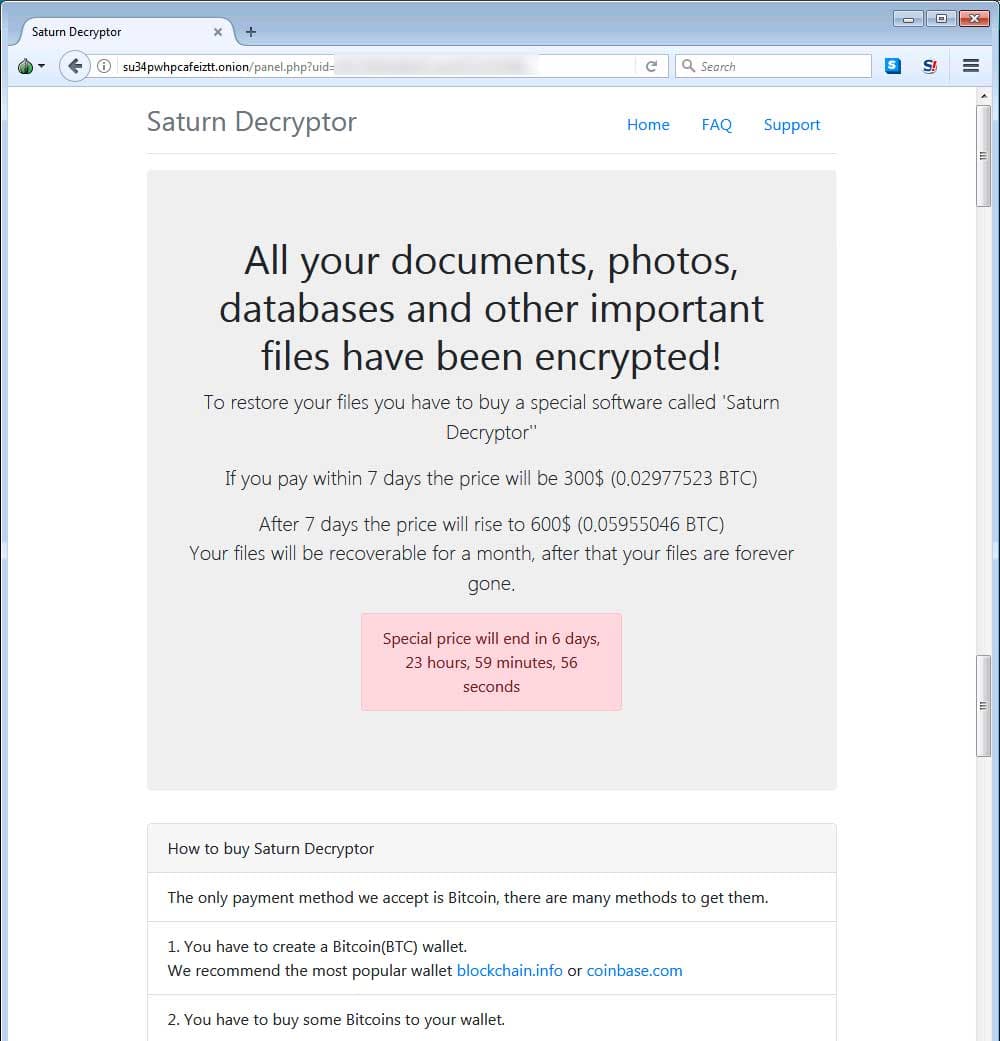
The ransomware such as many other threats uses a Tor payment site that is reported in the ransom note dropped on the machine while the Saturn ransomware is encrypting the files.

“While encrypting the computer, Saturn Ransomware will drop ransom notes named #DECRYPT_MY_FILES#.html and #DECRYPT_MY_FILES#.txt and a key file named #KEY-[id].KEY in each folder that it encrypts a file. The key file is used to login to the TOR ransom site, while the ransom note contains brief information on what has happened to the victims files and a link to the TOR payment site at su34pwhpcafeiztt.onion.” wrote Larwrence Abrams from Bleeping Computer.

Saturn Ransomware

File encrypted by the Saturn Ransomware (Source Bleeping computer)

The Saturn ransomware also drops a #DECRYPT_MY_FILES#.vbs triggers an audio message to the victims, and it sets your Windows desktop background to  #DECRYPT_MY_FILES.BMP.

The authentication to TOR site is made by uploading the key file, then users will display the Saturn Decryptor page for the victim that includes detailed instructions.

Researchers are still analyzing the Saturn ransomware, even if it is being actively distributed, it is still unclear what distribution vector threat actors are using to spread it.

Further information, including the Indicators of compromise (IoCs), are available in the blog post published by Bleeping Computer.

[adrotate banner=”9″] [adrotate banner=”12″]

Pierluigi Paganini

(Security Affairs – Saturn, cybercrime)

[adrotate banner=”5″]

[adrotate banner=”13″]