Russian telco operator Rostelecom was involved in BGP hijacking incident that impacted hundreds of CDNs and cloud providers last week.
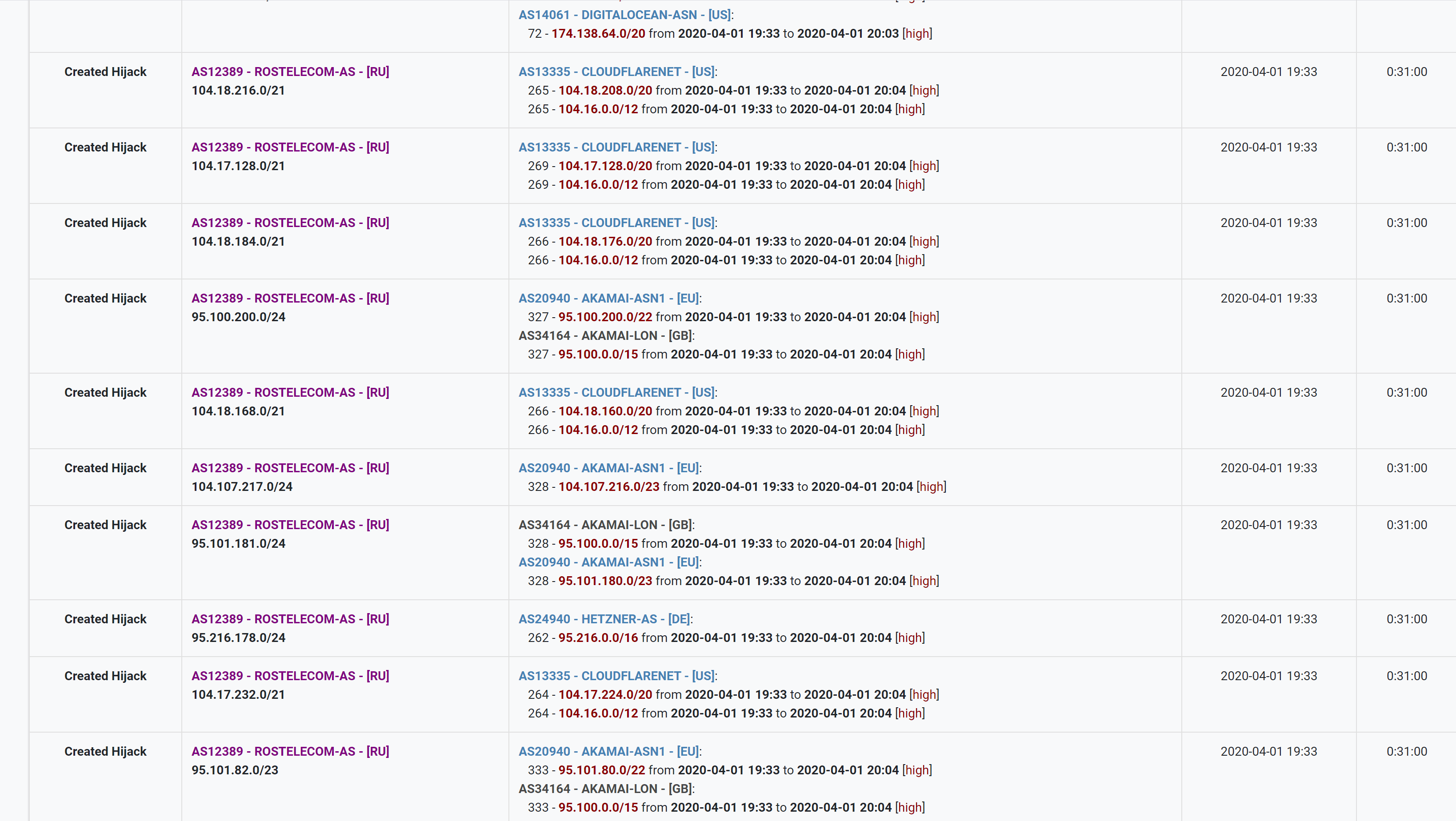
Last week, Russia’s state-owned telco Rostelecom was involved in an apparent incident that hijacked the traffic for more than 200 content delivery networks (CDNs) and cloud hosting providers, including giants like Google, Amazon, Facebook, Akamai, Cloudflare, GoDaddy, and Digital Ocean.
Over 8,800 internet traffic routes from more than 200 networks were impacted for about an hour.
The large scale BGP hijack incident involved AS12389 (Rostelecom) affecting over 8,000 prefixes.
According to the BGPmon.net, starting from 2020-04-01 19:27:28 its service detected a possible BGP hijack, the prefix involved is
The prefix 31.13.69.0/24 was instead announced by ASN 12389.
The phenomena were also monitored by security firm Qrator Labs, below and excerpt from its analysis.
“Here’s the beginning: for approximately an hour, starting at 19:28 UTC on April 1, 2020, the largest Russian ISP — Rostelecom (AS12389) — was announcing prefixes belonging to prominent internet players: Akamai, Cloudflare, Hetzner, Digital Ocean, Amazon AWS, and other famous names.” reads the analysis.
“Before the issue was resolved, paths between the largest cloud networks were somewhat disrupted — the Internet blinked. The route leak was distributed quite well through Rascom (AS20764) , then Cogent (AS174) and in a couple of minutes through Level3 (AS3356) to the world. The issue suddenly became bad enough that it saturated the route decision-making process for a few Tier-1 ISPs.”

BGP hijacking incidents are dangerous events, a large portion of traffic could be redirected allowing threat actors to analyze and decrypt it.
“However, what makes the case very different is that Rostelecom got a warning from the Qrator.Radar’s real-time feed and reached out for help with the incident troubleshooting. Given the simplicity of the BGP mistakes, during the coronavirus crisis, it’s so easy to allow for an error. However, with the monitoring data provided, the incident came to an end rather quickly, and the proper routing was restored.” concludes Qrator.Radar.
“We strongly encourage other ISPs who are not Rostelecom to start monitoring their BGP announcements to prevent incidents of scale. And, of course, RPKI Origin Validation is something everyone shouldn’t just think about, but implement.”
A similar incident took place in December 2018, when a suspicious event routed traffic for major tech companies (i.e. Google, Facebook, Apple, and Microsoft) through a previously unknown Russian Internet provider. Researchers who investigated the incident believe it was the result of a BGP hijacking attack.
In May 2017, Rostelecom was involved in another suspicious incident that impacted financial giants Visa, Mastercard, HSBC, and more.
In November 2018, security researchers Chris C. Demchak and Yuval Shavitt published a paper that details BGP hijacking attacks carried out by China Telecom over the past years.
China Telecom was a brand of the state-owned China Telecommunications Corporation, but after marketization of the enterprise spin off the brand and operating companies as a separate group.
China Telecom is currently present in North American networks with 10 points-of-presence (PoPs) (eight in the United States and two in Canada), spanning major exchange points.
The two researchers pointed out that the telco company leverages the PoPs to hijack traffic through China, it has happened several times over the past years,
| [adrotate banner=”9″] | [adrotate banner=”12″] |
(
[adrotate banner=”5″]
[