
Researchers discovered a new Windows malware, dubbed Raspberry Robin, with worm-like capabilities that spreads via removable USB devices.
Cybersecurity researchers from Red Canary have spotted a new Windows malware, dubbed Raspberry Robin, with worm-like capabilities that propagates through removable USB devices.
“Raspberry Robin is Red Canary’s name for a cluster of activity we first observed in September 2021 involving a worm that is often installed via USB drive.” reads the advisory published by Red Canary. “This activity cluster relies on msiexec.exe to call out to its infrastructure, often compromised QNAP devices, using HTTP requests that contain a victim’s user and device names.”
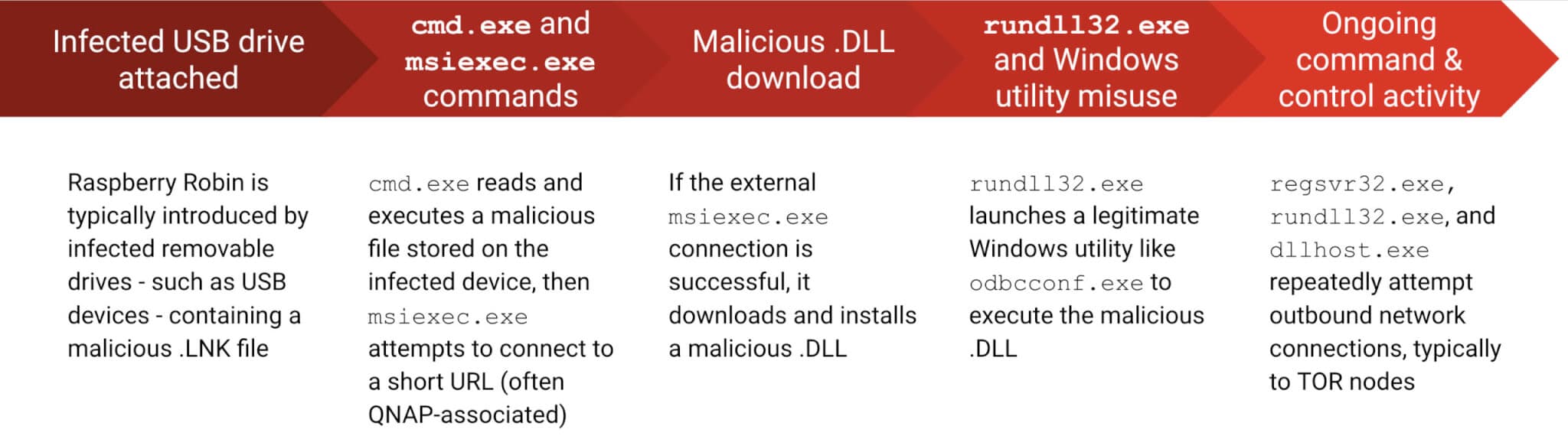
Raspberry Robin uses Windows Installer to reach out to QNAP-associated domains and download a malicious DLL.
The malware uses TOR exit nodes as a backup C2 infrastructure.
The malware was first spotted in September 2021, the experts observed Raspberry Robin targeting organizations in the technology and manufacturing industries. Initial access is typically through infected removable drives, often USB devices.
“Raspberry Robin is typically introduced via infected removable drives, often USB devices. The Raspberry Robin worm often appears as a shortcut .lnk file masquerading as a legitimate folder on the infected USB device.” continues the analysis. “Soon after the Raspberry Robin infected drive is connected to the system, the UserAssist registry entry is updated and records execution of a ROT13-ciphered value referencing a .lnk file when deciphered. In the example below, q:\erpbirel.yax deciphers to d:\recovery.lnk.”

Raspberry Robin uses cmd.exe to read and execute a file stored on the infected external drive, it leverages msiexec.exe for external network communication to a rogue domain used as C2 to download and install a DLL library file.
Then msiexec.exe launches a legitimate Windows utility, fodhelper.exe, which in turn run rundll32.exe to execute a malicious command. Experts pointed out that processes launched by fodhelper.exe run with elevated administrative privileges without requiring a User Account Control prompt.
According to the researchers, looking for fodhelper.exe as a parent process it is possible to detect the threat.
“The rundll32.exe command starts another legitimate Windows utility, in this case odbcconf.exe, and passes in additional commands to execute and configure the recently-installed malicious DLL bznwi.ku (Hash: 6f5ea8383bc3bd07668a7d24fe9b0828). Here is what that command looks like. (We modified the random string values in the command, as well as replaced the victim’s username with username.)” reads the analyis.
At the time of this writing, researchers have yet to determine the motivation behind these attacks. It is also still unclear how or where Raspberry Robin infects external drives to propagates.
“We also don’t know why Raspberry Robin installs a malicious DLL. One hypothesis is that it may be an attempt to establish persistence on an infected system, though additional information is required to build confidence in that hypothesis.” concludes the report.
Please vote for Security Affairs as the best European Cybersecurity Blogger Awards 2022 – VOTE FOR YOUR WINNERS
Vote for me in the sections “The Underdogs – Best Personal (non-commercial) Security Blog” and “The Tech Whizz – Best Technical Blog” and others of your choice.
To nominate, please visit: https://docs.google.com/forms/d/e/1FAIpQLSfxxrxICiMZ9QM9iiPuMQIC-IoM-NpQMOsFZnJXrBQRYJGCOw/viewform
Follow me on Twitter: @securityaffairs and Facebook
| [adrotate banner=”9″] | [adrotate banner=”12″] |
(SecurityAffairs – hacking, domain name system)
[adrotate banner=”5″]
[adrotate banner=”13″]


