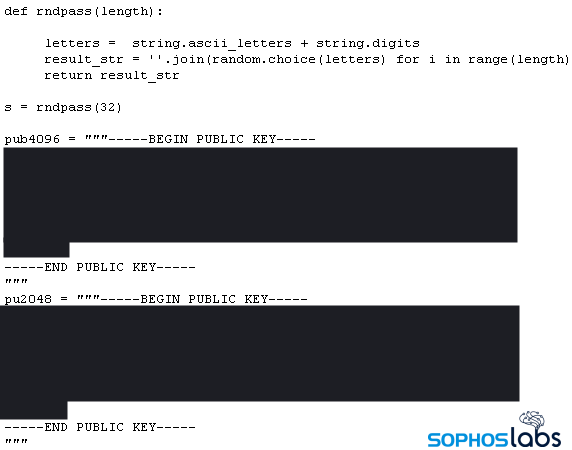
An unnamed ransomware gang used a custom Python script to target VMware ESXi and encrypt all the virtual machines hosted on the server.
Researchers from Sophos were investigating a ransomware attack when discovered that the attackers employed a Python script to encrypt virtual machines hosted on VMware ESXi servers.
In the attack investigated by the experts, ransomware operators encrypted the virtual disks in a VMware ESXi server only three hours after the initial intrusion.
The intruders gained access to the network by logging into a TeamViewer account running on a device with a domain admin logged on. Then the attackers used the Advanced IP Scanner to scan the network end identify other targets, then they logged onto an ESXi server using an SSH client called Bitvis. In this case, the IT administrators at the victim organization left SSH ESXi Shell service enabled opening the door to the attackers.
The ransomware operators then executed a tiny Python script (6kb) to encrypt all virtual disks and VM settings files of the virtual machines hosted on the server.
“Three hours after the attackers scanned the network, they used their credentials to log into the ESXi Shell, and copied a file named fcker.py to the ESXi datastore, which houses the virtual disk images used by the VMs that run on the hypervisor.” reads the Sophos analysis. “One by one, the attackers executed the Python script, passing the path to datastore disk volumes as an argument to the script. Each individual volume contained the virtual disk and VM settings files for multiple virtual machines.”
Forensic experts were able to recover a copy of the Python script and discovered that attackers can set up a set of variables to configure multiple encryption keys, email addresses and chose the file suffix for the encrypted files.
Attackers first shut down the virtual machines, overwrite the content of original files stored on the datastore volumes to prevent victims from recovering them, then deleting the VM disks.
“Initially, the script “walks” the filesystem of a datastore and creates a directory map of the drive, and inventories the names of every virtual machine on the hypervisor, writing them to a file called vms.txt. It then executes the ESXi Shell command vim-cmd vmsvc/power.off, one time for each VM, passing the VM names to the command as a variable, one at a time. Only when the VMs have powered off will the script begin encrypting the datastore volumes.” states the analysis. “Using a single instruction for each file it encrypts, the script invokes the open-source tool openssl to encrypt the files with the following command:
openssl rsautil -encrypt -inkey pubkey.txt -pubin -out [filename].txt
The script then overwrites the contents of the original file with just the word fuck then deletes the original file. Finally, it deletes the files that contain the directory listings, the names of the VMs, and itself by overwriting those files before deleting them.”
Experts noticed that this ransomware creates a unique key pair every time it is run.
Unfortunately, attacks against ESXi servers are becoming frequent, multiple ransomware gangs target them, including BlackMatter, RansomExx, HelloKitty, REvil, and Babuk Locker.
“Malware that runs under a Linux-like operating system such as ESXi uses is still relatively uncommon, but it is even less common for IT staff to install endpoint protection on servers like these. Hypervisors in general are often quite attractive targets for this kind of attack, since the VMs they host may run business-critical services or functions.” concludes the analysis. “Administrators who operate ESXi or other hypervisors on their networks should follow security best practices, avoiding password reuse, and using complex, difficult to brute-force passwords of adequate length. Wherever possible, enable the use of multi-factor authentication and enforce the use of MFA for accounts with high permissions, such as domain administrators. In the case of ESXi, use of the ESXi Shell is something that can be toggled on or off from either a physical console at the machine itself, or through the normal management tools provided by VMware.”
Follow me on Twitter: @securityaffairs and Facebook
| [adrotate banner=”9″] | [adrotate banner=”12″] |
(SecurityAffairs – hacking, ransomware)
[adrotate banner=”5″]
[adrotate banner=”13″]