Security Affairs
Patch Tuesday security updates for July 2026, the largest update ever. 621 CVEs in one month|U.S. Treasury Sanctions VPN Provider and Cryptor Seller Behind Billions in Ransomware Losses|Attacker Used AI to Build Custom PowerShell Recon Malware|Malware Hits Japan’s Largest Taxi Company Nihon Kotsu, Services Temporarily Suspended|CrashStealer: New macOS Infostealer Uses Signed Apps to Evade Gatekeeper|Lidl Notified Online Shop Customers in Germany, Belgium, and the Netherlands of a Data Breach|U.S. CISA adds a Cisco IOS flaw to its Known Exploited Vulnerabilities catalog|EU Targets FSB-Linked Hackers in New Sanctions Over Cyber Sabotage|Dutch Nationals Suspected in Odido Hack That Exposed Six Million Customers|Australia Alerts Organizations to Ongoing CMS Exploitation Attacks|Ryuk Ransomware Member Pleads Guilty Over Attacks on U.S. Organizations|Progress Told ShareFile Customers to Pull the Plug on Their Servers. Here’s What We Know.|Patch Tuesday security updates for July 2026, the largest update ever. 621 CVEs in one month|U.S. Treasury Sanctions VPN Provider and Cryptor Seller Behind Billions in Ransomware Losses|Attacker Used AI to Build Custom PowerShell Recon Malware|Malware Hits Japan’s Largest Taxi Company Nihon Kotsu, Services Temporarily Suspended|CrashStealer: New macOS Infostealer Uses Signed Apps to Evade Gatekeeper|Lidl Notified Online Shop Customers in Germany, Belgium, and the Netherlands of a Data Breach|U.S. CISA adds a Cisco IOS flaw to its Known Exploited Vulnerabilities catalog|EU Targets FSB-Linked Hackers in New Sanctions Over Cyber Sabotage|Dutch Nationals Suspected in Odido Hack That Exposed Six Million Customers|Australia Alerts Organizations to Ongoing CMS Exploitation Attacks|Ryuk Ransomware Member Pleads Guilty Over Attacks on U.S. Organizations|Progress Told ShareFile Customers to Pull the Plug on Their Servers. Here’s What We Know.|
Advertisement

Ad Placeholder

Full Width × 90

Breaking News

Python URL parsing function flaw can enable command execution

A severe vulnerability in the Python URL parsing function can be exploited to gain arbitrary file reads and command execution. Researchers warn of a high-severity security vulnerability, tracked as CVE-2023-24329 (CVSS score of 7.5), has been disclosed in the Python URL parsing function that could be exploited to bypass blocklisting methods. Successful exploitation of the vulnerability […]

Python URL parsing function

A severe vulnerability in the Python URL parsing function can be exploited to gain arbitrary file reads and command execution.

Researchers warn of a high-severity security vulnerability, tracked as CVE-2023-24329 (CVSS score of 7.5), has been disclosed in the Python URL parsing function that could be exploited to bypass blocklisting methods.

Successful exploitation of the vulnerability can lead to arbitrary file reads and command execution.

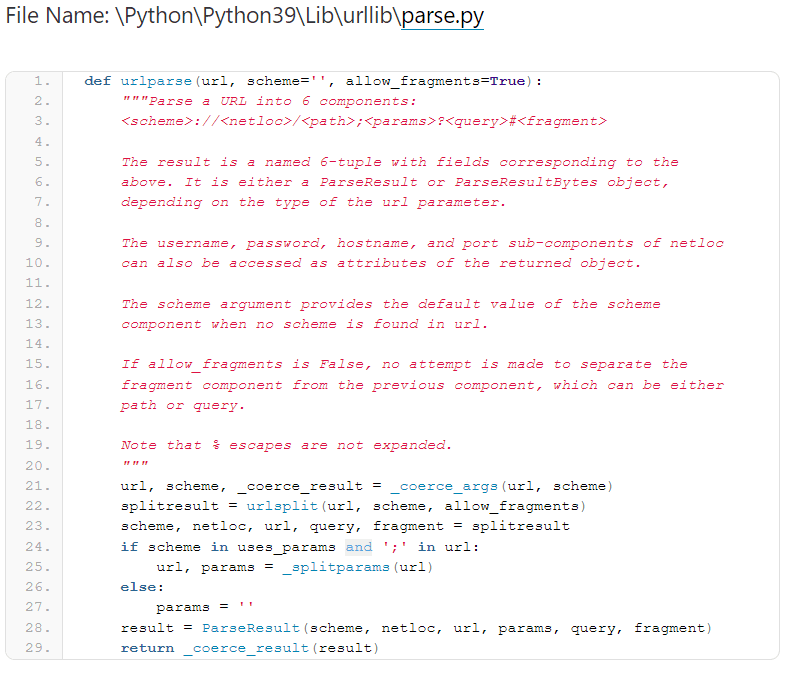
“An issue in the urllib.parse component of Python before v3.11 allows attackers to bypass blocklisting methods by supplying a URL that starts with blank characters.” reads the advisory published by CERT Coordination Center (CERT/CC). “urlparse has a parsing problem when the entire URL starts with blank characters. This problem affects both the parsing of hostname and scheme, and eventually causes any blocklisting methods to fail.”

The researchers pointed out that urlsplit() and urlparse() APIs do not perform input validation and may not raise errors on invalid inputs.

Python URL parsing function

The issue can be exploited by providing an URL that starts with blank characters.

The vulnerability was discovered by researcher Yebo Cao in July 2022.

“I personally think the impact of this vulnerability is huge because this urlparse() library is widely used. Although blocklist is considered an inferior choice, there are many scenarios where blocklist is still needed.” wrote Cao. “This vulnerability would help an attacker to bypass the protections set by the developer for scheme and host. This vulnerability can be expected to help SSRF and RCE in a wide range of scenarios.”

The issue impacts all python versions before 3.11.

The vulnerability has been fixed with the release of the following versions:

  • >= 3.12
  • 3.11.x >= 3.11.4
  • 3.10.x >= 3.10.12
  • 3.9.x >= 3.9.17
  • 3.8.x >= 3.8.17, and
  • 3.7.x >= 3.7.17

The flaw should also be mitigated by adding strip() function before processing the URL.

Follow me on Twitter: @securityaffairs and Facebook and Mastodon

Pierluigi Paganini

(SecurityAffairs – hacking, Python URL)