
U.S. CISA adds a Microsoft SharePoint Server flaw to its Known Exploited Vulnerabilities catalog|430,000 FortiGate Devices Exposed in FortiBleed Ransomware Link|Adobe fixed multiple maximum-severity flaws in ColdFusion and Campaign Classic|Alleged Scattered Spider Hacker Extradited to U.S. to Face Cybercrime Charges|Oracle E-Business Suite Flaw Under Active Attack, 950 Systems Exposed|Azure CLI Targeted in LSHIY Password Spray Campaign Across 64 Orgs|CISA Warns BlueHammer Flaw Is Now Exploited in Ransomware Attacks|RustDuck: The Botnet That’s Still Small but Engineering Like It Plans to Grow|GuardFall Flaw Hits 10 of 11 Popular Open-Source AI Agents|XSS.is, The Forum That Ran the Ransomware Supply Chain Is Down. The Market Isn’t|U.S. CISA adds SimpleHelp flaw to its Known Exploited Vulnerabilities catalog|Hackers Steal Data of 4.38 Million Aflac Japan Customers|U.S. CISA adds a Microsoft SharePoint Server flaw to its Known Exploited Vulnerabilities catalog|430,000 FortiGate Devices Exposed in FortiBleed Ransomware Link|Adobe fixed multiple maximum-severity flaws in ColdFusion and Campaign Classic|Alleged Scattered Spider Hacker Extradited to U.S. to Face Cybercrime Charges|Oracle E-Business Suite Flaw Under Active Attack, 950 Systems Exposed|Azure CLI Targeted in LSHIY Password Spray Campaign Across 64 Orgs|CISA Warns BlueHammer Flaw Is Now Exploited in Ransomware Attacks|RustDuck: The Botnet That’s Still Small but Engineering Like It Plans to Grow|GuardFall Flaw Hits 10 of 11 Popular Open-Source AI Agents|XSS.is, The Forum That Ran the Ransomware Supply Chain Is Down. The Market Isn’t|U.S. CISA adds SimpleHelp flaw to its Known Exploited Vulnerabilities catalog|Hackers Steal Data of 4.38 Million Aflac Japan Customers|
Advertisement

Ad Placeholder

Full Width × 90

Breaking News

PlugX Trojan disguised as a legitimate Windows open-source tool in recent attacks

Researchers detailed a new wave of attacks distributing the PlugX RAT disguised as a legitimate Windows debugger tool. Trend Micro uncovered a new wave of attacks aimed at distributing the PlugX remote access trojan masqueraded as an open-source Windows debugger tool called x32dbg. The legitimate tool allows to examine kernel-mode and user-mode code, crash dumps, or CPU […]

PlugX

Researchers detailed a new wave of attacks distributing the PlugX RAT disguised as a legitimate Windows debugger tool.

Trend Micro uncovered a new wave of attacks aimed at distributing the PlugX remote access trojan masqueraded as an open-source Windows debugger tool called x32dbg. The legitimate tool allows to examine kernel-mode and user-mode code, crash dumps, or CPU registers. 

The x32dbg.exe analyzed by the researchers has a valid digital signature for this reason it is considered safe by some security tools. Its use allows threat actors to avoid detection, maintain persistence, escalate privileges, and bypass file execution restrictions.

PlugX

The RAT uses DLL side-loading to load its own malicious payload malicious DLL when a digitally signed software application, such as the x32dbg debugging tool (x32dbg.exe), is executed.

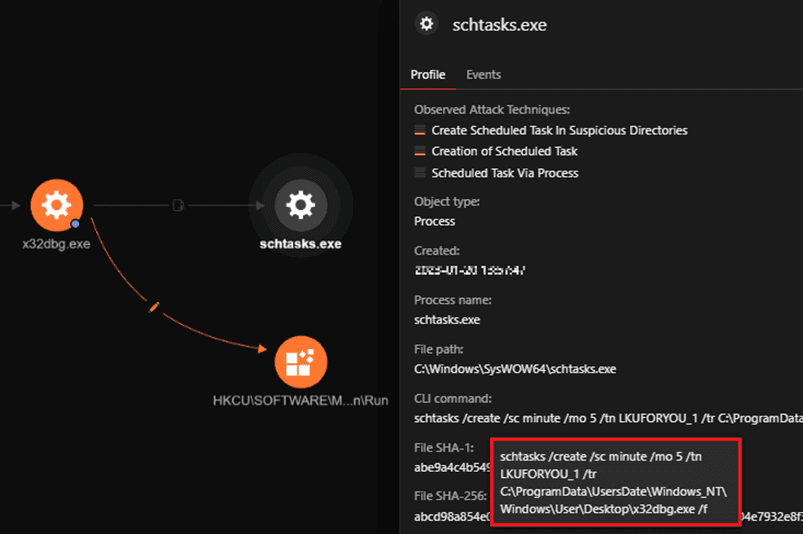
Attackers achieved persistence by modifying registry entries and creating scheduled tasks to maintain access even when the system is restarted.

Experts reported that the x32dbg.exe was used to drop a backdoor, a UDP shell client that collects system information, collects host information, and creates a thread to continuously wait for C2 commands, and decrypts C&C communication using the hardcoded key “Happiness is a way station between too much and too little.”

“Despite advances in security technology, attackers continue to use this technique since it exploits a fundamental trust in legitimate applications.” concludes the report that also provides Indicators of Compromise (IoCs). “This technique will remain viable for attackers to deliver malware and gain access to sensitive information as long as systems and applications continue to trust and load dynamic libraries.”

Follow me on Twitter: @securityaffairs and Facebook and Mastodon

Pierluigi Paganini

(SecurityAffairs – hacking, Moshen Dragon)


