
The Dutch developer Luke Paris has created a PHP rootkit that hides in PHP server modules, he also explained why it is more dangerous of classic rootkits.
The Dutch developer Luke Paris has created a rootkit that hides in PHP server modules that could be used by attackers to take over web servers.
While classic rootkits work on the lowest levels of the operating system, intercepting kernel operations to perform malicious actions, Luke Paris successfully attempted to create a rootkit that interacts with the PHP interpreter, instead of the OS kernel that is much more complex.
“The first and very obvious reason why you would write a rootkit as a PHP module is accessibility. Learning how to use the Zend Engine (the framework the entire PHP language is built with) is a lot easier than learning how to write kernel modules, simply because the code base itself is smaller, better documented and a lot less complex,” Paris explained. “Even without good documentation or tutorials, I managed to learn the basics of writing a PHP module within a day. If I (a novice C developer) can do it, the bad guys definitely can.
Paris’ PHP rootkit allows attackers to gain persistence on the hacked server without getting detected.
According to Paris, the use of PHP modules to hide rootkits is very effective for the following reasons:
Accessibility – Writing a rootkit as a PHP module is a lot easier than learning how to write kernel modules. Developers can use smaller portions of code, Paris explained that he has learned the basics of writing a PHP module in just one day.
Stability – Rootkits are designed to run in kernel space, this implies that poorly written malware can crash the entire system. Using PHP rootkits this problem is overwhelmed. A poorly written PHP rootkit can’t crash the entire system.
“In the worst-case scenario, a rootkit will cause a segmentation fault and just interrupt the current request (note: most web servers report this in their error log, so this could raise suspicion).” states Paris.
Detectability – PHP Rootkits are difficult to detect because of the lack of checks of PHP modules.
“Furthermore, kernel rootkits require you to hook system calls for every process rather than just one, this slows down your machine drastically, which might lead to more suspicion.” stated the developer.
Portability – PHP rootkits are cross-platform rootkits because PHP is (in most cases) platform-independent.
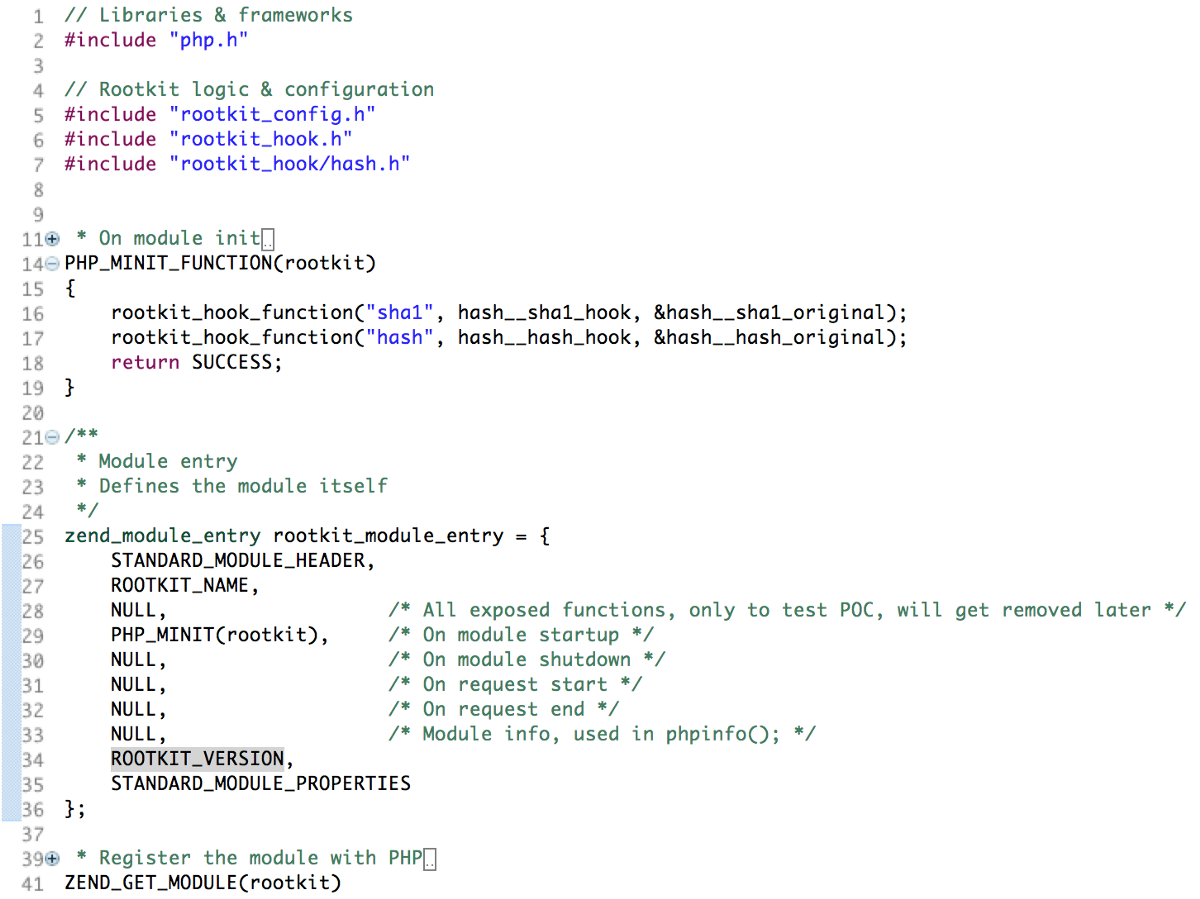
Luke Paris published on GitHub a Proof of concept PHP rootkit, it is an open-source project. The PoC code developed by Paris hooks into the PHP server’s “hash” and “sha1” functions, the rootkit is composed of only 80 lines of code, and it is quite easy for a hacker to hide it in legitimate modules.

To prevent attackers from using his code, Paris has omitted some of its parts, making compilation harder for non-expert PHP developers.
The post also includes a recommendation for administrators:
Keep a list of the module hashes after installing PHP. Administrators can use a cron job that tries to hash all files in the extension directory and compares them to the current hash. Paris also published a Python script that checks the SHA1 hashes of a user’s PHP modules.
[adrotate banner=”9″]
(Security Affairs – PHP rootkit, hacking)
[adrotate banner=”13″]


