
Europe Confirms Record €4.1B Penalty Against Google for Android Practices|U.S. CISA adds a Microsoft SharePoint Server flaw to its Known Exploited Vulnerabilities catalog|430,000 FortiGate Devices Exposed in FortiBleed Ransomware Link|Adobe fixed multiple maximum-severity flaws in ColdFusion and Campaign Classic|Alleged Scattered Spider Hacker Extradited to U.S. to Face Cybercrime Charges|Oracle E-Business Suite Flaw Under Active Attack, 950 Systems Exposed|Azure CLI Targeted in LSHIY Password Spray Campaign Across 64 Orgs|CISA Warns BlueHammer Flaw Is Now Exploited in Ransomware Attacks|RustDuck: The Botnet That’s Still Small but Engineering Like It Plans to Grow|GuardFall Flaw Hits 10 of 11 Popular Open-Source AI Agents|XSS.is, The Forum That Ran the Ransomware Supply Chain Is Down. The Market Isn’t|U.S. CISA adds SimpleHelp flaw to its Known Exploited Vulnerabilities catalog|Europe Confirms Record €4.1B Penalty Against Google for Android Practices|U.S. CISA adds a Microsoft SharePoint Server flaw to its Known Exploited Vulnerabilities catalog|430,000 FortiGate Devices Exposed in FortiBleed Ransomware Link|Adobe fixed multiple maximum-severity flaws in ColdFusion and Campaign Classic|Alleged Scattered Spider Hacker Extradited to U.S. to Face Cybercrime Charges|Oracle E-Business Suite Flaw Under Active Attack, 950 Systems Exposed|Azure CLI Targeted in LSHIY Password Spray Campaign Across 64 Orgs|CISA Warns BlueHammer Flaw Is Now Exploited in Ransomware Attacks|RustDuck: The Botnet That’s Still Small but Engineering Like It Plans to Grow|GuardFall Flaw Hits 10 of 11 Popular Open-Source AI Agents|XSS.is, The Forum That Ran the Ransomware Supply Chain Is Down. The Market Isn’t|U.S. CISA adds SimpleHelp flaw to its Known Exploited Vulnerabilities catalog|
Advertisement

Ad Placeholder

Full Width × 90

Breaking News

Unprotected DB exposed PII belonging to nearly 90% of Panama citizens

Personally identifiable information belonging to roughly 90% of Panama citizens were exposed on a poorly configured Elasticsearch server. Security researcher Bob Diachenko discovered an unprotected Elasticsearch server exposing personally identifiable information belonging to nearly 90% of Panama citizens. Exposed data includes full names, birth dates, national ID numbers, medical insurance numbers, and other personal data. […]

Panama Citizens data leak

Personally identifiable information belonging to roughly 90% of Panama citizens were exposed on a poorly configured Elasticsearch server.

Security researcher Bob Diachenko discovered an unprotected Elasticsearch server exposing personally identifiable information belonging to nearly 90% of Panama citizens.

Exposed data includes full names, birth dates, national ID numbers, medical insurance numbers, and other personal data.

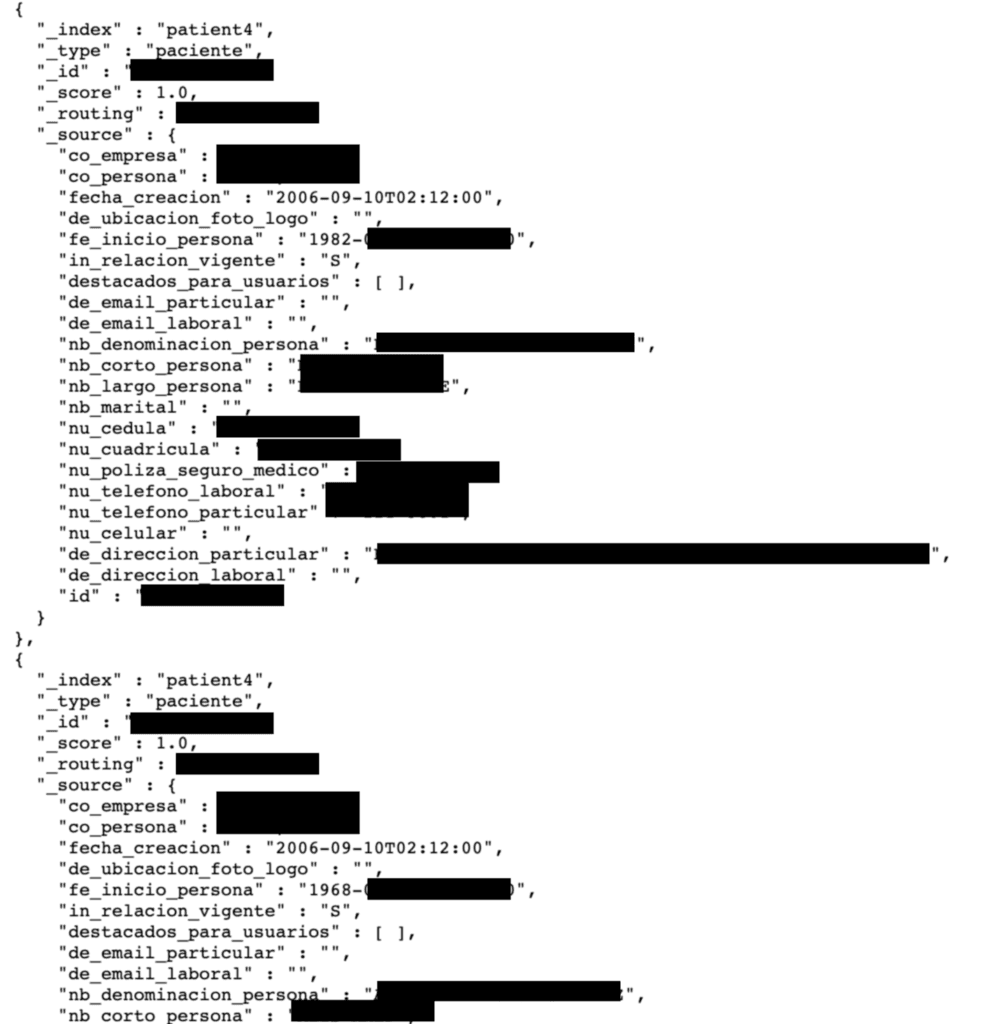
The database contained 3.4 million records related to Panamanian citizens, labeled as “patients,” and 468,086 records labeled as “test-patient.”

“On May 10th I identified a massive bulk of data sitting in an unprotected and publicly available Elasticsearch cluster (hence visible in any browser).” reads the blog post published by Diachenko.

“This database contained 3,427,396 records with detailed information on Panamanian citizens (labeled as ‘patients‘), plus 468,086 records with records labeled as ‘test-patient‘ (although, this data also appeared to be valid and not purely test data).”

Panama Citizens data leak

The expert reported his discovery to CERT Panama, and within 48 hours the database has been secured.

At this time, it is unclear who was running the poorly secured server, anyway the exposed information appears to be authentic.

Querying the Shodan search engine service, the researcher discovered that the IP address associated with the unprotected server has been indexed since April 24th, 2019. Of course, it is impossible to determine if anyone else has accessed the data.

“The danger of having an exposed Elasticsearch or similar NoSql databases is huge.” concludes Diachenko. “I have previously reported that the lack of authentication allowed the installation of malware or ransomware on the MongoDB servers. The public configuration allows the possibility of cybercriminals to manage the whole system with full administrative privileges.” “Once the malware is in place criminals could remotely access the server resources and even launch a code execution to steal or completely destroy any saved data the server contains.”

[adrotate banner=”9″] [adrotate banner=”12″]

Pierluigi Paganini

(SecurityAffairs – Panama, data leak)

[adrotate banner=”5″]

[adrotate banner=”13″]


