
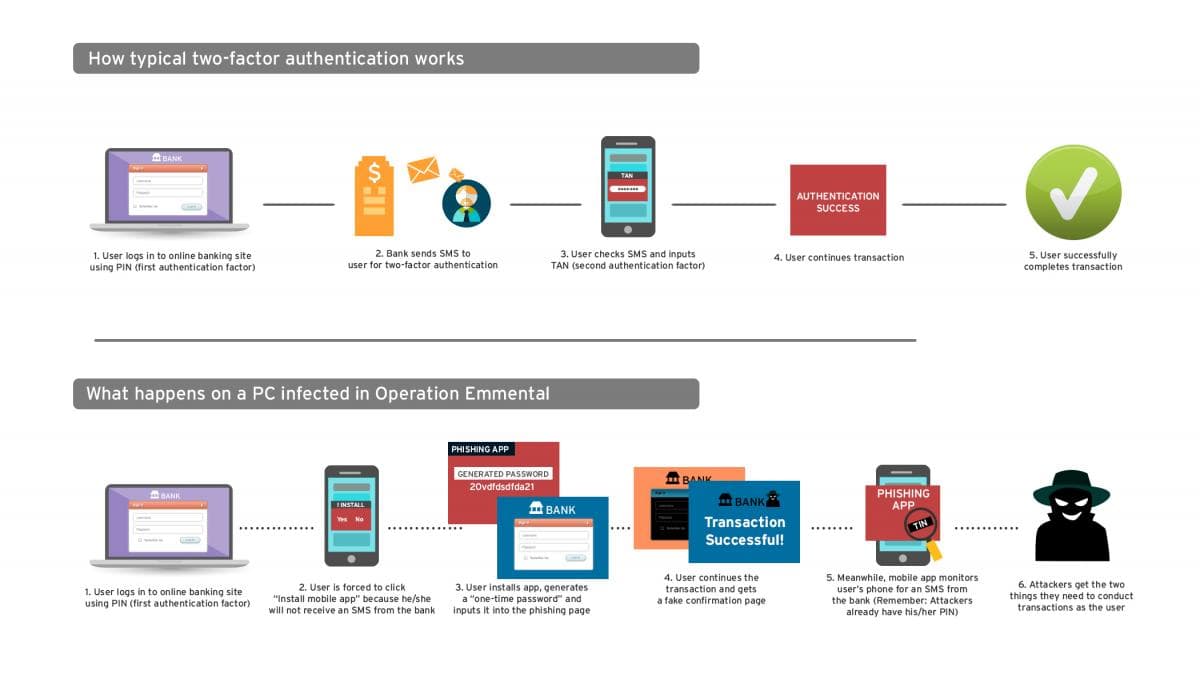
Trend Micro has discovered a malicious campaign named Operation Emmental, which is targeting online banking systems of financial institutions worldwide.
Trend Micro has published a report on a hacking campaign dubbed “Operation Emmental” which targeted Swiss bank accounts whit a multi-faceted attack that is able to bypass two factor authentication implemented by the organization to secure its customers. The name “Operation Emmental” has been chosen by investigators due the presence of numerous holes in banking security, exactly like the popular Swiss Emmental cheese. The attackers adopted a malware which is able to intercept SMS tokens used to authorize operations and change domain name system settings to hijack victims to rogue bank websites, which are a replica of legitimate ones, used for phishing attacks. The bad actors behind the Operation Emmental have been trying to violate the bank customers’ accounts in different countries, including in Switzerland, Austria, Japan and Sweden. Investigators suspect that Russian-speaking individuals are responsible for the Operation Emmental due clues discovered in the source code analyzed.
“The attackers in this case who are most likely to be based in a Russian-speaking country set up a system that could defeat session token protection. ” “A log message in the app, “Obnilim rid,” is Russian slang that translates to “set to zero.” ” ” A Russian speaker based in Romania could be responsible for the whole operation. ” states the official report issued by TrendMicro.
The malicious campaigns start with a fake email that pretend to be sent by a legitimate and well known entity, the cyber criminals serve the malware attached to the email as an apparently harmful Control Panel (.cpl) file that’s inoculate the malicious code through a bogus Windows update tool.

Once it infected the machine, the malware redirects victims to domains, controlled by attackers, by changing the device’s Domain Name System (DNS) settings, in this way every bank customers try to access visit bank websites, they are redirected to a phishing page. The experts have discovered that at least 34 financial institutions were targeted by attackers, six of which are in Austria, five in Japan, 16 in Switzerland, and seven in Sweden.
The attackers used also another trick to improve the efficiency of their operation, to improve phishing schema the malware installs a new root Secure Sockets Layer (SSL) certificate which prevents Web browser from warning victims when they land on these websites.
The criminals gang which manages the Operation Emmental used phishing attacks to gather bank customers personal information and other sensitive data, including username, bank account number, PIN, and any other information for the authentication process. The attackers in order to elude two-factor authentication process implemented by banks, instruct victims to install a malicious Android application which appears to be designed by the targeted banks. The app provides users an authentication code, which must be entered on the fake website to complete the authentication process, but in reality it is just a trick to get users to install the malicious app on their mobile devices. 
The malicious app is used by attackers to intercept the session tokens sent by banks via SMS and forward them to the command and control (C&C) server. The criminals use the session tokens with all the other data they gathered with the phishing campaign to bypass the authentication process.
“In reality, the app waits for an SMS from the bank, which provides a legitimate session token. When received, the app silently hijacks the communication and forwards the stolen information to the attackers’ C&C server. This would allow them to conduct banking transactions in the guise of bank customers. In case of absence of Internet connectivity, the app can also forward stolen session tokens via SMS. It also has the capability to transfer personally identifiable information (PII) such as phone number, phone model, Global System for Mobile Communications (GSM) operator, country/region, and other data from victims’ phones to the C&C server. The malicious app also registers its own SMS listener service and has its own SQLite database to store messages and settings. It also has the ability to receive remote commands. The SMS listener service executes every time an infected Android mobile phone is booted. ” states the report issued by Trend on the Operation Emmental.
Experts at Trend Micro also highlighted that the malware used in the Operation Emmental deletes itself from the machine once it completes its task, this feature has been implemented to remain hidden to the security firms. Resuming the Operation Emmental is considered a sophisticated operation which targeted online banking protection systems implemented by financial institutions in several countries. The attackers have demonstrated high technical capabilities which range from malware design to mobile app development.
“Operation Emmental is an attack that has very likely evolved over time.”
This consideration have to trigger an alert in the financial sector, in order to contrast the emerging cyber threats it is necessary a layered approach to cyber security and a multinational effort of law enforcement agencies and private companies to contrast criminal organizations.
| [adrotate banner=”9″] | [adrotate banner=”12″] |
Security Affairs – (Operation Emmental , cybercrime)
[adrotate banner=”5″]
[adrotate banner=”13″]


