Security Affairs
Medtronic Notifies 3.8 Million After ShinyHunters Data Breach|SECURITY AFFAIRS MALWARE NEWSLETTER ROUND 104|Security Affairs newsletter Round 584 by Pierluigi Paganini – INTERNATIONAL EDITION|U.S. Government Agency Paid $1M to Data Extortion Group Kairos|FBI: TeamPCP Compromised Dev Tools to Steal Cloud Credentials|Pegasus Used Against MEP Investigating Pegasus, Citizen Lab Finds|JADEPUFFER: First End-to-End AI-Driven Ransomware Operation|The Anatomy of a Shadow AI Supply-Chain Breach: Lessons from the 2026 Vercel Incident|Law enforcememt operation disrupted Malicious Residential Proxy Networks NetNut|Government and Healthcare Are the Weakest Links in Global Email Security|Europe Confirms Record €4.1B Penalty Against Google for Android Practices|U.S. CISA adds a Microsoft SharePoint Server flaw to its Known Exploited Vulnerabilities catalog|Medtronic Notifies 3.8 Million After ShinyHunters Data Breach|SECURITY AFFAIRS MALWARE NEWSLETTER ROUND 104|Security Affairs newsletter Round 584 by Pierluigi Paganini – INTERNATIONAL EDITION|U.S. Government Agency Paid $1M to Data Extortion Group Kairos|FBI: TeamPCP Compromised Dev Tools to Steal Cloud Credentials|Pegasus Used Against MEP Investigating Pegasus, Citizen Lab Finds|JADEPUFFER: First End-to-End AI-Driven Ransomware Operation|The Anatomy of a Shadow AI Supply-Chain Breach: Lessons from the 2026 Vercel Incident|Law enforcememt operation disrupted Malicious Residential Proxy Networks NetNut|Government and Healthcare Are the Weakest Links in Global Email Security|Europe Confirms Record €4.1B Penalty Against Google for Android Practices|U.S. CISA adds a Microsoft SharePoint Server flaw to its Known Exploited Vulnerabilities catalog|
Advertisement

Ad Placeholder

Full Width × 90

Breaking News

Nodersok malware delivery campaign relies on advanced techniques

Microsoft researchers observed a campaign delivering malware, dubbed Nodersok, relying on advanced techniques and elusive network infrastructure. Microsoft experts observed a malware campaign, tracked as Nodersok, relying on advanced techniques and elusive network infrastructure. Microsoft uncovered the campaign in mid-July when noticed patterns in the anomalous usage of MSHTA.exe. Nodersok abuse of legitimate tools also […]

Nodersok campaign

Microsoft researchers observed a campaign delivering malware, dubbed Nodersok, relying on advanced techniques and elusive network infrastructure.

Microsoft experts observed a malware campaign, tracked as Nodersok, relying on advanced techniques and elusive network infrastructure. Microsoft uncovered the campaign in mid-July when noticed patterns in the anomalous usage of MSHTA.exe.

Nodersok abuse of legitimate tools also called living-off-the-land binaries (LOLBins). Researchers observed threat actors dropping two legitimate tools onto the infected machines, namely Node.exe, the Windows implementation of the popular Node.js framework, and WinDivert, a network packet capture and manipulation utility.

“It’s not uncommon for attackers to download legitimate third-party tools onto infected machines (for example, PsExec is often abused to run other tools or commands).” reads the analysis published by Microsoft. “However, Nodersok went through a long chain of fileless techniques to install a pair of very peculiar tools with one final objective: turn infected machines into zombie proxies.”

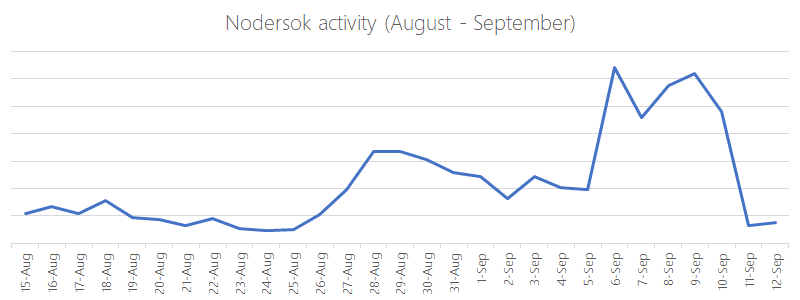
The Nodersok campaign has already infected thousands of machines in the last several weeks. Most of the victims are located in the United States and Europe, they are predominantly consumers. About 3% of the infected systems belong to organizations in different sectors, including education, professional services, healthcare, finance, and retail.

Nodersok campaign

The attack chain starts when the users run an HTML Application (HTA) that is delivered likely through compromised advertisements. The JavaScript code in the HTA file downloads a second state component that launches a Powershell.

The Powershell command downloads additional components. One of the second-stage instances of PowerShell downloads the legitimate node.exe tool, while another drops WinDivert packet capture library components.

Another PowerShell component runs a shellcode to use WinDivert for the filtering and modification of certain outgoing packets.

The final payload turns the infected machine into a proxy.

The attackers leverage lksktWinDivert tool is used to intercept packets sent out to initiate a TCP connection and modify them in a manner that likely benefits the attackers.

“Both the distributed network infrastructure and the advanced fileless techniques allowed this campaign fly under the radar for a while, highlighting how having the right defensive technologies is of utmost importance in order to detect and counter these attacks in a timely manner.” Microsoft concludes.

“If we exclude all the clean and legitimate files leveraged by the attack, all that remains are the initial HTA file, the final Node.js-based payload, and a bunch of encrypted files. Traditional file-based signatures are inadequate to counter sophisticated threats like this.”

[adrotate banner=”9″] [adrotate banner=”12″]

Pierluigi Paganini

(SecurityAffairs – Nodersok, hacking)

[adrotate banner=”5″]

[adrotate banner=”13″]