
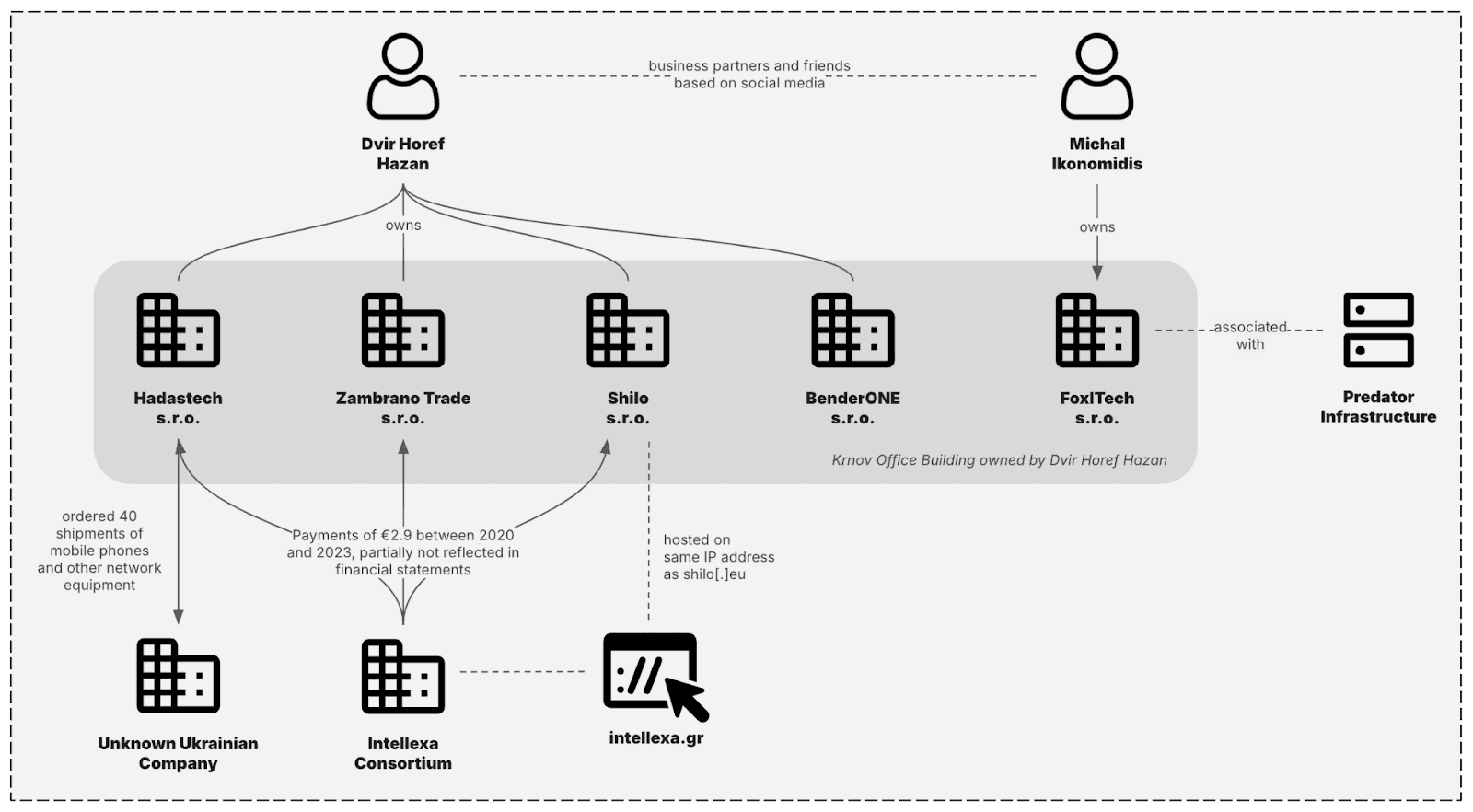
Connections between Predator infrastructure and FoxITech s.r.o. (Source: Investigace.cz, Recorded Future)
Insik Group analyzed the new Predator spyware infrastructure and discovered it’s still gaining users despite U.S. sanctions since July 2023.
Despite earlier declines in activity due to U.S. sanctions and public exposure, Predator spyware has resurged. Insikt Group analyzed a renewed infrastructure linked to the commercial spyware company and identified a new customer in Mozambique, highlighting continued use of the surveillance tools, especially in Africa. Over half of Predator’s identified clients are on the continent, and links to a Czech entity suggest the Intellexa Consortium remains active behind the scenes.
In March 2024, the Department of the Treasury’s Office of Foreign Assets Control (OFAC) announced actions on two individuals and five entities associated with the Intellexa Consortium for their role in the development and distribution of the commercial Predator spyware used to target Americans. The surveillance software was also used to spy on U.S. government officials, journalists, and policy experts. The Department of the Treasury warns that the proliferation of commercial spyware poses growing risks to the United States. Surveillance software was misused by foreign actors in attacks aimed at dissidents and journalists around the world.
The Intellexa Consortium was created in 2019, it has acted as a marketing umbrella for various offensive cyber companies that provide commercial spyware and surveillance tools designed for targeted and mass surveillance campaigns. The name “Predator” spyware was used to refer to a collection of surveillance tools that allows to compromise victims’ devices through zero-click attacks.
Predator spyware is known for its extensive data-stealing and surveillance capabilities.
Insikt Group uncovered a new Predator spyware infrastructure, including evasive updates and high-tier components. The researchers collected evidence of a renewed activity in several countries, with Mozambique newly linked. The experts also found a link between a Czech entity connected to the infrastructure and the Intellexa Consortium.
The new Predator spyware infrastructure includes domains likely used for delivering payloads and exploiting victims. While earlier Predator domains mimicked legitimate sites like news outlets, recent ones feature random English or Portuguese words, some hinting at specific target regions, like the Badinan area in Iraqi Kurdistan. These domains are mostly registered via PublicDomainRegistry and hosted on a wider range of networks than before, reflecting efforts to avoid detection.
Predator’s infrastructure has evolved to include a more complex, five-tiered design. The first four tiers route traffic through multiple layers to hide the spyware’s origin, with Tier 4 often pointing to in-country IPs linked to customers. Tier 5, still somewhat mysterious, is connected to a Czech company, FoxITech, tied to the Intellexa Consortium.

Operators also now use fake websites, 404 pages, login screens, or mock event sites, as part of their deception tactics. These adaptations show how Predator remains a persistent and adaptable threat in the cyber landscape.
“While only Tiers 1 through 4 appear directly connected to the operational infrastructure of Predator customers, Insikt Group has also been monitoring an additional layer, tracked as Tier 5, that seems to play a central, though still unclear, role in Predator-related operations.” reads the analysis published by Insik. “Tier 5 servers have been linked to an entity in the Czech Republic, FoxITech s.r.o., which has previously been publicly associated with Intellexa and is discussed further in the Connection to Czech Entity section.”
Since March 2024, Insikt Group has tracked Predator spyware activity in over a dozen countries. In some regions, activity ceased after public exposure, like in the Democratic Republic of the Congo and Angola, though Angola resumed operations in early 2025. Mozambique emerged as a new user, with several linked domains and IPs. These were tied to a still-active operator using fake news and lifestyle sites. Another short-lived cluster, likely tied to Eastern Europe, suggests possible testing or reaction to new sanctions.
“Insikt Group has uncovered evidence indicating the continued use of Predator, including in Mozambique, despite widespread media attention and sanctions targeting Intellexa and related entities.” concludes the report. “Although recent activity has been observed, the reduced number of suspected operators compared to earlier reports suggests that public exposure, sanctions, and related measures have likely imposed operational costs on Intellexa. Moreover, while Predator operators historically maintained a consistent modus operandi, the latest findings reveal the adoption of new tactics to evade detection. “
Follow me on Twitter: @securityaffairs and Facebook and Mastodon
(SecurityAffairs – hacking, spyware)


