
Pirated software seekers are targeted by the new MassJacker clipper malware, according to CyberArk researchers.
A new malware campaign spreading a new clipper malware dubbed MassJacker targets users searching for pirated software, Cyberark users warn.
A clipper malware is a type of malicious software designed to intercept and manipulate clipboard data, typically for cryptocurrency theft. When a victim copies a cryptocurrency wallet address, the malware replaces it with an attacker-controlled address, redirecting funds to the hacker instead of the intended recipient.
Clipper malware operates silently in the background, monitoring clipboard activity and altering copied text in real time. Some advanced variants include anti-detection techniques and the ability to communicate with remote servers to update wallet addresses dynamically.
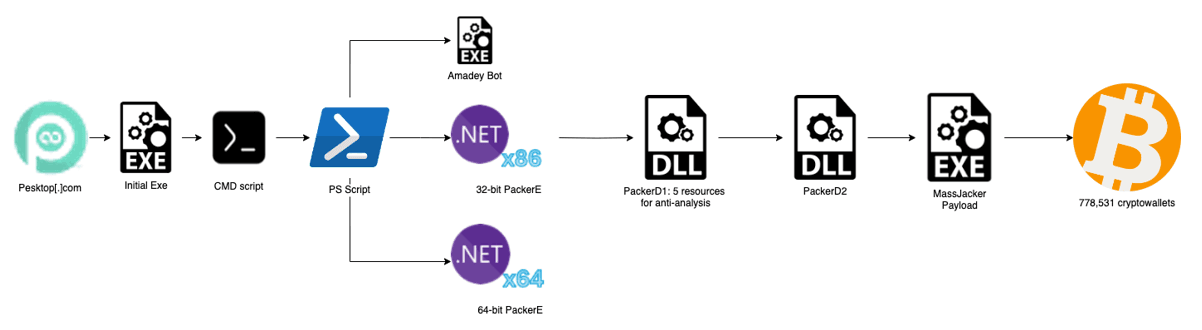
The MassJacker infection starts from a site (pesktop[.]com) distributing pirated software that also spreads malware. The attack involves executing a cmd script followed by a PowerShell script, which downloads three executables, including the Amadey botnet and two .NET executables (32-bit and 64-bit). The malware, dubbed PackerE, downloads an encrypted DLL (PackerD1) that employs multiple anti-analysis techniques. It then loads PackerD2, which contains the MassJacker payload, injecting it into InstalUtil.exe for execution.

PackerD1 employs JIT Hooking, a .NET technique that modifies functions at runtime by hooking the JIT compiler’s compileMethod. This method obfuscates code execution, making static analysis harder. The malware’s first resource contains replacement code and size data needed for JIT Hooking, which it parses and applies before proceeding with further execution.
MassJacker supports multiple anti-analysis techniques, including memory obfuscation and an infinite anti-debugging loop. It uses a configuration file with regex patterns to detect cryptocurrency wallet addresses and C2 addresses for downloading encrypted wallet lists (recovery.dat and recoverysol.dat). These contain stolen crypto wallet addresses, with the latter specifically for Solana wallets. MassJacker monitors clipboard activity, replacing copied wallet addresses with those controlled by the attacker, enabling cryptocurrency theft.
“While investigating the wallet addresses downloaded from the C2, we discovered that the threat actors used the same encryption scheme for quite some time without changing the key. This meant we could use MassJacker to decrypt older files from previous campaigns and recover additional addresses.” reads the report published by CyberArk. “While the sample we looked at originally used around 50,000 wallets belonging to the threat actor, adding the wallets from older files resulted in 778,531 unique addresses!”
CyberArk reported that MassJacker-linked wallets held $95,300 at the time of checking, with a total of $336,700 previously transferred out. Only 423 wallets contained funds, however, the researchers believe the actual number could be higher. Experts suspect most funds didn’t come from cryptojacking alone but other malicious activities. Additionally, cryptocurrency values fluctuate, making exact estimations uncertain. The total amount may be higher or lower than reported due to these factors.
MassJacker appears to be a malware-as-a-service (MaaS), likely used by multiple threat actors, similar to Amadey and MassLogger. Despite this, researchers suspect the wallets found belong to a single threat actor due to shared file names, encryption keys, and a Litecoin wallet consolidating funds from multiple sources. While not definitive, this pattern suggests a single entity managing the stolen funds rather than multiple independent operators.
“It’s difficult to say why cryptojackers are so poorly known. One possibility is that there simply aren’t that many of them. If they really aren’t that profitable, it makes sense that there wouldn’t be many of them.” concludes the report. “Another possibility is that they are more challenging to identify. When using sandboxes for analysis, ransomware and infostealers stick out because of the files they access. A cryptojacker, on the other hand, will only perform malicious behavior under very specific circumstances and might go unnoticed in a sandbox.”
Follow me on Twitter: @securityaffairs and Facebook and Mastodon
(SecurityAffairs – hacking, MassJacker)


