Europe Confirms Record €4.1B Penalty Against Google for Android Practices|U.S. CISA adds a Microsoft SharePoint Server flaw to its Known Exploited Vulnerabilities catalog|430,000 FortiGate Devices Exposed in FortiBleed Ransomware Link|Adobe fixed multiple maximum-severity flaws in ColdFusion and Campaign Classic|Alleged Scattered Spider Hacker Extradited to U.S. to Face Cybercrime Charges|Oracle E-Business Suite Flaw Under Active Attack, 950 Systems Exposed|Azure CLI Targeted in LSHIY Password Spray Campaign Across 64 Orgs|CISA Warns BlueHammer Flaw Is Now Exploited in Ransomware Attacks|RustDuck: The Botnet That’s Still Small but Engineering Like It Plans to Grow|GuardFall Flaw Hits 10 of 11 Popular Open-Source AI Agents|XSS.is, The Forum That Ran the Ransomware Supply Chain Is Down. The Market Isn’t|U.S. CISA adds SimpleHelp flaw to its Known Exploited Vulnerabilities catalog|Europe Confirms Record €4.1B Penalty Against Google for Android Practices|U.S. CISA adds a Microsoft SharePoint Server flaw to its Known Exploited Vulnerabilities catalog|430,000 FortiGate Devices Exposed in FortiBleed Ransomware Link|Adobe fixed multiple maximum-severity flaws in ColdFusion and Campaign Classic|Alleged Scattered Spider Hacker Extradited to U.S. to Face Cybercrime Charges|Oracle E-Business Suite Flaw Under Active Attack, 950 Systems Exposed|Azure CLI Targeted in LSHIY Password Spray Campaign Across 64 Orgs|CISA Warns BlueHammer Flaw Is Now Exploited in Ransomware Attacks|RustDuck: The Botnet That’s Still Small but Engineering Like It Plans to Grow|GuardFall Flaw Hits 10 of 11 Popular Open-Source AI Agents|XSS.is, The Forum That Ran the Ransomware Supply Chain Is Down. The Market Isn’t|U.S. CISA adds SimpleHelp flaw to its Known Exploited Vulnerabilities catalog|
Advertisement

Ad Placeholder

Full Width × 90

Breaking News

Trend Micro observed notable malware activity associated with the Momentum Botnet

Security experts recently found notable malware activity affecting devices running Linux that is associated with the Momentum Botnet. Malware researchers from Trend Micro recently observed notable malware activity affecting devices running Linux that is associated with the Momentum Botnet. Experts revealed details on the tools and techniques used by the botnet to compromise Linux devices […]

Momentum bot

Security experts recently found notable malware activity affecting devices running Linux that is associated with the Momentum Botnet.

Malware researchers from Trend Micro recently observed notable malware activity affecting devices running Linux that is associated with the Momentum Botnet.

Experts revealed details on the tools and techniques used by the botnet to compromise Linux devices and recruit them in launching distributed denial-of-service (DDoS) attacks.

The Momentum bot targets various Linux platforms running upon multiple CPU architectures, including ARM, MIPS, Intel, and Motorola 68020.

The bot was observed distributing the Mirai, Kaiten, and Bashlite variants, it leverages multiple exploits for routers and web services to compromise the target devices.

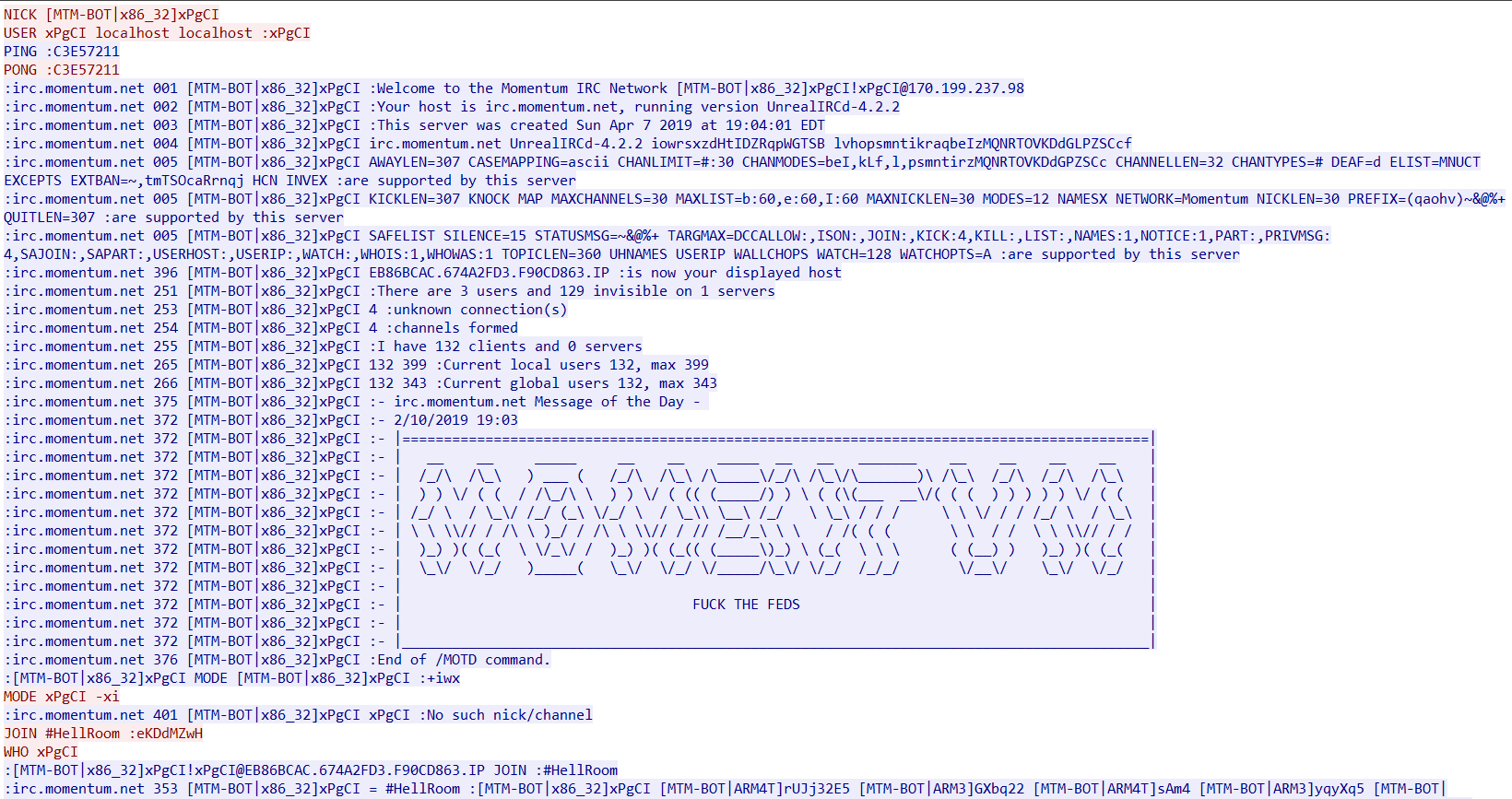
The Momentum bot achieves persistence by modifying the ‘ rc’ files, then connect to command and control (C&C) server and to an internet relay chat (IRC) channel called #HellRoom to register itself and accept commands. Experts pointed out that the bot mainly uses the IRC protocol to communicate with the command and control (C&C) servers.

Momentum botnet

“The distribution server (as seen above) hosts the malware executables. The other server is a C&C server for the botnet. The C&C servers were live as recently as November 18 2019.” reads the analysis published by TrendMicro.

“Once the communication lines are established, Momentum can use various commands to attack using the compromised devices.”

Momentum supports 36 different methods for DDoS attacks, including multiple reflection and amplifications attack methods that target MEMCACHE, LDAP, DNS and Valve Source Engine.

“Apart from DoS attacks, we found that Momentum is also capable of other actions: opening a proxy on a port on a specified IP, changing the nick of the client, disabling or enabling packeting from the client, and more.” concludes the analysis.

“Smart and connected devices are prone compromise because of limited security settings and protection options. The devices themselves are often manufactured with operation in mind, not security. Users should take proactive steps in securing their devices, particularly routers.”

The report published by Trend Micro includes technical details about the Momentum denial-of-service attacks and other capabilities.

[adrotate banner=”9″] [adrotate banner=”12″]

Pierluigi Paganini

(SecurityAffairs – Momentum Botnet, malware)

[adrotate banner=”5″]

[adrotate banner=”13″]