
Cyberespionage group Molerats has been observed abusing legitimate cloud services, like Google Drive and Dropbox as attack infrastructure.
Zscaler ThreatLabz analyzed an active espionage campaign carried out by Molerats cyberespionage group (aka TA402, Gaza Hackers Team, Gaza Cybergang, and Extreme Jackal) that abuses legitimate cloud services like Google Drive and Dropbox as attack infrastructure. Public cloud services are used to host malicious payloads or for command-and-control infrastructure in attacks aimed at targets across the Middle East.
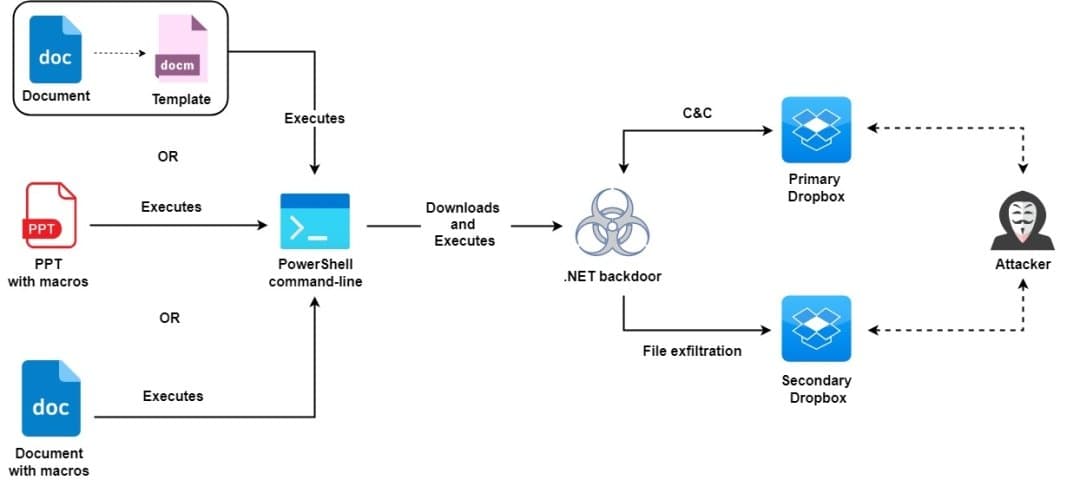
In December 2021, ThreatLabz researchers identified several macro-based MS office files that were used in attacks against entities in the Middle East. The bait files were employed in cyber espionage attacks, they contain decoy themes related to geo-political conflicts between Israel and Palestine. Similar bait files were also used in previous cyberespionage campaigns attributed to the Molerats APT group.
MoleRATs is an Arabic-speaking, politically motivated group of hackers that has been active since 2012,
The researchers discovered that the current campaign has been active since July 2021, the threat actors switched the distribution method in December 2021 and applied minor changes in the .NET backdoor.
“The targets in this campaign were chosen specifically by the threat actor and they included critical members of banking sector in Palestine, people related to Palestinian political parties, as well as human rights activists and journalists in Turkey.” reads the analysis published by Zscaler.
The macro code embedded in the weaponized decoy document simply executes a command using cmd.exe which in turn executes a PowerShell command to download and drop the stage-2 payload from the URL (“http://45.63.49[.]202/document.html”) to the path “C:\ProgramData\document.htm”.
Then it renames document.htm to servicehost.exe and executes ‘servicehost.exe.’

The .NET-based malware masquerades itself as a WinRAR application by using the icon and other resources and is obfuscated using the ConfuserEx packer.
The backdoor performs the following operations:
1. Collects the machine manufacture and machine model information using WMI which is used for execution environment checks and is later exfiltrated to C2 server.
2. Checks if it should execute in the current execution environment.
3. Creates a mutex with the name of executing binary.
4. Checks if the mutex is created successfully.
5. Determines if it is executed for the first time using the registry key value “HKCU/Software/{name_of_executing_binary}/{name_of_executing_binary}”.
6. If the registry key doesn’t exist, the code flow goes via a mouse check function which executes the code further only if it detects a change in either of the mouse cursor coordinates. In the end, the mouse check function also creates the same registry key.
The backdoor supports multiple capabilities, such as taking snapshots, listing and uploading files, and running arbitrary commands on the compromised system.
“The major difference between the new attack chain and the old attack chain is seen in the backdoor delivery. Although we are not sure how these RAR/ZIP files were delivered but considering the past attacks they were likely delivered using Phishing PDFs. Additionally, we found a minor variation in the way the backdoor extracted the primary Dropbox account token.” Zscaler ThreatLabz researchers conclude.
Follow me on Twitter: @securityaffairs and Facebook
| [adrotate banner=”9″] | [adrotate banner=”12″] |
(SecurityAffairs – hacking, Molerats APT)
[adrotate banner=”5″]
[adrotate banner=”13″]


