
Europe Confirms Record €4.1B Penalty Against Google for Android Practices|U.S. CISA adds a Microsoft SharePoint Server flaw to its Known Exploited Vulnerabilities catalog|430,000 FortiGate Devices Exposed in FortiBleed Ransomware Link|Adobe fixed multiple maximum-severity flaws in ColdFusion and Campaign Classic|Alleged Scattered Spider Hacker Extradited to U.S. to Face Cybercrime Charges|Oracle E-Business Suite Flaw Under Active Attack, 950 Systems Exposed|Azure CLI Targeted in LSHIY Password Spray Campaign Across 64 Orgs|CISA Warns BlueHammer Flaw Is Now Exploited in Ransomware Attacks|RustDuck: The Botnet That’s Still Small but Engineering Like It Plans to Grow|GuardFall Flaw Hits 10 of 11 Popular Open-Source AI Agents|XSS.is, The Forum That Ran the Ransomware Supply Chain Is Down. The Market Isn’t|U.S. CISA adds SimpleHelp flaw to its Known Exploited Vulnerabilities catalog|Europe Confirms Record €4.1B Penalty Against Google for Android Practices|U.S. CISA adds a Microsoft SharePoint Server flaw to its Known Exploited Vulnerabilities catalog|430,000 FortiGate Devices Exposed in FortiBleed Ransomware Link|Adobe fixed multiple maximum-severity flaws in ColdFusion and Campaign Classic|Alleged Scattered Spider Hacker Extradited to U.S. to Face Cybercrime Charges|Oracle E-Business Suite Flaw Under Active Attack, 950 Systems Exposed|Azure CLI Targeted in LSHIY Password Spray Campaign Across 64 Orgs|CISA Warns BlueHammer Flaw Is Now Exploited in Ransomware Attacks|RustDuck: The Botnet That’s Still Small but Engineering Like It Plans to Grow|GuardFall Flaw Hits 10 of 11 Popular Open-Source AI Agents|XSS.is, The Forum That Ran the Ransomware Supply Chain Is Down. The Market Isn’t|U.S. CISA adds SimpleHelp flaw to its Known Exploited Vulnerabilities catalog|
Advertisement

Ad Placeholder

Full Width × 90

Breaking News

Microsoft detects 77,000 active web shells on a daily basis

Microsoft published an interesting report that investigates web shell attacks, the IT giant says it detects 77,000 active web shells daily. According to a report published by Microsoft, the company detects an average of 77,000 active web shells, spreading across 46,000 infected servers, on a daily base. A web shell is a code, often written […]

web shells Microsoft encounters

Microsoft published an interesting report that investigates web shell attacks, the IT giant says it detects 77,000 active web shells daily.

According to a report published by Microsoft, the company detects an average of 77,000 active web shells, spreading across 46,000 infected servers, on a daily base.

A web shell is a code, often written in typical web development programming languages (e.g., ASP, PHP, JSP), that attackers implant on web servers to gain remote access and code execution.

Microsoft observed several threat groups, including ZINCKRYPTON, and GALLIUM, using these malicious codes in their campaigns. Threat actors use to exploit known issues in web applications to compromise web server and install the web shells. One of the most widely adopted web shells is the China Chopper one that was employed in numerous cyberespionage campaigns carried out by China-linked APT groups.

In October 2018, security agencies belonging to Five Eyes (United States, United Kingdom, Canada, Australia and New Zealand) have released a joint report that details some popular hacking tools, including China Chopper.

77,000 detections on a daily base are worrisome figure and could give us an indication of the intense activity of threat actors in cyberspace.

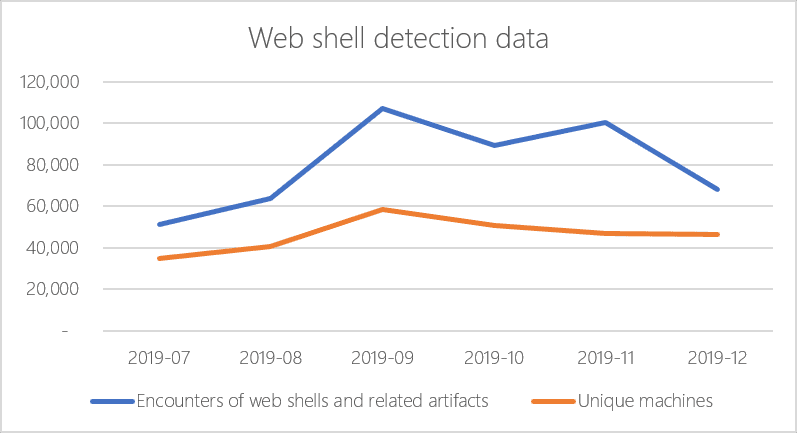
“Unfortunately, these gaps appear to be widespread, given that every month, Microsoft Defender Advanced Threat Protection (ATP) detects an average of 77,000 web shell and related artifacts on an average of 46,000 distinct machines.” reads the report published by Microsoft.

web shells Microsoft encounters

“Because web shells are a multi-faceted threat, enterprises should build comprehensive defenses for multiple attack surfaces.” concludes Microsoft. ” Gaining visibility into internet-facing servers is key to detecting and addressing the threat of web shells. The installation of web shells can be detected by monitoring web application directories for web script file writes. Applications such as Outlook Web Access (OWA) rarely change after they have been installed and script writes to these application directories should be treated as suspicious. “

[adrotate banner=”9″] [adrotate banner=”12″]

Pierluigi Paganini

(SecurityAffairs – cybersecurity, hacking)

[adrotate banner=”5″]

[adrotate banner=”13″]


