
Masuta botnet targets routers using default credentials, one of the versions analyzed dubbed “PureMasuta” relies on the old network administration EDB 38722 D-Link exploit.
Security experts at NewSky’s believe the operators of the recently discovered Satori botnet are launching a new massive hacking campaign against routers to infect and recruit them in the botnet.
“We analyzed two variants of an IoT botnet named “Masuta” where we observed the involvement of a well-known IoT threat actor and discovered a router exploit being weaponized for the first time in a botnet campaign.” reads the analysis published by NewSky.
“We were able to get hands on the source code of Masuta (Japanese for “master”) botnet in an invite only dark forum. After analyzing the configuration file., we saw that Masuta uses 0xdedeffba instead of Mirai’s 0xdeadbeef as the seed of the cipher key, hence the strings in the configuration files were effectively xored by ((DE^DE)^FF) ^BA or 0x45.”
The Satori botnet is a variant of the Mirai botnet first discovered by the group of experts MalwareMustDie, it made the headlines at the end of 2016 when it was involved in hundreds of thousands of attempts to exploit a recently discovered vulnerability in Huawei HG532 home routers.
Masuta also targets routers using default credentials, one of the versions analyzed by the experts dubbed “PureMasuta” relies on the old network administration EDB 38722 D-Link exploit.
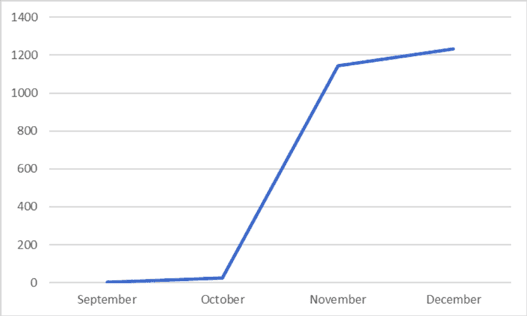
Researchers noticed a rise in the Masuta attacks since September, their honeypots observed 2400 IPs involved in the botnet in last three months and experts believe that other routers will be recruited in the next months.

The flaw triggered by the EDB 38722 D-Link exploit was discovered in 2015 by the researchers Craig Heffner, it affects the D-Link’s Home Network Administration Protocol.
“The weaponized bug introduced in PureMasuta botnet is in the HNAP (Home Network Administration Protocol) which itself is based on the SOAP protocol.” continues the analysis published by NewSky.
“It is possible to craft a SOAP query which can bypass authentication by using hxxp://purenetworks.com/HNAP1/GetDeviceSettings. Also, it is feasible to run system commands (leading to arbitrary code execution) because of improper string handling. When both issues are combined, one can form a SOAP request which first bypasses authentication, and then causes arbitrary code execution.”
The experts explained that a string like the following one will cause a reboot.
SOAPAction: “hxxp://purenetworks.com/HNAP1/GetDeviceSettings/`reboot`”
An attacker can run any command inserted after ‘GetDeviceSettings’, this mechanism is used by the PureMasuta bot to run a wget to fetch and run a shell script and take over the target router.
The experts noticed that the command and control server (93.174.93.63) used by PureMasuta variant is the same as used in the original Masuta variants, this means that PureMasuta is an evolution of the botnet operated by the same threat actors.
NewSky attributes the Masuta botnet to an entity dubbed “Nexus Zeta”, the name comes from the C&C URL nexusiotsolutions(dot)net, this URL is the same used by the Satori botnet.
| [adrotate banner=”9″] | [adrotate banner=”12″] |
(Security Affairs – Masuta botnet, Satori botnet)
[adrotate banner=”5″]
[adrotate banner=”13″]


