
Europe Confirms Record €4.1B Penalty Against Google for Android Practices|U.S. CISA adds a Microsoft SharePoint Server flaw to its Known Exploited Vulnerabilities catalog|430,000 FortiGate Devices Exposed in FortiBleed Ransomware Link|Adobe fixed multiple maximum-severity flaws in ColdFusion and Campaign Classic|Alleged Scattered Spider Hacker Extradited to U.S. to Face Cybercrime Charges|Oracle E-Business Suite Flaw Under Active Attack, 950 Systems Exposed|Azure CLI Targeted in LSHIY Password Spray Campaign Across 64 Orgs|CISA Warns BlueHammer Flaw Is Now Exploited in Ransomware Attacks|RustDuck: The Botnet That’s Still Small but Engineering Like It Plans to Grow|GuardFall Flaw Hits 10 of 11 Popular Open-Source AI Agents|XSS.is, The Forum That Ran the Ransomware Supply Chain Is Down. The Market Isn’t|U.S. CISA adds SimpleHelp flaw to its Known Exploited Vulnerabilities catalog|Europe Confirms Record €4.1B Penalty Against Google for Android Practices|U.S. CISA adds a Microsoft SharePoint Server flaw to its Known Exploited Vulnerabilities catalog|430,000 FortiGate Devices Exposed in FortiBleed Ransomware Link|Adobe fixed multiple maximum-severity flaws in ColdFusion and Campaign Classic|Alleged Scattered Spider Hacker Extradited to U.S. to Face Cybercrime Charges|Oracle E-Business Suite Flaw Under Active Attack, 950 Systems Exposed|Azure CLI Targeted in LSHIY Password Spray Campaign Across 64 Orgs|CISA Warns BlueHammer Flaw Is Now Exploited in Ransomware Attacks|RustDuck: The Botnet That’s Still Small but Engineering Like It Plans to Grow|GuardFall Flaw Hits 10 of 11 Popular Open-Source AI Agents|XSS.is, The Forum That Ran the Ransomware Supply Chain Is Down. The Market Isn’t|U.S. CISA adds SimpleHelp flaw to its Known Exploited Vulnerabilities catalog|
Advertisement

Ad Placeholder

Full Width × 90

Breaking News

Microsoft warns of “massive campaign” using COVID-19 themed emails

Experts from the Microsoft Security Intelligence team provided some details on a new “massive campaign” using COVID-19 themed emails. Researchers from the Microsoft Security Intelligence team provided some details on a new massive phishing campaign using COVID-19 themed emails. The messages used weaponized Excel documents, the IT giant observed a spike in the number of […]

COVID-19

Experts from the Microsoft Security Intelligence team provided some details on a new “massive campaign” using COVID-19 themed emails.

Researchers from the Microsoft Security Intelligence team provided some details on a new massive phishing campaign using COVID-19 themed emails.

The messages used weaponized Excel documents, the IT giant observed a spike in the number of malicious documents in malspam campaigns which use Excel 4.0 macros.

“For several months now, we’ve been seeing a steady increase in the use of malicious Excel 4.0 macros in malware campaigns. In April, these Excel 4.0 campaigns jumped on the bandwagon and started using COVID-19 themed lures.” states Microsoft in a Tweet.

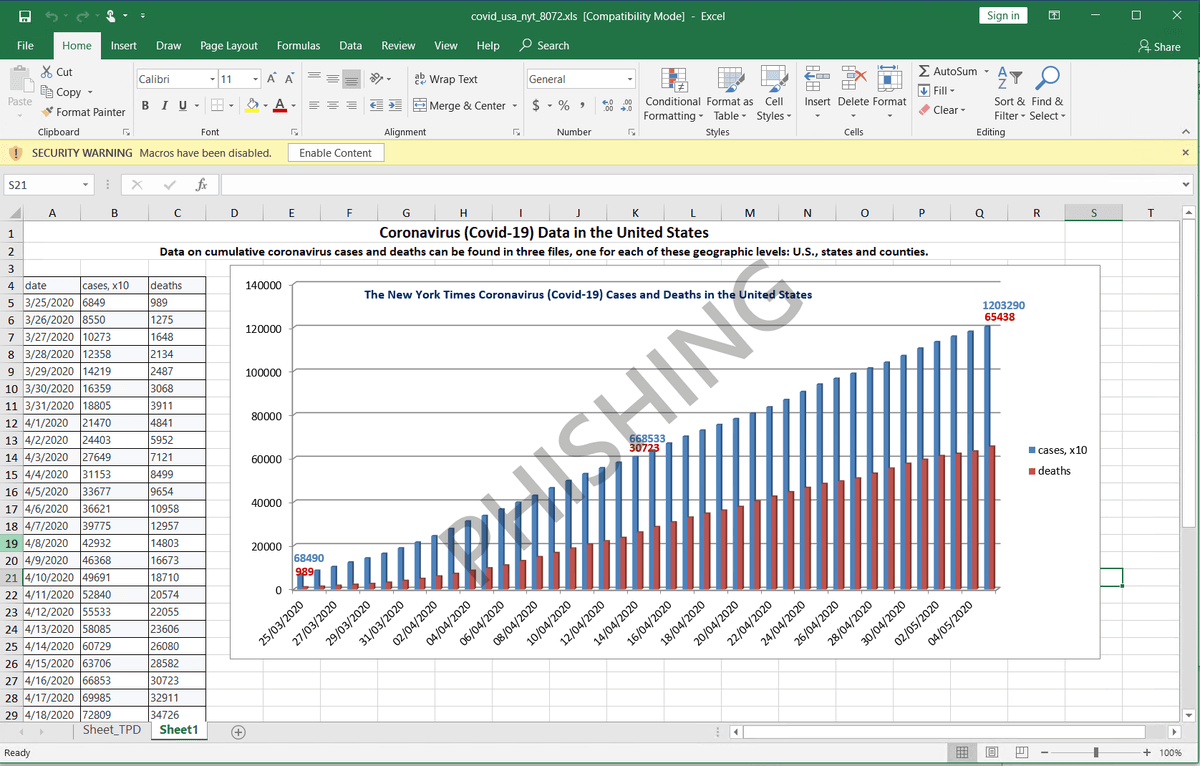
The latest COVID-19 campaign began in April, the messages purport to be from the Johns Hopkins Center and use an Excel attachment. Once opened the attachment, it will show a graph of Coronavirus cases in the United States and trick the victims into enabling the macros to start the infection.

The macros drop a remote access tool (RAT) named NetSupport Manager, it is a legitimate application that is abused by attackers to take control over victim systems.

“The hundreds of unique Excel files in this campaign use highly obfuscated formulas, but all of them connect to the same URL to download the payload. NetSupport Manager is known for being abused by attackers to gain remote access to and run commands on compromised machines.” continues Microsoft.

The NetSupport RAT employed in this COVID-19-themed campaign also drops multiple components, including several .dll, .ini, and other .exe files, a VBScript, and an obfuscated PowerSploit-based PowerShell script. Then it connects to a command and control server, allowing threat actors to send further commands.

Below the Indicators of Compromise (IoCs) shared by Microsoft:

Below a list or recommendations to avoid this threat:

  • Keep your anti-virus software up to date.
  • Search for existing signs of the threat using IoCs in your environment.
  • Keep applications and operating systems running and up to date.
  • Be vigilant with attachments and links in emails.
[adrotate banner=”9″][adrotate banner=”12″]

Pierluigi Paganini

(SecurityAffairs – COVID-19, hacking)

[adrotate banner=”5″]

[adrotate banner=”13″]


