
Dutch malware detection company RedSocks has issued its first Malware Trend Report related to the malicious code trends observed in the first quarter of 2014.
RedSocks, a Dutch malware detection company which provides netflow-based malware detection service, has published its first Malware Trend Report Labs related to the first quarter of 2014. The report provides precious insights into the trends related malware diffusion, to achieve this goal, the company is analyzing about 100k malware samples a day, as well as around 1 million bad IP’s every hour.
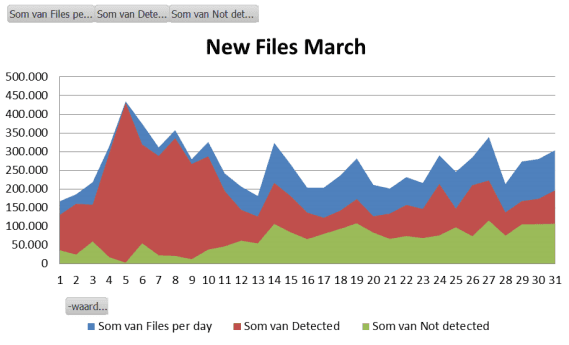
In the first 3 months of 2014 the total amount of new malicious malware instances processed per month went from ~7.0 million in January to ~5.2 million in the successive month of February to reach the incredible amount of ~8.2 million in March 2014.

The United States are the privileged country for malware C&C infrastructure hosting, followed by the Russian Federation.
As explained by the experts at RedSocks in the Malware Trend Report Labs, in the first three months of the year, respectively 29%, 35% and 26% of malware were not detected by Anti-Virus software, a scaring scenario if we think of the consequences. Giving a close look to backdoor and botnet detection in the same period is possible to note that the overall amount tracked in January was 180,583, while in February this number dropped to 97,317, in March, malware analysts have observed that the number of malicious agents has tripled reaching the number of 275,508 new Backdoors and Botnets.

The number Trojans also followed a similar trend, it went from 3,411,358 in January to 2,220,575 in February reaching the impressive amount of 3,981,145 in March. “Trojan.Generic.10391474” counted for 140k detected instances, it was the most used malware of this category in Q1.
Potentially unwanted programs, aka PUPs, confirmed to be an insidious and underhanded cyber threat. Let’s remember that PUPs are able to alter browser settings, inject HTML code altering the perception of web content accessed by the users, mine Bitcoin, or open it in a new tab window of the web browser whenever the computer user opens a blank page.
“PUPs are often related to adware and, therefore, may insert a relevant plug-in, add-on or extension or perform other unwanted and potentially harmful actions on the computer system (e.g., show disturbing pop-up advertisements). PUPs may also be associated with browser hijackers that take control of the web browser and reroute PC users to sites that facilitate fraudulent revenue, such as ad-clicking or traffic boosting. PUPs may be distributed and enter the computer through bundled freeware that PC users can download from the Web.” states the Report.
The data proposed by Malware Trend Report shows that only 0.04% of the files were detected as Exploit and 0.05% as Rootkit in January by Anti-virus software, the situation in February was of 0.04% Rootkits and 0.12% Exploits, meanwhile for March it is 0.07% Exploits and 0.04% for the Rootkits.
The Malware Trend Report also reports that overall volume for Worm that was detected by RedSocks is passed from 347k in January to 252k in March.
I suggest you to read the report for further interesting info.
(Security Affairs – Malware, Malware Trend Report)


