
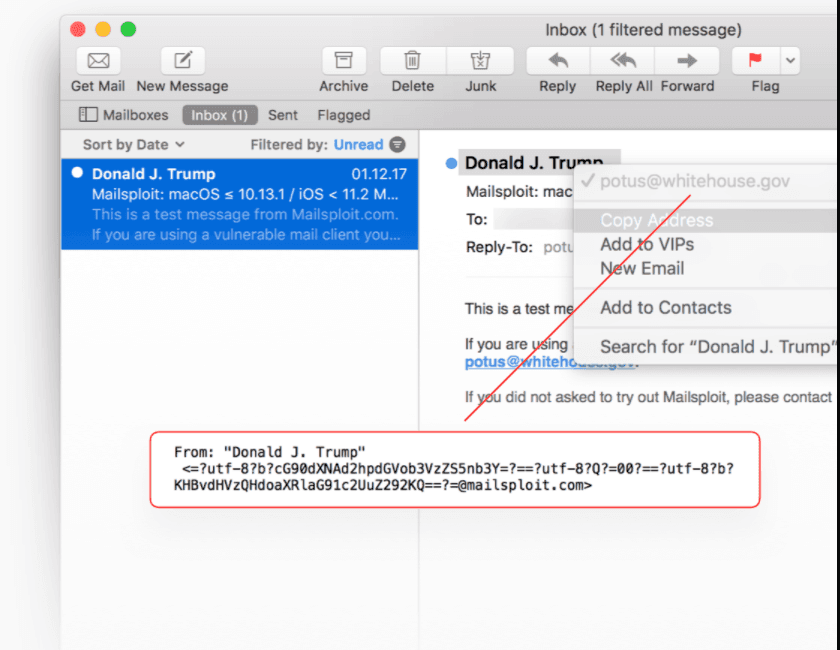
A security researcher discovered a collection of vulnerabilities dubbed MailSploit affecting more than 30 popular email client software.
Email spoofing is quite simple and it is an important activity in any phishing/spear phishing attack.
Attackers modify email headers and send an email with the forged sender address to trick recipients into opening the message believing they are receiving it from a trusted source.
The security researcher Sabri Haddouche has discovered a collection of vulnerabilities affecting more than 30 popular email client software that could be exploited by an attacker to send spoofed messages bypassing anti-spoofing systems.
The collection of flaws discovered by Haddouche was dubbed MailSploit, the list of vulnerable clients includes Apple Mail (macOS, iOS, and watchOS), Mozilla Thunderbird, several Microsoft email clients, Yahoo Mail, ProtonMail, and others.
The expert set up a dedicated website that contains details about the set vulnerabilities.
“Mailsploit is a collection of bugs in email clients that allow effective sender spoofing and code injection attacks. The spoofing is not detected by Mail Transfer Agents (MTA) aka email servers, therefore circumventing spoofing protection mechanisms such as DMARC (DKIM/SPF) or spam filters.” reads the website.
“Bugs were found in over 30 applications, including prominent ones like Apple Mail (macOS, iOS and watchOS), Mozilla Thunderbird, various Microsoft email clients, Yahoo! Mail, ProtonMail and others.”
Haddouche explained that flaws result from the lack of input sanitization by flawed email clients, they are not related to vulnerabilities in DMARC mechanisms.
The researcher published a PoC, he used the email of the US President potus@whitehouse.gov, he explained that all headers must only contain ASCII characters, including the “From” header.
“The trick resides in using RFC-1342 (from 1992!), a recommendation that provides a way to encode non-ASCII chars inside email headers in a such way that it won’t confuse the MTAs processing the email.” continues the expert.
“Unfortunately, most email clients and web interfaces don’t properly sanitize the string after decoding which leads to this email spoofing attack.”
Haddouche created a payload by encoding non-ASCII characters inside the email headers, with this trick he was able to send a spoofed email from an official address belonging to President of the United States.
“Using a combination of control characters such as new lines or null-byte, it can result in hiding or removing the domain part of the original email,” explained Haddouche.
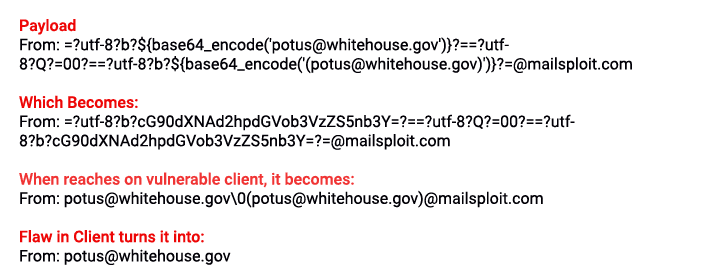
Below a video PoC of the attack published by the expert.
Haddouche also discovered that some of the email clients, including Hushmail, Open Mailbox, Spark, and Airmail, are affected by cross-site scripting (XSS) vulnerabilities.
It is important to highlight that Mozilla and Opera will not release any fix because classified the MailSploit as a server-side issue.
“All vendors were contacted at least 3 months prior to the publication, some of them even 4 or 5 months before the publication.” concluded the expert.
“The spoofing bug was found and confirmed in 33 different products. As of Dec 5th 2017, it was fixed in 8 products (~ 24%) and triaged for 12 additional products (~ 36%). Two vendors (Mozilla and Opera) said they won’t fix the bug (they consider it to be a server-side problem) and another one (Mailbird) closed the ticket without responding.
As for the remaining 12 products (~ 36%), the vendors have received the bug report but have not commented on whether they will address it.”
| [adrotate banner=”9″] | [adrotate banner=”12″] |
(Security Affairs – MailSploit, hacking)
[adrotate banner=”5″]
[adrotate banner=”13″]


