Security Affairs
Medtronic Notifies 3.8 Million After ShinyHunters Data Breach|SECURITY AFFAIRS MALWARE NEWSLETTER ROUND 104|Security Affairs newsletter Round 584 by Pierluigi Paganini – INTERNATIONAL EDITION|U.S. Government Agency Paid $1M to Data Extortion Group Kairos|FBI: TeamPCP Compromised Dev Tools to Steal Cloud Credentials|Pegasus Used Against MEP Investigating Pegasus, Citizen Lab Finds|JADEPUFFER: First End-to-End AI-Driven Ransomware Operation|The Anatomy of a Shadow AI Supply-Chain Breach: Lessons from the 2026 Vercel Incident|Law enforcememt operation disrupted Malicious Residential Proxy Networks NetNut|Government and Healthcare Are the Weakest Links in Global Email Security|Europe Confirms Record €4.1B Penalty Against Google for Android Practices|U.S. CISA adds a Microsoft SharePoint Server flaw to its Known Exploited Vulnerabilities catalog|Medtronic Notifies 3.8 Million After ShinyHunters Data Breach|SECURITY AFFAIRS MALWARE NEWSLETTER ROUND 104|Security Affairs newsletter Round 584 by Pierluigi Paganini – INTERNATIONAL EDITION|U.S. Government Agency Paid $1M to Data Extortion Group Kairos|FBI: TeamPCP Compromised Dev Tools to Steal Cloud Credentials|Pegasus Used Against MEP Investigating Pegasus, Citizen Lab Finds|JADEPUFFER: First End-to-End AI-Driven Ransomware Operation|The Anatomy of a Shadow AI Supply-Chain Breach: Lessons from the 2026 Vercel Incident|Law enforcememt operation disrupted Malicious Residential Proxy Networks NetNut|Government and Healthcare Are the Weakest Links in Global Email Security|Europe Confirms Record €4.1B Penalty Against Google for Android Practices|U.S. CISA adds a Microsoft SharePoint Server flaw to its Known Exploited Vulnerabilities catalog|
Advertisement

Ad Placeholder

Full Width × 90

Breaking News

A new Mac malware dubbed Tarmac has been distributed via malvertising campaigns

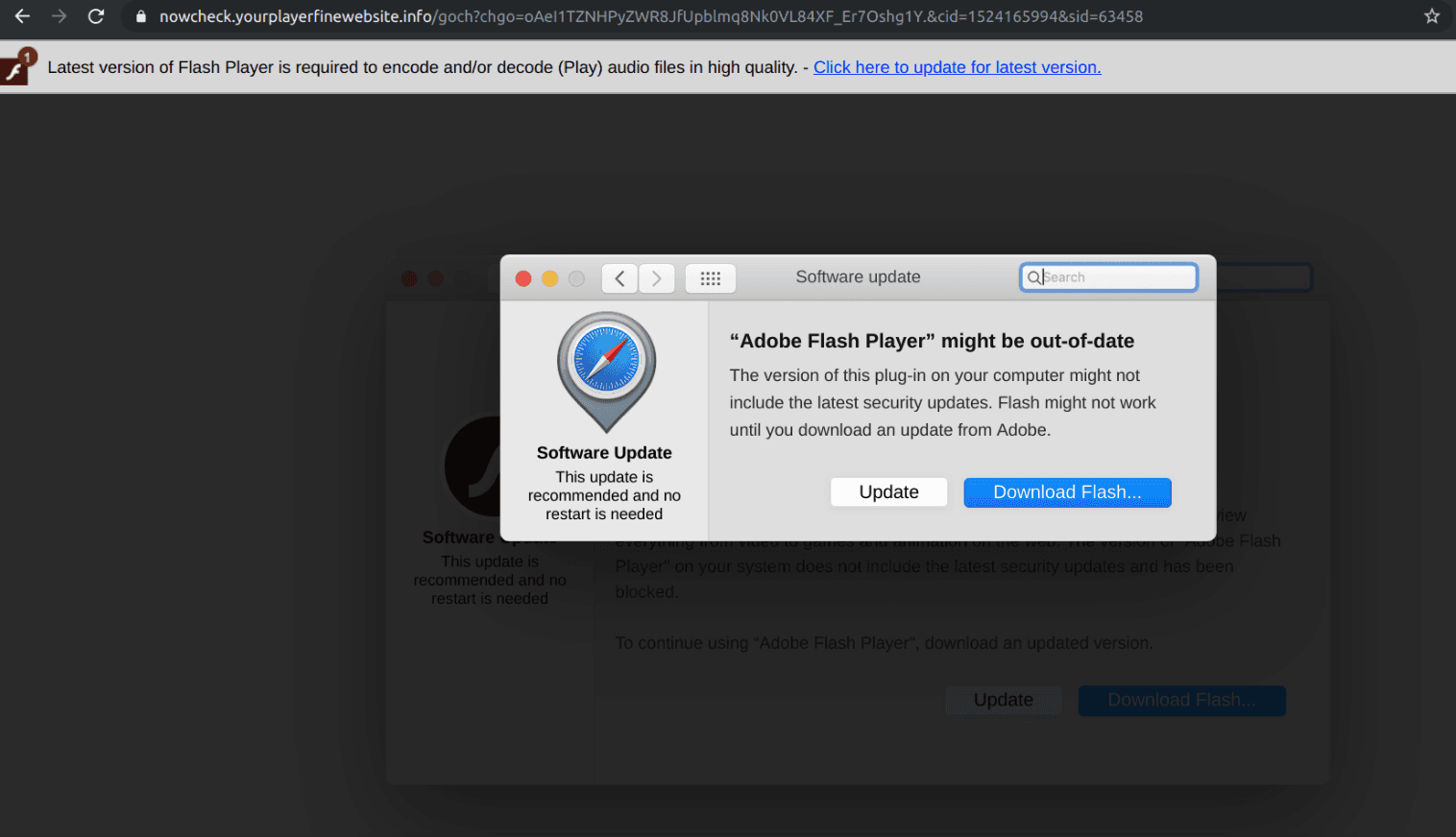
Confiant researchers have discovered a new Mac malware dubbed Tarmac distributed via malvertising campaigns in the US, Italy, and Japan. Security experts at Confiant have discovered a new Mac malware dubbed Tarmac that is distributed via malvertising campaigns in the US, Italy, and Japan. “Malicious ads redirect victims to sites showing popups peddling software updates, […]

Tarmac

Confiant researchers have discovered a new Mac malware dubbed Tarmac distributed via malvertising campaigns in the US, Italy, and Japan.

Security experts at Confiant have discovered a new Mac malware dubbed Tarmac that is distributed via malvertising campaigns in the US, Italy, and Japan.

“Malicious ads redirect victims to sites showing popups peddling software updates, mainly Adobe Flash Player updates, that once executed will install first install the OSX/Shlayer MacOS malware, which then execute the final payload, the OSX/Tarmac” reads the analysis.

“Indeed, that’s not the official Adobe installer but a fake Flash Player installer that was signed using an Apple developer certificate 2L27TJZBZM issued probably to a fake identity named : Fajar Budiarto

Malware authors use to sign malware with Apple developer certificates because it is quite easy to do and allow their code to bypass security protections like Gatekeeper and XProtect.

Tarmac

This malvertising campaign distributing the two malware Shlayer and Tarmac began in January, but at the time experts did not spot the Tarmac malicious code.

Tarmac acts as a second-stage payload for the Shlayer infection, experts pointed out that at the time of the analysis the command and control servers had been shut down and the samples they analyzed were relatively old. Experts believe the campaign is still ongoing and threat actors likely changed its infrastructure.

Tarmac gathers information about the infected hardware and sends it to the C2 servers, then it waits for commands.

At the time of the analysis, it was not possible to understand which commands the malware supports because the C&C servers were down.

Experts noticed that most of key components strings are protected with custom encryption and compression in the attempt to thwart analysis.

ZDNet reported that the malvertising campaign that distributed the Shlayer and Tarmac combo was targeted at users located in the US, Italy, and Japan.

The analysis published by the experts also includes additional technical details along with indicators of compromise (IoCs).

[adrotate banner=”9″] [adrotate banner=”12″]

Pierluigi Paganini

(SecurityAffairs – Tarmac, malvertising)

[adrotate banner=”5″]

[adrotate banner=”13″]