
Security researchers discovered a strain of ransomware called Locky that uses AES encryption to encrypt local files and files on network shares.
Security researchers have discovered a new piece of ransomware called Locky, which uses AES encryption algorithm to encrypt both local files and files on network shares, even if they are unmapped.
Security experts at BleepingComputer spotted a new strain of ransomware dubbed Locky that encrypts local files and files on network shares by using the AES encryption.
“A new ransomware has been discovered called Locky that encrypts your data using AES encryption and then demands .5 bitcoins to decrypt your files. ” BleepingComputer reports in a blog post.
The experts noticed that Locky is the second ransomware spotted in the last months that is able to encrypt files on unmapped network shares, a trend that results from the availability online of the source code of ransomware like Hidden Tear.
The Locky ransomware is being spread via malicious emails with Word document attachments that pretend to be an invoice, but that includes malicious macros. When the victim enables macros to view the document, it triggers a downloader for the Locky ransomware. The malware is then downloaded from a remote server and executed.
Like the CryptoWall ransomware, Locky uses to change the filenames of encrypted files to make harder data recovery.
When started, Locky creates and assigns a unique 16 hexadecimal number to the infected machine, then he will scan all drives and unmapped network shares for files to encrypt.
The malware uses the AES encryption algorithm and encrypts only file with extensions matching a certain criteria while it skips files containing certain strings in their full pathname and filename (i.e. tmp, winnt, Application Data, AppData, Program Files (x86), Program Files, temp, thumbs.db, $Recycle.Bin, System Volume Information, Boot, and Windows).
The Locky ransomware encrypts files renaming the to [unique_id][identifier].locky, the researchers also discovered that the unique ID and other information are embedded at the end of the encrypted file.
The malware will also delete all of the copies of documents in the Shadow Volume, making impossible to restore files.
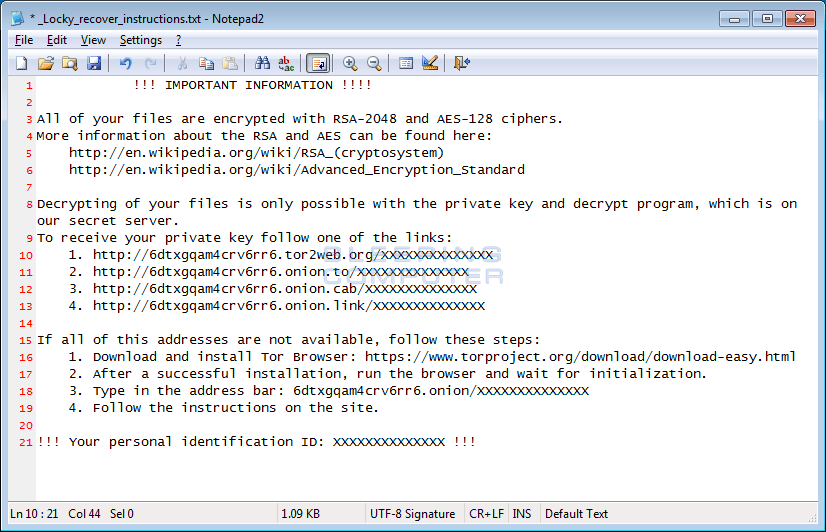
Locky leaves a ransom note, the _Locky_recover_instructions.txtin, in each folder containing encrypted files.

“Inside the Locky ransom notes are links to a Tor site called the Locky Decrypter Page. This page is located at 6dtxgqam4crv6rr6.onion and contains the amount of bitcoins to send as a payment, how to purchase the bitcoins, and the bitcoin address you should send payment to. Once a victim sends payment to the assigned bitcoin address, this page will provide a decrypter that can be used to decrypt their files.” continues the post.
“Locky will change the Windows wallpaper to %UserpProfile%\Desktop\_Locky_recover_instructions.bmp, which contains the same instructions as the text ransom notes.”
[adrotate banner=”9″]
(Security Affairs – Locky Ransomware, malware)


