
Intel announced a new Threat Detection Technology and a framework of critical root-of-trust hardware security capabilities in its chips.
Intel continues to innovate its products, the tech giant announced two new technologies, the Threat Detection Technology (TDT) and Security Essentials.
The Threat Detection Technology leverages the silicon-level telemetry and functionality to allow security products detect sophisticated threats.
The new Intel Threat Detection Technology (TDT) includes two main capabilities, the Accelerated Memory Scanning and Advanced Platform Telemetry.
The Accelerated Memory Scanning feature allows anti-malware solutions to use Intel’s integrated GPU to scan and detect fileless malware attacks without having any impact on performance and power consumption.
Microsoft will integrate the Accelerated Memory Scanning feature into Windows Defender Advanced Threat Protection (ATP) within a couple of weeks.
According to Intel researchers, using the GPU instead of the CPU to scan the memory will allow frequent scanning reducing the impact on performance, Intel tests revealed that the CPU usage dropped from 20 percent to as little as 2 percent.
“The first new capability is Accelerated Memory Scanning. Current scanning technologies can detect system memory-based cyberattacks, but at the cost of CPU performance.” reads the announcement published by Intel
“With Accelerated Memory Scanning, the scanning is handled by Intel’s integrated graphics processor, enabling more scanning, while reducing the impact on performance and power consumption. Early benchmarking on Intel test systems show CPU utilization dropped from 20 percent to as little as 2 percent”
The second Intel Threat Detection Technology is Intel Advanced Platform Telemetry that was designed to include cloud-based machine learning and endpoint data collection to improve threat detection.
The New Intel Advanced Platform Telemetry technology will first be integrated into Cisco Tetration, a solution designed to provide data center security and cloud workload protection.
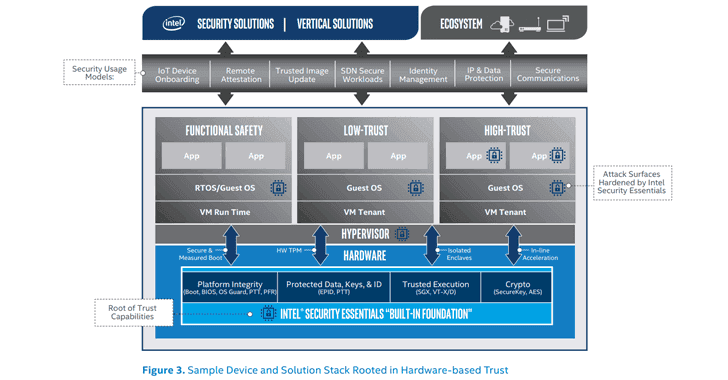
Intel has announced Security Essentials, a set of critical root-of-trust hardware security capabilities in Intel chips, including Core, Xeon and Atom processors.
“These capabilities are platform integrity technologies for secure boot, hardware protections (for data, keys and other digital assets), accelerated cryptography and trusted execution enclaves to protect applications at runtime.” continues Intel“This standard set of capabilities will accelerate trusted computing as customers build solutions rooted in hardware-based protections.”

| [adrotate banner=”9″] | [adrotate banner=”12″] |
(Security Affairs – Intel, Threat Detection Technology)
[adrotate banner=”5″]
[adrotate banner=”13″]


