
Europe Confirms Record €4.1B Penalty Against Google for Android Practices|U.S. CISA adds a Microsoft SharePoint Server flaw to its Known Exploited Vulnerabilities catalog|430,000 FortiGate Devices Exposed in FortiBleed Ransomware Link|Adobe fixed multiple maximum-severity flaws in ColdFusion and Campaign Classic|Alleged Scattered Spider Hacker Extradited to U.S. to Face Cybercrime Charges|Oracle E-Business Suite Flaw Under Active Attack, 950 Systems Exposed|Azure CLI Targeted in LSHIY Password Spray Campaign Across 64 Orgs|CISA Warns BlueHammer Flaw Is Now Exploited in Ransomware Attacks|RustDuck: The Botnet That’s Still Small but Engineering Like It Plans to Grow|GuardFall Flaw Hits 10 of 11 Popular Open-Source AI Agents|XSS.is, The Forum That Ran the Ransomware Supply Chain Is Down. The Market Isn’t|U.S. CISA adds SimpleHelp flaw to its Known Exploited Vulnerabilities catalog|Europe Confirms Record €4.1B Penalty Against Google for Android Practices|U.S. CISA adds a Microsoft SharePoint Server flaw to its Known Exploited Vulnerabilities catalog|430,000 FortiGate Devices Exposed in FortiBleed Ransomware Link|Adobe fixed multiple maximum-severity flaws in ColdFusion and Campaign Classic|Alleged Scattered Spider Hacker Extradited to U.S. to Face Cybercrime Charges|Oracle E-Business Suite Flaw Under Active Attack, 950 Systems Exposed|Azure CLI Targeted in LSHIY Password Spray Campaign Across 64 Orgs|CISA Warns BlueHammer Flaw Is Now Exploited in Ransomware Attacks|RustDuck: The Botnet That’s Still Small but Engineering Like It Plans to Grow|GuardFall Flaw Hits 10 of 11 Popular Open-Source AI Agents|XSS.is, The Forum That Ran the Ransomware Supply Chain Is Down. The Market Isn’t|U.S. CISA adds SimpleHelp flaw to its Known Exploited Vulnerabilities catalog|
Advertisement

Ad Placeholder

Full Width × 90

Breaking News

InnfiRAT Trojan steals funds from Bitcoin and Litecoin wallets

Researchers at Zscaler have spotted a new malware dubbed InnfiRAT that infects victims’ systems to steal cryptocurrency wallet data.  Researchers at Zscaler have discovered a new Trojan dubbed InnfiRAT that implements many standard Trojan capabilities along with the ability to steal cryptocurrency wallet data.  “As with just about every piece of malware, InnfiRAT is designed […]

Bitcoin

Researchers at Zscaler have spotted a new malware dubbed InnfiRAT that infects victims’ systems to steal cryptocurrency wallet data. 

Researchers at Zscaler have discovered a new Trojan dubbed InnfiRAT that implements many standard Trojan capabilities along with the ability to steal cryptocurrency wallet data. 

“As with just about every piece of malware, InnfiRAT is designed to access and steal personal information on a user’s computer.” states a blog post published by Zscaler. “Among other things, InnfiRAT is written to look for cryptocurrency wallet information, such as Bitcoin and Litecoin. InnfiRAT also grabs browser cookies to steal stored usernames and passwords, as well as session data.”

Upon execution, the malware initially checks whether the file is executing from %AppData% directory or not with the name NvidiaDriver.exe. The malware then checks for network connectivity by making a request to “iplogger[.]com/1HEt47,” and records all the running processes in an array to check whether any of them is running with the name NvidiaDriver.exe. If it finds one of the processes running with this name, it kills that process and waits for an exit.

The malicious code will make a copy of itself in the AppData directory before writing a Base64 encoded PE file in memory to execute the main component of the Trojan. 

As the execution of the malware starts, it checks for the presence of virtualized environment that could be used by researchers to analyze the threat. If the malware is not running in a sandbox it will contact the command-and-control (C2) server, transfer the information stolen form the machine, and await further commands.

The InnfiRAT Trojan can also deploy additional payloads to steal files, capture browser cookies to harvest stored credentials for various online services and grab open sessions. The malware is also able to shut down traditional antivirus processes.

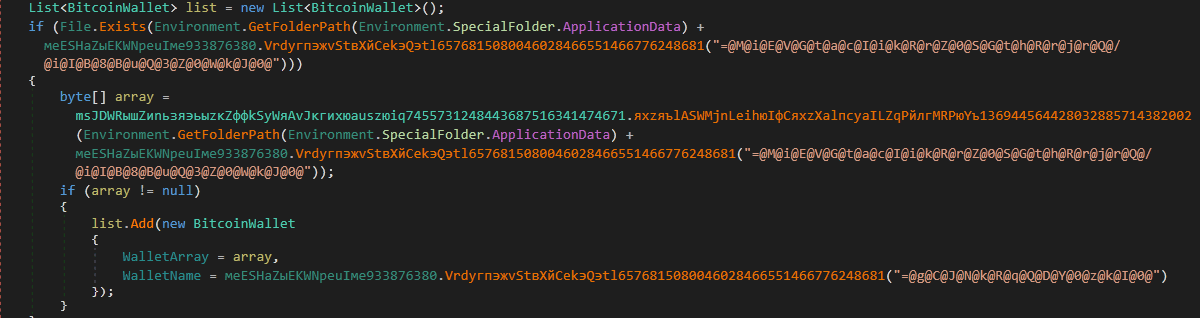
InnfiRAT scans the machine for files associated with Bitcoin (BTC) and Litecoin (LTC) wallets (Litecoin: %AppData%\Litecoin\wallet.dat,
Bitcoin%AppData%\Bitcoin\wallet.dat), if they are present, the malicious code siphons existing data in the attempt of stealing the victims’ funds.

Bitcoin

“Because RATs are usually downloaded as a result of a user opening an email attachment or downloading an application that has been infected, the first line of defense is often the users who must, as always, refrain from downloading programs or opening attachments that aren’t from a trusted source.” concludes the researchers.

[adrotate banner=”9″] [adrotate banner=”12″]

Pierluigi Paganini

(SecurityAffairs – InnfiRAT, hacking)

[adrotate banner=”5″]

[adrotate banner=”13″]


