
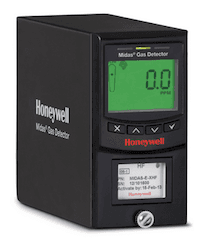
Another vulnerable IoT device is in the headlines, this time two serious vulnerabilities affect the Honeywell Midas gas detectors.
Honeywell has just released firmware updates for its Midas gas detectors to fix two high severity vulnerabilities.
The Midas gas detectors are a category of product manufactured by Honeywell to detect toxic, ambient and flammable gasses in the environment.
Midas gas detectors are usually used in light industrial manufacturing, university laboratories, semiconductor processing, and aerospace. Any unauthorized changes to the configuration of the Midas gas detectors could lead to wrong gas level measures, that could cause serious damage of industrial equipment and even the loss of human life.
According to the security expert Maxim Rupp, the Midas gas detectors running firmware versions 1.13b1 and prior, and Midas Black products running firmware versions 2.13b1 and prior are affected by two serious flaws (CVE-2015-7907, CVE-2015-7908) that can be easily exploited without having specific skills.
The first flaw (CVE-2015-7907) is a path traversal vulnerability that received the CVSS score of 8.6, it can be exploited by a remote attacker to bypass the authentication mechanism implemented to protect the web interface.
The access to the web interface gives the attackers full control on the configuration of the Midas gas detectors, ill-intentioned can exploit it to launch calibration and test processes.
The second flaw (CVE-2015-7908), that received the CVSS score of 9.4, is related to the transmission of the user passwords, the secret code are in fact transmitted in clear text.
“Successful exploitation of these vulnerabilities could allow a remote attacker to gain unauthenticated access to the device, potentially allowing configuration changes, as well as the initiation of calibration or test processes.” states the Advisory published by the ICS-CERT.
“Impact to individual organizations depends on many factors that are unique to each organization. NCCIC/ICS-CERT recommends that organizations evaluate the impact of these vulnerabilities based on their operational environment, architecture, and product implementation.”

Basically, the attacker can bypass authentication on the vulnerable Midas gas detectors simply by typing the URL of the page they want to access, for example, http://<host>/Network.htm. Rupp also discovered that the administrator password in embedded in clear text in the source code of the Security.htm page.
Rupp reported the flaws to the ICS-CERT which forwarded them to the Honeywell in July, the company fixed the vulnerabilities in October.
Honeywell urges its customers to apply the security patches, meantime protect the access to the Midas gas detectors, for example placing them in DMZs and using a firewall.
(Security Affairs – Midas gas detectors, security)


