
U.S. CISA adds a Microsoft SharePoint Server flaw to its Known Exploited Vulnerabilities catalog|430,000 FortiGate Devices Exposed in FortiBleed Ransomware Link|Adobe fixed multiple maximum-severity flaws in ColdFusion and Campaign Classic|Alleged Scattered Spider Hacker Extradited to U.S. to Face Cybercrime Charges|Oracle E-Business Suite Flaw Under Active Attack, 950 Systems Exposed|Azure CLI Targeted in LSHIY Password Spray Campaign Across 64 Orgs|CISA Warns BlueHammer Flaw Is Now Exploited in Ransomware Attacks|RustDuck: The Botnet That’s Still Small but Engineering Like It Plans to Grow|GuardFall Flaw Hits 10 of 11 Popular Open-Source AI Agents|XSS.is, The Forum That Ran the Ransomware Supply Chain Is Down. The Market Isn’t|U.S. CISA adds SimpleHelp flaw to its Known Exploited Vulnerabilities catalog|Hackers Steal Data of 4.38 Million Aflac Japan Customers|U.S. CISA adds a Microsoft SharePoint Server flaw to its Known Exploited Vulnerabilities catalog|430,000 FortiGate Devices Exposed in FortiBleed Ransomware Link|Adobe fixed multiple maximum-severity flaws in ColdFusion and Campaign Classic|Alleged Scattered Spider Hacker Extradited to U.S. to Face Cybercrime Charges|Oracle E-Business Suite Flaw Under Active Attack, 950 Systems Exposed|Azure CLI Targeted in LSHIY Password Spray Campaign Across 64 Orgs|CISA Warns BlueHammer Flaw Is Now Exploited in Ransomware Attacks|RustDuck: The Botnet That’s Still Small but Engineering Like It Plans to Grow|GuardFall Flaw Hits 10 of 11 Popular Open-Source AI Agents|XSS.is, The Forum That Ran the Ransomware Supply Chain Is Down. The Market Isn’t|U.S. CISA adds SimpleHelp flaw to its Known Exploited Vulnerabilities catalog|Hackers Steal Data of 4.38 Million Aflac Japan Customers|
Advertisement

Ad Placeholder

Full Width × 90

Breaking News

How to get back files encrypted by the Hacked Ransomware for free

Good news for the victims of the Hacked Ransomware, the security firm Emsisoft has released a free decryptor to decrypt the data of infected computers. Security experts at Emsisoft released a free decryptor for the Hacked Ransomware. The Hacked Ransomware was first spotted in 2017, it appends .hacked extension to the encrypted files and includes […]

Hacked Ransomware tool

Good news for the victims of the Hacked Ransomware, the security firm Emsisoft has released a free decryptor to decrypt the data of infected computers.

Security experts at Emsisoft released a free decryptor for the Hacked Ransomware. The Hacked Ransomware was first spotted in 2017, it appends .hacked extension to the encrypted files and includes ransom notes in Italian, English, Spanish, and Turkish.

Hacked Ransomware

Experts observed a large number of infections, the malicious code pretends to be a windows update, it displays a fake Windows Update screen while encrypting a victim’s files.

In 2018, the popular malware researcher Michael Gillespie discovered a weakness in the encryption process that allowed the expert to create a decryption tool.

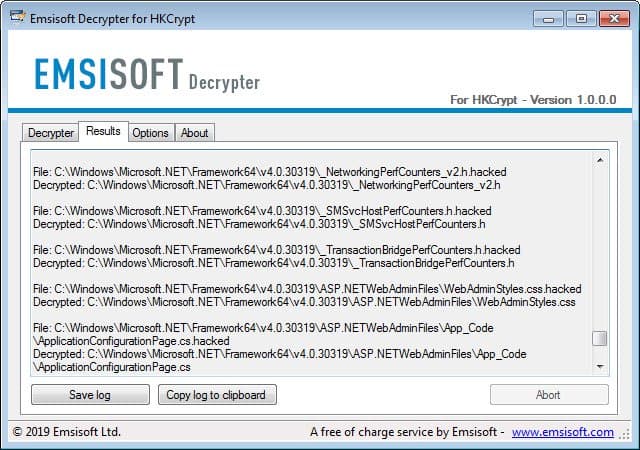
Victims of the Hacked Ransomware can download the decrypt_HKCrypt.exe executable from the Emsisoft website.

HKCrypt (also known as “Hacked Ransomware”) first appeared in late 2017, and encrypts a victim’s files using the RC4 algorithm, then adds the extension “.hacked” to files. The malware pretends to be running a Windows update, then shows a lock screen telling the victim to contact “payment.hkdecrypt@mail.ru”.” states the post published on the
Emsisoft website.

“This ransomware also leaves ransom notes in English (@readme_English.txt or How_to_decrypt_files.txt), Spanish (@Readme_Spanish.txt), and Italian (@Leggimi_decrypt_Italian.txt). “

Victims have to launch the program with administrative privileges, once executed the decryptor tool will search the computer for encrypted files and automatically decrypt them.

Yeasterday, I wrote about another threat, the PewDiePie ransomware, that obliges users to subscribe to PewDiePie YouTube channel. Well, experts an Emsisoft also released a free decryptor tool for this threat.

[adrotate banner=”9″] [adrotate banner=”12″]

Pierluigi Paganini

(SecurityAffairs – Hacked ransomware, malware)

[adrotate banner=”5″]

[adrotate banner=”13″]


