
Security Affairs
Dark Caracal Deploys New Go Malware With Ethereum-Based C2 Fallback|Australian Police Charge Two Over TeamPCP Credential Theft|Meta to Pay Up to $18B Over Teen Social Media Use|CISA Warns Water Utilities: Find Your Exposed PLCs Before Attackers Do|OpenAI banned Russian ChatGPT accounts backing covert influence operation|CISA Red Team Fully Compromised Two Critical Infrastructure Orgs|FBI Seizes China-Linked Hacking Platforms QScan and QTRouter Used Against Critical Infrastructure|U.S. CISA adds Gitea flaw to its Known Exploited Vulnerabilities catalog|88 ID Verification Breaches Show the Cost of Collecting Identity Data|WhatsApp Adds Stronger Security as Passkeys Hit 1 Billion|Operation Jackal: 58 Arrests Expose the Money Laundering Machine Behind Global Scams|Norway ’s Digital Government Infrastructure Hit by a new DDoS Attack|Dark Caracal Deploys New Go Malware With Ethereum-Based C2 Fallback|Australian Police Charge Two Over TeamPCP Credential Theft|Meta to Pay Up to $18B Over Teen Social Media Use|CISA Warns Water Utilities: Find Your Exposed PLCs Before Attackers Do|OpenAI banned Russian ChatGPT accounts backing covert influence operation|CISA Red Team Fully Compromised Two Critical Infrastructure Orgs|FBI Seizes China-Linked Hacking Platforms QScan and QTRouter Used Against Critical Infrastructure|U.S. CISA adds Gitea flaw to its Known Exploited Vulnerabilities catalog|88 ID Verification Breaches Show the Cost of Collecting Identity Data|WhatsApp Adds Stronger Security as Passkeys Hit 1 Billion|Operation Jackal: 58 Arrests Expose the Money Laundering Machine Behind Global Scams|Norway ’s Digital Government Infrastructure Hit by a new DDoS Attack|
Advertisement

Ad Placeholder

Full Width × 90

Breaking News

The Google E2EMail is now fully community-driven open source project

Google has now announced that E2EMail is no more a Google product, instead, it has become a “fully community-driven open source project.” The End-to-End crypto library is a core component of several projects of the IT giant such as the E2EMail, a Chrome app that runs independent of the normal Gmail web interface and allows non-technical users to […]

The Google E2EMail is now fully community-driven open source project

Google has now announced that E2EMail is no more a Google product, instead, it has become a “fully community-driven open source project.”

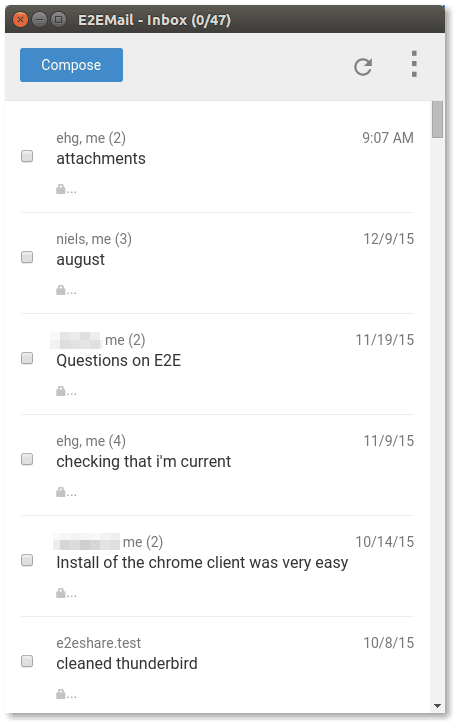
The End-to-End crypto library is a core component of several projects of the IT giant such as the E2EMail, a Chrome app that runs independent of the normal Gmail web interface and allows non-technical users to exchange encrypted text mail over Gmail.

In the past, Google shared the E2EMail source code in order to receive the contributions from several security communities. Now Google has now announced that the same project is no more a Google product, instead, it has become a “fully community-driven open source project.”

The decision is probably motivated by the consideration that no one since now has developed a Chrome extension for E2EMail.

“E2EMail is not a Google product, it’s now a fully community-driven open source project, to which passionate security engineers from across the industry have already contributed.” reads the blog post published by Google.

E2EMail

“E2EMail offers one approach to integrating OpenPGP into Gmail via a Chrome Extension, with improved usability, and while carefully keeping all cleartext of the message body exclusively on the client. E2EMail is built on a proven, open source Javascript crypto library developed at Google.”

Google is looking forward to receive the support of the security community to integrate E2EMail with other projects.

“E2EMail in its current incarnation uses a bare-bones central keyserver for testing, but the recent Key Transparency announcement is crucial to its further evolution,” continues the post. “Key discovery and distribution lie at the heart of the usability challenges that OpenPGP implementations have faced. Key Transparency delivers a solid, scalable, and thus practical solution, replacing the problematic web-of-trust model traditionally used with PGP.”

[adrotate banner=”9″]

Pierluigi Paganini

(Security Affairs – Google, encryption)


