
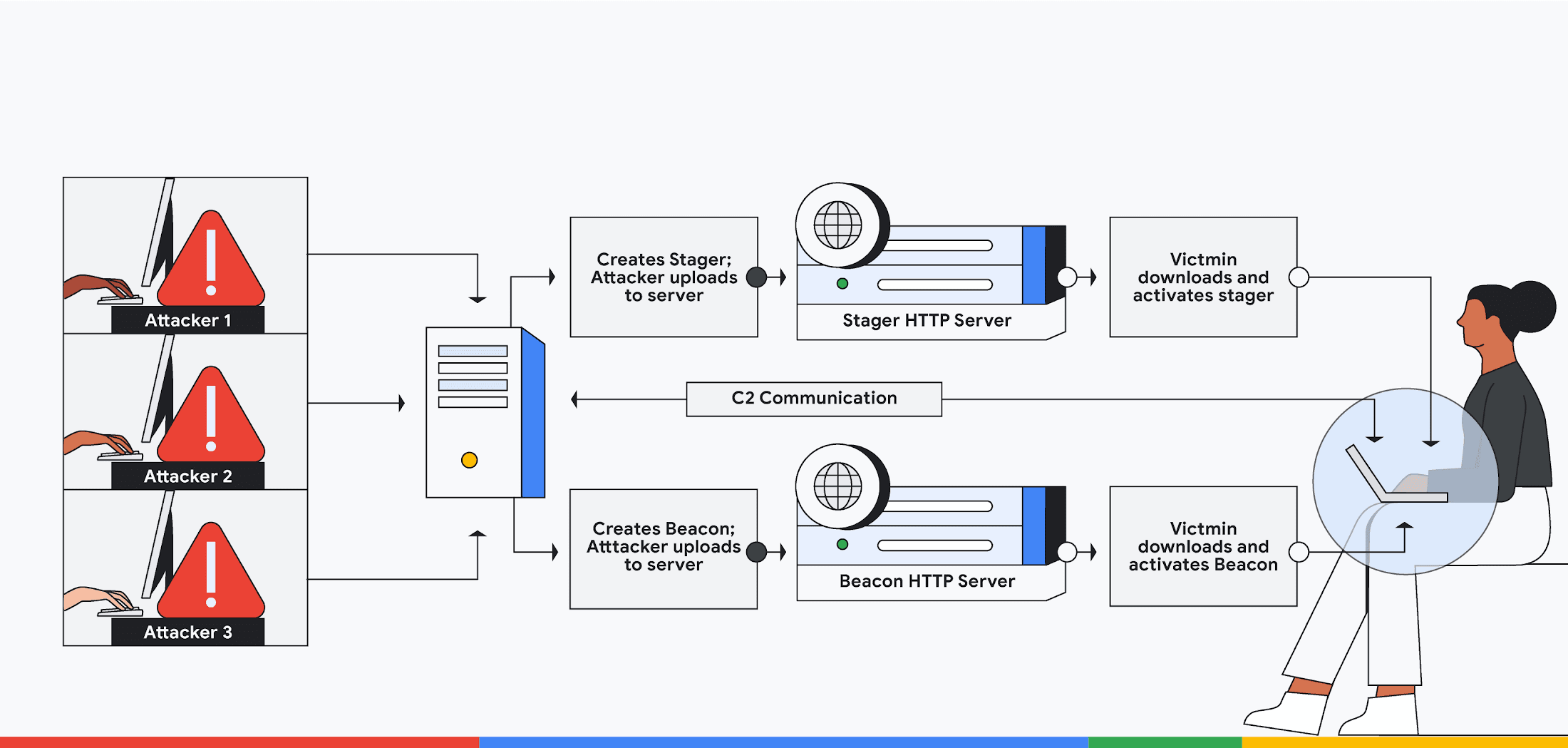
Researchers at Google Cloud identified 34 different hacked release versions of the Cobalt Strike tool in the wild.
Cobalt Strike is a paid penetration testing product that allows an attacker to deploy an agent named ‘Beacon’ on the victim machine. The Beacon includes a wealth of functionality for the attacker, including, but not limited to command execution, key logging, file transfer, SOCKS proxying, privilege escalation, mimikatz, port scanning and lateral movement.

Google Cloud researchers announced to have discovered 34 different Cobalt Strike hacked release versions with a total of 275 unique JAR files across these versions.
Google Cloud Threat Intelligence (GCTI) researchers developed a set of YARA rules to detect hacked variants in the wild with a high degree of accuracy. The researchers noticed that each Cobalt Strike version contains approximately 10 to 100 attack template binaries
The experts were able to locate versions of the Cobalt Strike JAR file starting with version 1.44 (which was released in 2012) up to the latest version at the time of publishing the analysis, Cobalt Strike 4.7.
The researchers cataloged the stagers, templates, and beacons, including the XOR encodings used by Cobalt Strike since version 1.44.
GCTI noticed that the cracked versions of the post-exploitation tool used in the attack in the wild are not the latest versions from the vendor Fortra, but are typically at least one release version behind. For this reason, Google researchers focused on these versions.
“We focused on these versions by crafting hundreds of unique signatures that we integrated as a collection of community signatures available in VirusTotal.” states the report published by Google. “We also released these signatures as open source to cybersecurity vendors who are interested in deploying them within their own products, continuing our commitment to improving open source security across the industry.”
The activity conducted by Google aims at improving the detection of malicious activities involving hacked version of the tool. It is an important work that did not impact legitimate versions of the tools used by penetration testing and “red teams”.
“We wanted to enable better detection of actions done by bad actors, and we needed a surgical approach to excise the bad versions while leaving the legitimate ones untouched. This required detecting the exact version of the Cobalt Strike component.” concludes the post. “By targeting only the non-current versions of the components, we can leave the most recent versions alone, the version that paying customers are using.”
Follow me on Twitter: @securityaffairs and Facebook and Mastodon
| [adrotate banner=”9″] | [adrotate banner=”12″] |
(SecurityAffairs – hacking, cybersecurity)
[adrotate banner=”5″]
[adrotate banner=”13″]


