
Security researchers at the Mandiant Threat Intelligence team believe that Ghostwriter APT group is linked to the government of Belarus.
Mandiant Threat Intelligence researchers believe that the Ghostwriter disinformation campaign (aka UNC1151) was linked to the government of Belarus.
In August 2020, security experts from FireEye uncovered a disinformation campaign aimed at discrediting NATO by spreading fake news content on compromised news websites.
According to FireEye, the campaign tracked as GhostWriter, has been ongoing since at least March 2017 and is aligned with Russian security interests.

Unlike other disinformation campaigns, GhostWriter doesn’t spread through social networks, instead, threat actors behind this campaign abused compromised content management systems (CMS) of news websites or spoofed email accounts to disseminate fake news.
The attackers used to replace existing legitimate articles on the sites with fake content, instead of creating new posts.
The attackers were spreading fabricated content, including falsified news articles, quotes, correspondence, and other documents designed to appear as coming from military officials and political figures in the target countries.
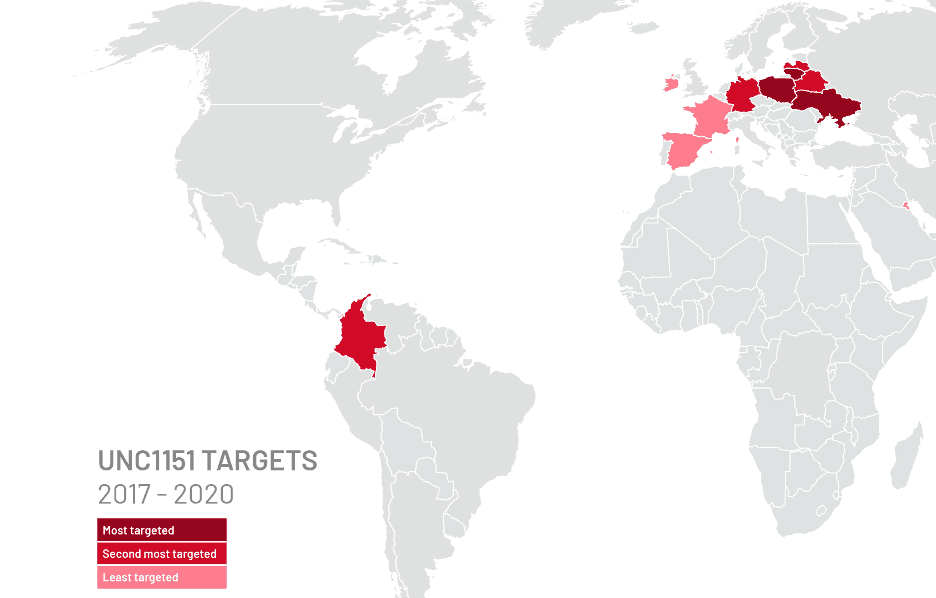
According to the experts, the campaign primarily targeted audiences in specific states members of the alliance, including Lithuania, Latvia, and Poland.
Ghostwriter operators focused on spreading fabricated quotes, such as a quote falsely attributed to the commander of the NATO eFP Battle Group that was used to push a narrative that 21 Canadian soldiers stationed in Latvia had been infected with COVID-19.
Another piece of fabricated content was a letter presented as to be authored by NATO Secretary General Jens Stoltenberg, which was written to bolster a narrative suggesting that the Atlantic alliance was planning to withdraw from Lithuania in response to the COVID-19 pandemic
According to a report published this week by Mandiant, Belarus was involved in the campaigns tracked as GhostWriter.
“Mandiant Threat Intelligence assesses with high confidence that UNC1151 is linked to the Belarusian government.” reads the report published by Mandiant. “In April 2021, we released a public report detailing our high-confidence assessment that UNC1151 provides technical support to the Ghostwriter information operations campaign; this assessment, along with observed Ghostwriter narratives consistent with Belarusian government interests, causes us to assess with moderate confidence that Belarus is also likely at least partially responsible for the Ghostwriter campaign. We cannot rule out Russian contributions to either UNC1151 or Ghostwriter. “
In August 2020, the Ghostwriter campaign spread articles claiming that the protests in Belarus were orchestrated by the U.S. and NATO. Since the August 2020 elections, 16 out of 19 Ghostwriter operations promoted narratives defaming the Polish and Lithuanian governments.
The operators behind Ghostwriter targeted Belarusian entities before the 2020 elections, some of the individuals (representatives of the Belarusian opposition) targeted by the nation-state actor were later arrested by the Belarusian government.
Sensitive technical information gathered by the researchers suggests the threat actors were operating from Minsk, Belarus under the control of the Belarusian Military.
Mandiant investigated the possible involvement of Russian APTs in Ghostwriter operations, but despite a high level TTP overlaps with Russian operations, the researchers have not found direct evidence of Russian government involvement.
“Mandiant assesses with high confidence that Ghostwriter information operations are conducted in support of the Belarusian government and with moderate confidence that they are conducted with Belarusian sponsorship.” Mandiant concludes.
Follow me on Twitter: @securityaffairs and Facebook
| [adrotate banner=”9″] | [adrotate banner=”12″] |
(SecurityAffairs – hacking, APT)
[adrotate banner=”5″]
[adrotate banner=”13″]


