
U.S. CISA adds a Microsoft SharePoint Server flaw to its Known Exploited Vulnerabilities catalog|430,000 FortiGate Devices Exposed in FortiBleed Ransomware Link|Adobe fixed multiple maximum-severity flaws in ColdFusion and Campaign Classic|Alleged Scattered Spider Hacker Extradited to U.S. to Face Cybercrime Charges|Oracle E-Business Suite Flaw Under Active Attack, 950 Systems Exposed|Azure CLI Targeted in LSHIY Password Spray Campaign Across 64 Orgs|CISA Warns BlueHammer Flaw Is Now Exploited in Ransomware Attacks|RustDuck: The Botnet That’s Still Small but Engineering Like It Plans to Grow|GuardFall Flaw Hits 10 of 11 Popular Open-Source AI Agents|XSS.is, The Forum That Ran the Ransomware Supply Chain Is Down. The Market Isn’t|U.S. CISA adds SimpleHelp flaw to its Known Exploited Vulnerabilities catalog|Hackers Steal Data of 4.38 Million Aflac Japan Customers|U.S. CISA adds a Microsoft SharePoint Server flaw to its Known Exploited Vulnerabilities catalog|430,000 FortiGate Devices Exposed in FortiBleed Ransomware Link|Adobe fixed multiple maximum-severity flaws in ColdFusion and Campaign Classic|Alleged Scattered Spider Hacker Extradited to U.S. to Face Cybercrime Charges|Oracle E-Business Suite Flaw Under Active Attack, 950 Systems Exposed|Azure CLI Targeted in LSHIY Password Spray Campaign Across 64 Orgs|CISA Warns BlueHammer Flaw Is Now Exploited in Ransomware Attacks|RustDuck: The Botnet That’s Still Small but Engineering Like It Plans to Grow|GuardFall Flaw Hits 10 of 11 Popular Open-Source AI Agents|XSS.is, The Forum That Ran the Ransomware Supply Chain Is Down. The Market Isn’t|U.S. CISA adds SimpleHelp flaw to its Known Exploited Vulnerabilities catalog|Hackers Steal Data of 4.38 Million Aflac Japan Customers|
Advertisement

Ad Placeholder

Full Width × 90

Cyber Crime

Geodo, the banking trojan with email self-spreading feature

Security researchers from Seculert firm have discovered a variant of the Cridex banking worm, dubbed Geodo, which spreads itself through email. In the last months a significant number of banking trojans have been proposed by cyber criminal ecosystem, from EMOTET to Dyreza, criminals have used a wide casuistry of techniques to deceive bank customers. The primary purpose of the […]

Geodo, the banking trojan with email self-spreading feature

Security researchers from Seculert firm have discovered a variant of the Cridex banking worm, dubbed Geodo, which spreads itself through email.

In the last months a significant number of banking trojans have been proposed by cyber criminal ecosystem, from EMOTET to Dyreza, criminals have used a wide casuistry of techniques to deceive bank customers.

The primary purpose of the malware authors is to spread the banking trojan infecting as many victims as possible, last malicious code detected by security experts at Seculert dubbed Geodo, a new version of the Cridex (aka Feodo or Bugat) banking Trojan, implements a feature to spread itself in an efficient way.
Cridex is a banking worm which uses as attack vector removable drives, a second malware dropped by other malware or the download of a file hosted on a compromised website.
Geodo target Windows machined and works in conjunction with a worm that use as attack vector the email, it is able to propagate the infection sending out emails automatically.
Recent efforts by our Research Lab has revealed new activity related to Cridex. As you may recall, Cridex is a data stealer also referred to as Feodo, and Bugat. The new Cridex version we are seeing now, aka Geodo, combines a self-spreading infection method–effectively turning each bot in the botnet into a vehicle for infecting new targets.” has written Aviv Raff, CTO at Seculert, in a blog post.
Once Geodo has infected the victim, it drops an additional piece of malware from the C&C servers which includes approximately 50,000 stolen SMTP account credentials including those of the associated SMTP servers.
Geodo banking trojan
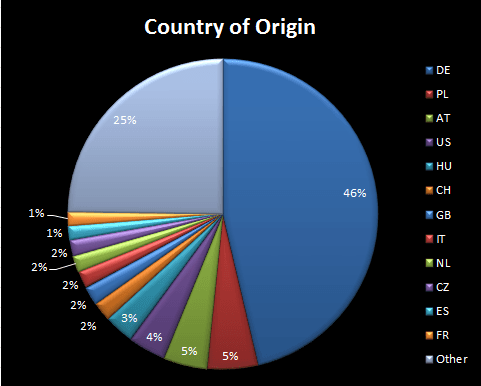
The stolen SMTP credentials used by Geodo allows the malware to send out emails from legitimate accounts, according to the data published by the security firm, the Germany is the country with the major number of infections followed by Austria, Hungary and the US.
Banking users infected by Geodo were targeted through a phishing attack, Phishing mails include a link to download a zip file containing the malware disguised as an invoice or Shipment PDF file.

The C&C provides the malware with a batch of 20 targeted email addresses.The malware is also given a from address, subject line, and email body text unique to this particular batch of emails. Once the malware has run through the batch, it is provided with a new batch of 20 emails. And with each new batch of emails the C&C also sends a new from address, subject line, and body.

geodo email

The emails we have seen, written in German, contain a link prompting the recipient to download a zip file which contains an executable disguised as a PDF document,” “By opening the file, Geodo [new version of Cridex] is installed on the newly infected endpoint, adding a new bot to the mix.” states Seculert in the blog post.

geodo infection

Like many other banking malware, also Geodo is able to inject code into the browser to conduct operations in the name of the victims and manipulate content proposed through the browser to the bank customer.
Banking customers must be aware that cybercrime  is very prolific, knowing the threats could help to mitigate them.
[adrotate banner=”9″] [adrotate banner=”12″]

Pierluigi Paganini

(Security Affairs –  Geodo,  banking trojan)

[adrotate banner=”5″]

[adrotate banner=”13″]


