
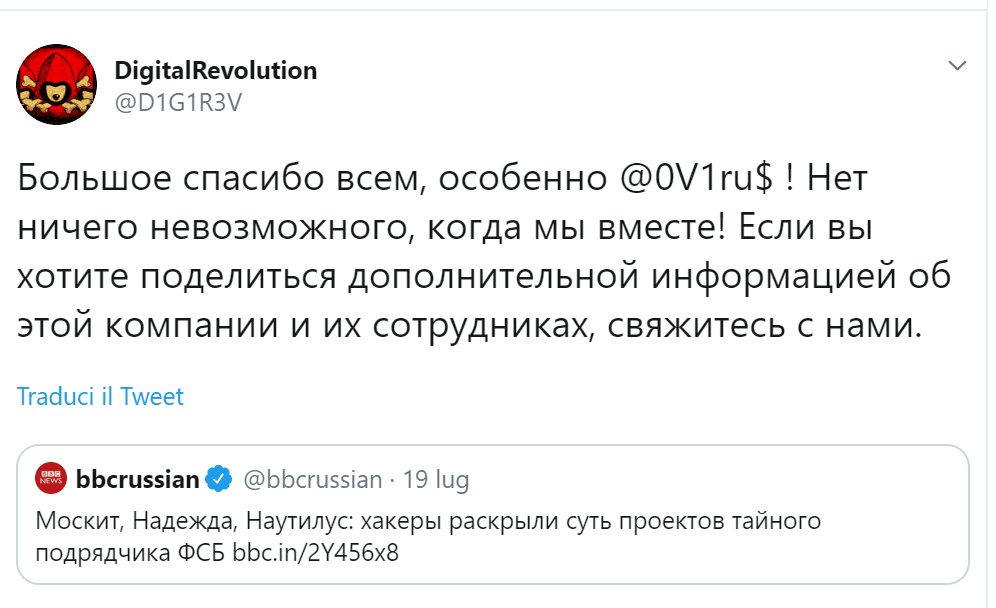
SyTech , a contractor for the Federal Security Service of the Russian Federation (FSB) has been hacked, attackers stole data about interna l projects.
Attackers have hacked SyTech, a contractor for the Federal Security Service of the Russian Federation (FSB), and
According to the Russian media,
“According to the data received, the majority of non-public projects of Sytech were commissioned by military unit No. 71330, which allegedly is part of the 16th directorate of the FSB of Russia.” states the website CrimeRussia.”This unit is engaged in electronic intelligence, experts form the International Center for Defense and Security in Tallinn believe.”
Some of the research projects accessed by the hackers were
On July 13, a hacker group named 0v1ru$ hacked into SyTech’s Active Directory server then compromised the entire infrastructure of the company, including JIRA instance.
The hackers
The hackers published images of the company’s servers on Twitter and also shared the data with another hacker crew known as Digital Revolution, that in 2018 breached the FSB

The hackers provided the stolen data to BBC Russia, who verified the presence of other older projects for compromising other network protocols, including Jabber, ED2K, and OpenFT.
“Among the projects of Sytech there is the work on
“Sytech was also supposed to explore the possibilities of developing a complex of penetration and covert use of resources of peer-to-peer and hybrid networks, network protocols Jabber, OpenFT and ED2K, which were used by darknet users and hackers.
The list of projects shared by BBCRussia includes:
- Nautilus – a project for tracking the activity of users on the principal social media platforms (such as Facebook, MySpace, and LinkedIn).
- Nautilus-S – a project for
deanonymizing Tor traffic, it leverages on a network of rogue Tor nodes. In January 2014, researchers from Karlstad University in Sweden, presented the results of a four-month study conducted to test Tor network exit nodes for sneaky behavior. They discovered that a notspecified Russian entity was eavesdropping nodes at the edge of the Tor network. - Reward – a project to covertly penetrate P2P networks.
- Mentor – a project to spy on email communications managed by Russian companies.
- Hope/Nadezhda – a project to
analyzed the overall Russian internet and its connections to the global WWW. - Tax-3 – a project to allow you to manually remove from the information system of the FTS data of persons under state protection.
Researchers identified 25 malicious servers, 18 of which were located in Russia, and running Tor version 0.2.2.37, the same one detailed in the leaked files.
“Website “Siteka” is not available – neither in its previous form, nor in the version with “Yob-face”. When you call the company on the answering machine, the standard message is turned on, in which you are invited to wait for the secretary’s response, but short beeps follow.” concludes BBC Russia.
| [adrotate banner=”9″] | [adrotate banner=”12″] |
(
[adrotate banner=”5″]
[adrotate banner=”13″]


